At a moment when Nigeria is redefining its economic story beyond oil and volatility, two policy moves have converged to signal a deeper shift. Led by President Bola Ahmed Tinubu in company of Dr. Jumoke Oduwole, Honourable Minister of Industry, Trade and Investment, one opens borders through trade liberalisation with a strategic Middle Eastern partner while the other mobilises climate finance at scale, positioning sustainability as a growth engine rather than a constraint. Together, they frame a reform narrative that speaks not just to markets, but to Nigeria’s long-term economic identity. Enam Obiosio writes.
Nigeria’s reform story has often unfolded in fragments, fiscal adjustments here, FX reforms there, promises of diversification always just ahead of delivery. In early 2026, however, two policy decisions landed almost simultaneously, drawing a clearer picture of where the country is heading. One was the signing of a far-reaching trade pact with the United Arab Emirates (UAE) that dismantles tariffs on over 13,000 goods between both countries. The other was the unveiling of a $2 billion national climate fund, anchoring Nigeria’s energy transition and green industrialisation ambitions.
Individually, each move matters. Taken together, they signal something more structural, an attempt to rewire Nigeria’s trade, investment, and production logic in a world defined by supply chain rebalancing, climate finance, and geopolitical realignments.
A Trade Pact Built for Market Access
The Nigeria–UAE Comprehensive Economic Partnership Agreement (CEPA) signed on January 13, 2026, marks Nigeria’s most ambitious bilateral trade agreement outside Africa in recent years. Under the deal, Nigeria has eliminated tariffs on 6,243 products imported from the UAE, while the UAE has removed tariffs on 7,315 products from Nigeria. The agreement was negotiated by Dr. Oduwole, alongside the Federal Ministry of Justice and the Nigeria Customs Service.
The pact was signed in the presence of President Bola Tinubu and UAE President Sheikh Mohamed bin Zayed Al Nahyan, with UAE Minister of Foreign Trade Dr Thani bin Ahmed Al Zeyoudi as co-signatory. Symbolism aside, the structure of the deal reveals a deliberate attempt to balance openness with domestic protection.
Nigeria will immediately remove tariffs on 3,949 UAE products, about 63.3 percent of the total, while phasing out tariffs on 2,294 products over five years. It excluded 123 products entirely from liberalisation, including sensitive food items such as meat, dairy, vegetable oils, cocoa preparations, tomato paste, alcoholic beverages, soaps, detergents, and certain textiles. The Import Prohibition List remains intact.
On the UAE side, 2,805 Nigerian products will enjoy immediate tariff-free access, while 1,468 products will be liberalised within three years and 3,042 over five years. The UAE excluded or prohibited 593 products, maintaining restrictions on items such as pork, narcotic substances, used tyres, and asbestos-containing products.
This calibrated approach underscores Nigeria’s core concern, opening markets without undermining local production capacity.
Non-oil Exports Move to the Foreground
The real significance of the CEPA lies not in the tariff numbers alone, but in the composition of goods covered. Nigerian agricultural and primary products stand to gain immediate access to the UAE market. Tariffs are removed on fish and seafood, cereals and milling products, oil seeds, live animals and meat products, fruits and nuts, cotton, vegetable textile fibres, raw hides and skins, and other animal products.
Over a three-to-five-year period, tariffs will also be eliminated on cocoa and cocoa preparations, coffee, tea and spices, mineral fuels, wood and wood articles, precious stones and metals, and animal and vegetable fats and oils.
For industrial and manufactured goods, the UAE is removing tariffs on pharmaceutical products, chemicals, paper and paperboard, printed books, and newspapers immediately, while phasing out duties on machinery, vehicles, electrical equipment, apparel, furniture, footwear, ceramics, and glass.
For Nigeria, this represents something more than export expansion. It is an attempt to reposition itself within global value chains, shifting from raw commodity exports toward processed, manufactured, and semi-industrial goods.
What Nigeria Opens, and What It Protects
Nigeria’s side of the deal provides market access for UAE industrial and consumer goods, including mineral fuels, machinery, vehicles, electrical equipment, iron and steel, and plastics. Tariffs on fish, fruits, vegetables, and apparel from the UAE will be phased out over five years.
Yet the exclusions matter as much as the openings. By shielding food staples, agro-processing outputs, and select manufactured goods, Nigeria is signalling that liberalisation will not be blind. Instead, it will be sequenced around domestic industrial policy and food security concerns.
This approach reflects lessons drawn from earlier liberalisation episodes, particularly those that weakened local manufacturing without delivering export competitiveness.
Beyond Goods, Services and Mobility
CEPA goes well beyond trade in goods. Nigeria committed to opening 99 specific services across 10 sectors, while the UAE opened 108 services across 11 sectors. Nigerian business visitors can now enter the UAE to explore opportunities in covered sectors, establish corporate entities, and operate with clearer regulatory protections.
For Nigerian professionals, startups, logistics firms, and digital service providers, the agreement reduces friction in one of the world’s most connected commercial hubs. For the UAE, it strengthens access to Africa’s largest consumer market and Nigeria’s role as a gateway to ECOWAS and the African Continental Free Trade Area.
The government has been explicit that the agreement aligns with Nigeria’s obligations under the World Trade Organisation, AfCFTA, and ECOWAS, without undermining regional integration.
Green Finance as Economic Strategy
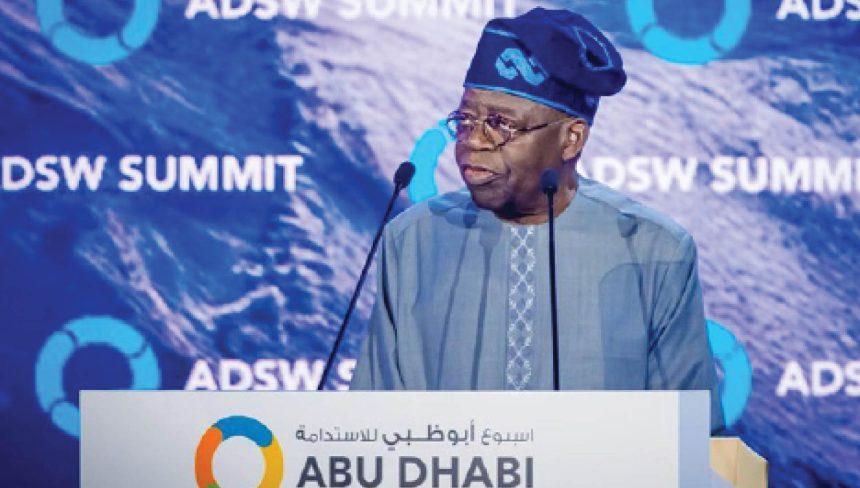
If trade liberalisation defines Nigeria’s external opening, climate finance now defines its investment pitch. Speaking at Abu Dhabi Sustainability Week, President Tinubu unveiled plans for a $2 billion National Climate Change Fund, alongside a Climate Investment Platform targeting at least $500 million for climate-resilient infrastructure.
The goal is ambitious. Nigeria aims to unlock between $25 billion and $30 billion annually in climate finance to support its Energy Transition Plan, which targets net-zero emissions by 2060 while delivering universal energy access to over 200 million people.
For a country that remains Africa’s largest oil producer, the challenge is stark. Gas flaring, methane emissions, grid inefficiencies, and power access gaps coexist with a global shift away from fossil fuels. Nigeria’s response is to treat climate action not as a cost, but as an investment opportunity.
Investor Appetite Tells a Story
The government’s confidence is not entirely speculative. Nigeria’s recent green bond issuances have drawn strong demand. A N50 billion sovereign green bond issued in 2025 attracted N91 billion in subscriptions. Lagos State’s green bond was oversubscribed by nearly 98 percent.
These signals matter in global capital markets, where appetite increasingly tracks climate-aligned assets. The Nigeria Sovereign Investment Authority’s $500 million Distributed Renewable Energy Fund, launched in March 2025, has further demonstrated that domestic institutions can catalyse private capital for clean energy solutions.
To complement these flows, the government has launched a Climate and Green Industrialisation Investment Playbook, designed to help investors navigate Nigeria’s manufacturing policies, incentives, and regulatory frameworks.
Trade, Climate, and a Single Reform Narrative
What ties the CEPA and the climate fund together is not coincidence, but strategy. Both were announced in Abu Dhabi. Both emphasise market access, investor protection, and long-term capital. Both position Nigeria as open, reform-oriented, and aligned with global economic currents.
Under CEPA, renewable energy, aviation, logistics, agriculture, digital trade, and climate-smart infrastructure are priority sectors. These align directly with Nigeria’s energy transition goals and its push to diversify away from oil dependence.
According to President Tinubu, non-oil exports have grown by 21 percent, while investment commitments now exceed $50 billion across key sectors. Whether these figures translate into sustained growth will depend on execution, but the direction is clear.
Technology, Blended Finance, and Fiscal Reality
The administration is also prioritising technology partnerships, modernising the electricity grid, deploying artificial intelligence for efficiency, and rolling out pilot projects in electric mobility and green industrialisation.
Crucially, Tinubu has argued for greater use of blended finance structures that combine public, philanthropic, and private capital. His argument is pragmatic. Sovereign guarantees, while attractive, often increase fiscal pressure. Blended finance spreads risk more equitably and aligns incentives across stakeholders.
This framing reflects a broader shift in how emerging economies engage with global capital, moving from debt-heavy models toward partnership-driven investment structures.
Implementation Will Decide the Outcome
As with all reform agendas, the real test lies beyond announcements. The federal government has pledged to work with the Nigeria Customs Service, the Nigerian Export Promotion Council, and the Nigerian Investment Promotion Commission to implement CEPA, clarify rules of origin, and facilitate trade flows.
Exporters and investors have been advised to seek detailed guidance on product coverage, services commitments, and procedures. Without administrative efficiency, tariff liberalisation risks becoming theoretical rather than transformational.