By Musa Ibrahim
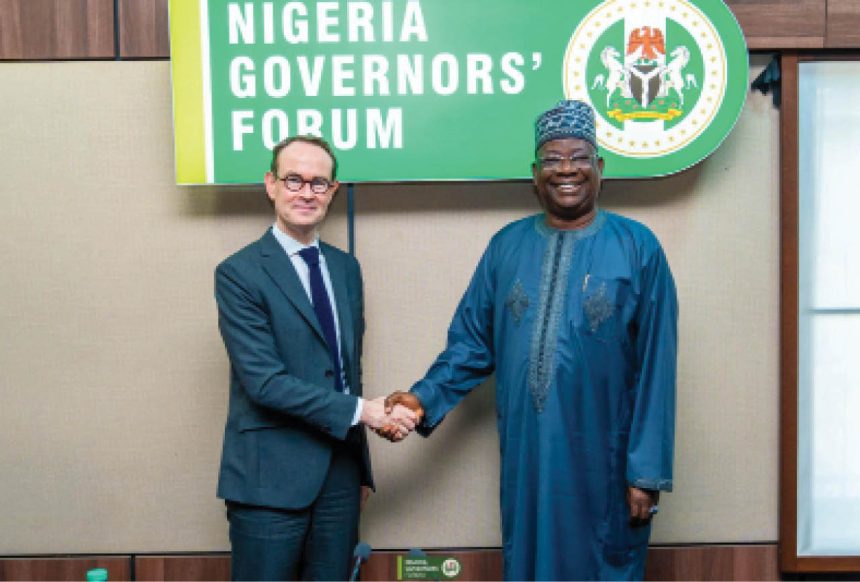
When the Agence Française de Développement (AFD) led a high-level macroeconomic risk analysis mission to Abuja, the meeting with the Nigeria Governors’ Forum (NGF) was more than a courtesy call. It was a signal moment in how development finance institutions are rethinking Nigeria, not only through federal macroeconomic indicators, but through the prism of subnational governance, fiscal credibility, and execution capacity.
For AFD, Nigeria represents both scale and complexity. For the NGF, the engagement reflected a growing reality, that states are increasingly the arena where macroeconomic reforms succeed or fail.
Opening the engagement, AFD’s Country Director for Nigeria, Jacky Amprou, framed the visit as part of a broader effort to deepen institutional understanding and recalibrate partnerships.
“It is my first time, because I took office in October, and I heard a lot about the collaboration between AFD and NGF,” she said. “It is our first opportunity to meet, so I am very happy and thankful for your time and for your welcoming.”
She reminded participants that AFD is not a commercial lender, but a French public development bank with a long-term mandate. “We are a French public bank in charge of financing development across more than 90 countries,” she said. “We are only one shareholder with the French government, and the French government gave us an important mandate in Nigeria, which is to strengthen and contribute to this strong partnership between France and Nigeria.”
That mandate has already translated into significant financial exposure. “We have been operating in Nigeria since 2008, and we have invested about three billion euros since then in different sectors,” Amprou said, listing electricity, water and sanitation, public transportation, health, education, higher education, and cultural industries. Crucially, she stressed that while AFD works closely with the federal government, “our main partners when it comes to implementing projects are sub-national governments.”
This, she explained, is why engagement with the NGF is strategic. “Interactions with the sub-national level for us is very important,” she said, “and that is why we think that NGF is a very important partner that we need to meet on a regular basis, because we understand the role that you have here.”
Amprou also contextualised the visit as part of a deeper analytical exercise. Accompanied by senior economists from Paris, she noted that AFD was updating its assessment of Nigeria’s macroeconomic, fiscal, and institutional environment. “On the macroeconomic aspect, we have already met with the Ministry of Finance, we will be meeting with the Ministry of Budget, the Central Bank of Nigeria, the National Bureau of Statistics,” she said. “On the institutional aspect, we have less actors to meet with, and I think that the NGF is probably the most important.”
For AFD, governance is not abstract. “You mentioned stabilisation, how do we move to macroeconomic stabilisation, to growth, to poverty reduction,” she told the NGF Secretariat. “That is really what AFD is contributing to in Nigeria, growth and poverty reduction.”
From the analytical side, Sylvain Belefontaine, Senior Economist in charge of country risk and public policy assessment, made clear why subnational governance now sits at the heart of AFD’s Nigeria calculus.
“We consider that the macroeconomic and financial trajectory of the country is quite positive over the past two to three years,” he said. “But we are at a particular juncture, one year ahead of the general election, and we are very aware that the governance aspect, the relationship between the federal government and sub-national government, is very critical for the reforms to bear fruit at the very low level for the population.”
Belefontaine was explicit about the learning gap AFD is seeking to close. “The federal system remains quite unfamiliar to me,” he said. “I would like to have your insights regarding the role, the duties, the sharing of responsibilities between the federal government and the sub-national governments, how fiscal revenues are collected, and how national wealth is redistributed from richer states to poorer ones.”
His intervention underscored a shift in development finance logic. National reform signals matter, but delivery credibility increasingly depends on how states manage fiscal flows, risks, and investments.
Responding on behalf of the NGF, Director-General (DG) of the NGF, Dr. Abdulateef Shittu, placed the discussion firmly within Nigeria’s current adjustment phase.
“We are meeting at an important moment in Nigeria’s economic trajectory,” he said. “After a period of significant macroeconomic adjustment, early signs of stabilisation are beginning to emerge. Price pressures are easing, exchange rate dynamics are becoming more predictable, fiscal discipline is being reinforced, and market sentiment is gradually responding to reform signals.”
But he cautioned against premature optimism. “These developments do not yet constitute recovery,” Shittu said. “The real question before us is how these macro-level shifts translate into sustained growth, jobs, and improved welfare for Nigerians.”
For the NGF, the answer lies at the state level. “That translation happens largely at the subnational level,” he said. “States are where macroeconomic reforms encounter real economies, where investment decisions are made, infrastructure is built, services are delivered, and productivity is shaped.”
Shittu was clear that this transition is not automatic. “This is not a trivial task, particularly in a constrained fiscal environment,” he said. “It requires coordination across tiers of government, credible planning frameworks, and a clear understanding of risk.”
He also linked governance reform directly to investment outcomes. “Capital is increasingly selective,” he noted. “Investors are scrutinising subnational execution capacity, project readiness, and the quality of governance at the point of delivery.”
It is in response to this scrutiny that the NGF has intensified its investment facilitation role. Shittu pointed to structured platforms such as NGF Investopedia, explaining that the objective is “to help states move from broad reform narratives to clearly defined, investment-ready projects.”
The engagement with AFD, he argued, was therefore timely. “It allows us to interrogate assumptions, assess macroeconomic and fiscal risks, and align perspectives on how states can navigate the current transition period,” he said. “More importantly, it helps ensure that adjustment leads not just to balance, but to inclusive and sustained development outcomes.”
Taken together, the exchange between AFD and the NGF reflects a broader recalibration in development finance. Large-scale funding commitments are no longer sufficient on their own. What matters increasingly is how governance systems function below the federal surface, how risks are managed at the point of delivery, and how reform momentum is converted into bankable, executable outcomes.
For Nigeria’s states, the message is direct. As international partners sharpen their focus on subnational performance, the credibility of governance institutions, planning systems, and fiscal discipline will increasingly determine who attracts long-term development capital. For AFD and its peers, Nigeria’s future will be judged less by headline reforms and more by what happens where citizens actually live, work, and receive services.