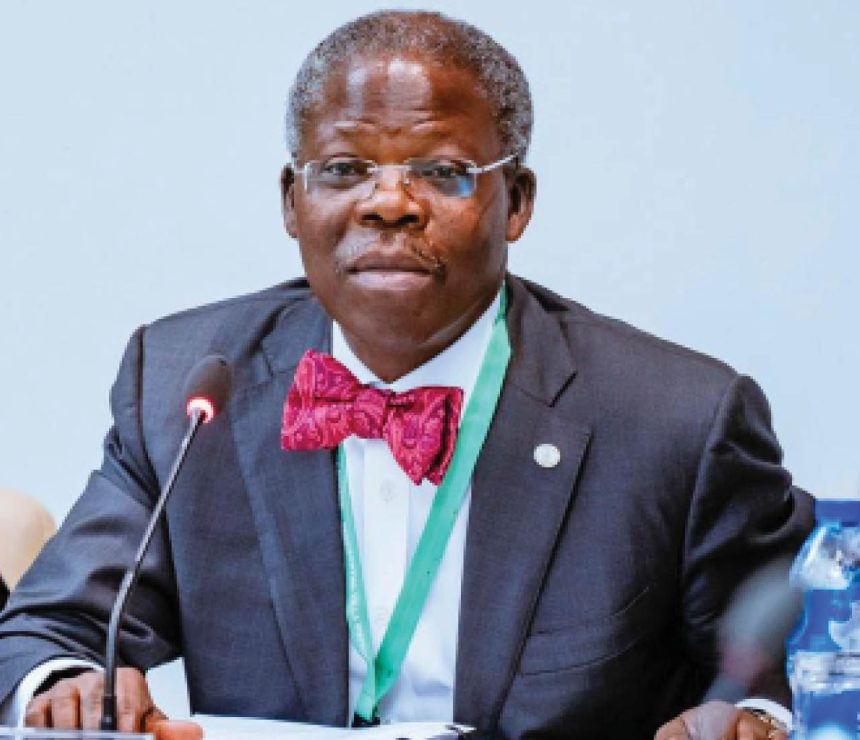
In Abuja recently, on the second day of September, Mr. Ayodeji Gbeleyi, the Director-General (DG) of the Bureau of Public Enterprises (BPE), was before a throng of media men, policymakers, and industry stakeholders to present, among others, the impact and the achievements of the federal government’s reforms as led by President Bola Tinubu. Delving into the triumphs, trials, and trajectories outlined in Mr. Gbeleyi’s address, Enam Obiosio tells how the BPE Boss, a seasoned reformer with a mandate, unveiled a sweeping vision for Nigeria’s economic transformation, revealing how BPE aims to align with the president’s eight-point agenda to lift 100 million Nigerians out of poverty and create 50 million jobs.
We have indeed set sail on re-engineering the reform and privatization of public enterprises, one transaction at a time,” Mr. Gbeleyi declared, echoing the optimism of the Renewed Hope Agenda. The briefing was not just a routine update; it was a roadmap to catapult Nigeria’s GDP to $1 trillion, leveraging privatization, commercialization, and public-private partnerships (PPPs) to bridge infrastructure gaps, create jobs, and foster inclusive growth.
At its core, Mr. Gbeleyi’s presentation painted BPE as the unsung hero of Nigeria’s economic liberalization—an agency born in 1999 from the Public Enterprises (Privatization and Commercialization) Act, tasked with dismantling state monopolies and injecting private sector vitality into moribund enterprises. Over two decades, BPE has orchestrated 243 transactions, generating over N1 trillion in revenue while reshaping sectors from telecoms to power. Yet, as Nigeria grapples with fiscal constraints, inflation, and a staggering $2.3 trillion infrastructure deficit, the bureau is looking to bolder strategies.
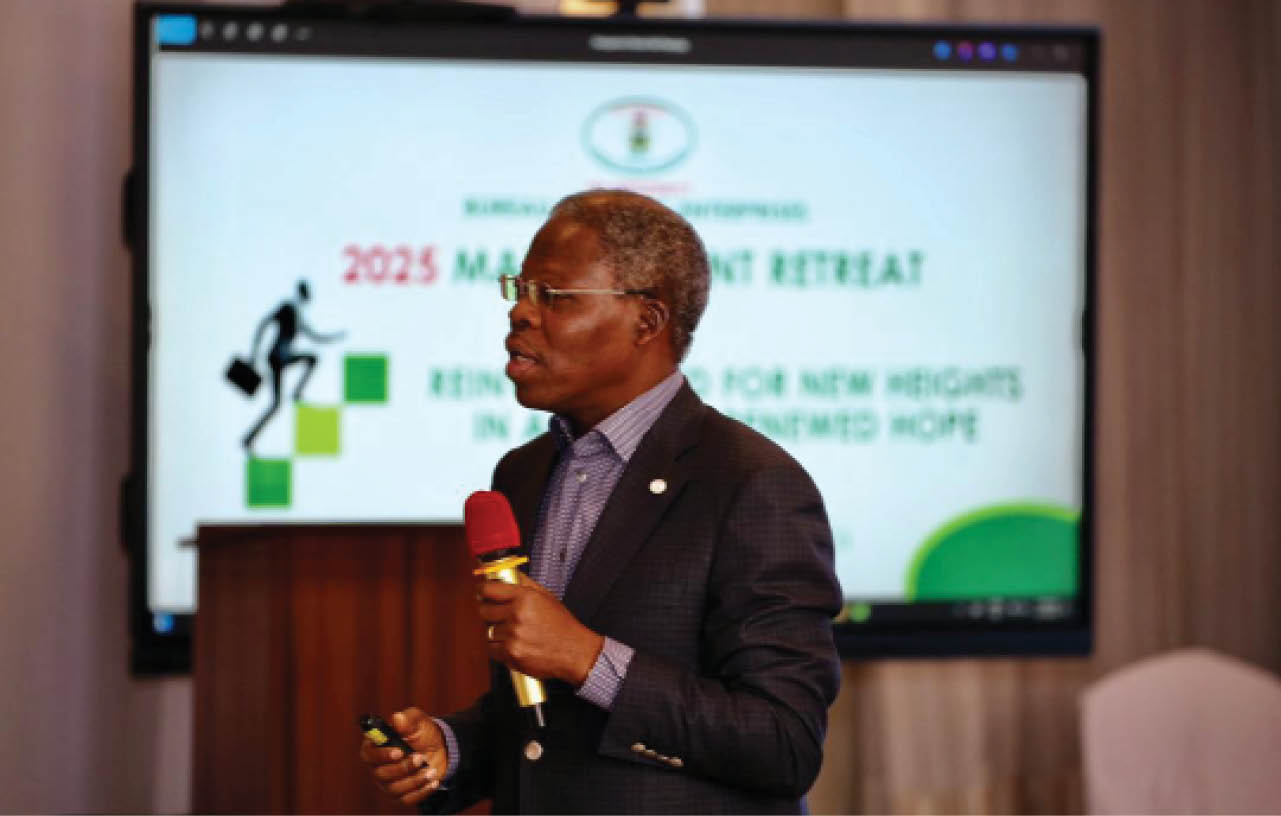
BPE’s Mandate and Historical Footprint
Established as the secretariat of the National Council on Privatization (NCP), BPE’s raison d’être is straightforward yet profound: to liberalize the economy by privatizing and commercializing state-owned enterprises (SOEs). Mr. Gbeleyi reminded the stakeholders of the agency’s vision—to become Africa’s model reform agency—and its mission to promote a competitive, private-sector-driven economy while institutionalizing accountability and efficient resource deployment.
The rationale? Pre-privatization Nigeria was plagued by inefficiencies: monopolies stifled innovation, debt burdens mounted, and government resources were diverted from social sectors. BPE’s interventions aimed to reduce these inefficiencies, attract foreign investment, create jobs, and boost fiscal revenues. As Mr. Gbeleyi put it, quoting the policy objectives: “We dismantle monopolies, infuse private capital and technology, and focus government on what it does best—social services.”
A sectoral breakdown of remaining enterprises under the amended PE Act schedules underscores the unfinished business. Of 200 enterprises, 109 have been optimized (55%), leaving 91—notably in oil and gas (16), agriculture (12), aviation (20), and mining (3)—ripe for reform. This includes giants like Ajaokuta Steel, the Nigerian Railway Corporation (NRC), and national parks, signaling vast untapped potential.
Transformative Reforms
The briefing shone a spotlight on BPE’s reform impacts, weaving a narrative of pre- and post-reform contrasts that illustrate Nigeria’s economic evolution.
Take telecommunications: Before reforms, Nigeria had a mere 400,000 telephone lines, a teledensity of 0.4%, and a NITEL/MTEL monopoly contributing just 0.3% to GDP. Today, with 169.3 million subscribers and 78.11% teledensity, the sector boasts 138.7 million internet users, 104.1 million broadband subscribers, and a 14.40% GDP contribution. Players like MTN, Airtel, Globacom, and 9mobile dominate a competitive landscape, spawning over 1.2 million POS jobs, 500,000 direct jobs, and a $15 billion e-commerce market projected to hit $33 billion by 2026. “This is the backbone of our fintech revolution—Flutterwave, Paystack, Opay,” Mr. Gbeleyi enthused, highlighting eight submarine fiber optic cables as enablers.
Pension reforms tell a similar story. The old Defined Benefit Scheme left N2 trillion in liabilities, with inadequate coverage and opacity. Post-reform, a supervisory framework oversees 23 Pension Fund Administrators (PFAs), four Pension Fund Custodians (PFCs), and six Closed Pension Fund Administrators (CPFAs). By June 2025, 10.79 million Retirement Savings Accounts (RSAs) were registered, with assets under management soaring to N24.63 trillion—a testament to transparency and growth.
Ports and aviation reforms have been equally catalytic. Pre-reform ports, monopolized by the Nigerian Ports Authority (NPA), saw cargo dwell times of 28-30 days, leading to diversions. Now, 26 concessioned terminals across six ports have slashed turnaround to 7-14 days, attracting $2.5 billion in investments and generating royalties, taxes, and jobs. In aviation, NAHCO’s turnover ballooned from N3.25 billion in 2006 to N53.5 billion in 2024, while SAHCO’s grew from N2.31 billion to N28.9 billion.
The power sector, often Nigeria’s Achilles’ heel, has seen incremental gains. From 3,432 MW average generation in 2013, it rose to 5,366 MW in Q1 2025 out of 13,500 MW capacity. Metering jumped from 403,255 in 2013 to 6.46 million by March 2025, aided by initiatives like the World Bank’s $500 million Distribution Sector Recovery Program (DISREP) and the Presidential Metering Initiative (PMI). Aggregate Technical, Commercial, and Collection (ATC&C) losses dropped from 55% to 39.1%, with revenue collections hitting N553.63 billion. The unbundling of the Transmission Company of Nigeria (TCN) birthed the Nigerian Independent System Operator (NISO) in May 2024, operational since June 2025, to enhance efficiency.
Manufacturing and services sectors echo these successes. Privatized entities like Oando PLC, Conoil PLC, and Dangote Cement have flourished, while tourism assets such as Federal Palace Hotel and Abuja Continental Hotel now thrive under private management.
Overall, these reforms have dismantled monopolies, created millions of jobs, and infused innovation—proving privatization’s multiplier effects.
Revenue Targets and Strategic Projects
Looking ahead, Mr. Gbeleyi outlined 15 strategic projects aligned with the Renewed Hope Agenda’s eight focus areas, targeting N312.3 billion in revenue for 2025. This includes six revenue-generating initiatives and nine reform-based ones.
Key revenue streams: Afam 3 Fast Power (N53.92 billion), four coal blocks (N7.11 billion), non-core NCC assets (N0.90 billion), Zungeru Hydro (N101.50 billion from commencement fees), Kainji-Jebba Hydro (N71.06 billion annual fees), Shiroro Hydro (N33.04 billion), and sundry sources (N44.79 billion). By August 2025, performance stood at 54.7%, with peaks in June (N170.74 billion) and November projections.
Reform highlights include boosting agriculture via Bank of Agriculture (BOA) recapitalization, Nigerian Agricultural Insurance Corporation (NAIC) commercialization, and River Basin Development Authorities (RBDAs) PPPs. Energy unlocks feature DISREP’s 3.2 million meters, Afam 3, Makurdi Hydropower, and mining reforms. Diversification efforts target national parks commercialization, Nigeria Film Corporation (NFC) reforms, housing via Federal Mortgage Bank of Nigeria (FMBN) and Federal Housing Authority (FHA), and Kano Free Zone concession.
Infrastructure enablers involve Phase II of the Highway Development & Management Initiative (HDMI) for 30 road corridors, five airport concessions, and Baro Inland Port optimization.
From Dispute Resolutions to Governance Overhauls
Mr. Gbeleyi touted recent wins: Clearing N45 billion of a N48 billion accumulated deficit in BPE’s audited financial statements (AFS), concluding arrears for 2021-2023 within six months, and submitting the first NCP/BPE annual report to the president. Power sector resets include secondary sales in Eko and Ibadan Discos, and DISREP’s meter shipments (330,000 shipped, 163,000 delivered).
Legacy disputes are resolving: Arbitration victories against Aulic Nigeria Limited (Lagos Trade Fair) and BHS (TBS Lagos), plus engagements to settle ALSCON, Sapele Power, and NITEL/MTEL litigations. Governance enhancements feature directorate realignments, capacity building, and collaborative engagements with NERC and the Ministry of Power.
PPPs, IPOs, and Sectoral Acceleration
With Nigeria’s infrastructure stock at 35% of GDP (versus 70% in larger economies), BPE is emphasizing PPPs to close the $2.3 trillion gap, targeting $100 billion annually per the National Integrated Infrastructure Master Plan (NIIMP). A pipeline with ICRC, IFC, and NSIA will span airports, roads, rail, agriculture, health, and more.
Shared prosperity via IPOs of federal/state shares in Discos and a Genco on the Nigerian Exchange (NGX) aims for inclusivity. Sectoral accelerations include TSP reform, seaport renewals, special economic zones, airport terminals, oil & gas concessions, and the World Bank’s Sustainable Power and Irrigation Project (SPIN).