

REFORM TALKS with Enam Obiosio
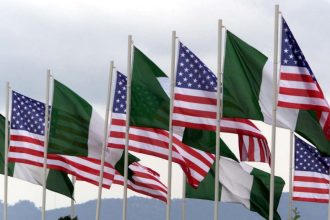
I have watched the latest diplomatic storm swirling around Nigeria with a growing sense of concern, not only because of its geopolitical implications, but because of what it reveals about the ways powerful nations frame their interests into moral imperatives. When former United States President Donald Trump threatened military action against Nigeria over alleged persecution of Christians, I found myself reflecting on a long global pattern that treats African nations as objects of pressure rather than sovereign actors deserving of respect. And when China stepped forward to warn against the use of force and to reaffirm its partnership with Nigeria, I saw two visions of global engagement clashing in real time. One relies on coercion. The other insists on sovereignty. And Nigeria, yet again, is caught in the centre of someone else’s rivalry.
I believe Nigeria must speak clearly and strongly at this moment, not because we need to choose between Washington and Beijing, but because we must choose ourselves. As a nation of more than two hundred million people, with a complex religious, ethnic, and political landscape, Nigeria cannot afford to be a staging ground for ideological battles or a convenient target for foreign leaders looking to score domestic political points. Trump’s threat that the United States would halt all assistance and potentially take military action against Nigeria does more than inflame tensions. It reduces our country to a caricature and trivialises the real challenges we face in combating violent extremism.
As someone who has reported on and watched Nigeria struggle with terrorism, banditry, and sectarian violence for more than a decade, I know how irresponsible such rhetoric is. Violent extremism in Nigeria has taken Christians, Muslims, and people of no religious affiliation. It has ravaged communities across the north and middle belt. It has displaced millions, eroded livelihoods, and forced the country into years of security spending that has strained the national budget. To cast this struggle as the Nigerian government condoning the killing of Christians is to erase the truth. It is also to weaponise religion in a way that undermines social cohesion in a country where interfaith coexistence is a daily reality for most citizens.
China’s response was no surprise to me. For years, Beijing has positioned itself as a partner that does not interfere in domestic governance. Whether or not one agrees with that model, it remains a key pillar of China’s diplomacy. At a press briefing in Beijing, Foreign Ministry spokesperson Mao Ning stated clearly that China “firmly supports the Nigerian government” and opposes the use of religion or human rights as a justification for interference. For many Nigerians, this stance echoes a growing desire for respect on the global stage. No nation wants to be threatened into compliance. No nation wants to be told that its internal challenges justify military aggression from abroad.
But I am not naïve. China’s interest in Nigeria is not rooted in altruism. Our twenty billion dollar trade relationship, our role as a major African economy, and our position as a growing consumer market make Nigeria a strategic partner. China’s warning to the United States against the use of force is also a reinforcement of Beijing’s broader worldview: that global order should be shaped through dialogue, not coercion. Yet even as I consider this, I believe Nigeria’s priority should not be aligning with one world power over the other. It should be asserting that foreign governments cannot dictate our internal affairs through pressure or threats.
Nigeria’s Ministry of Foreign Affairs responded by dismissing Trump’s allegations as inconsistent with the facts. The statement pointed out that the government remains committed to combating violent extremism, protecting all citizens regardless of religion, and upholding a rules-based international order. I agree with that position because it affirms important truths. Nigeria is not a perfect state. Our security institutions are still evolving, our investigations sometimes stall, and our justice processes can be slow. Yet the idea that the Nigerian government is enabling religious killings is not grounded in evidence. It is grounded in politics.
Trump’s rhetoric was as dramatic as it was dangerous. He claimed that the United States might move in “guns a blazing” to wipe out terrorists in Nigeria. He promised an attack that would be “fast, vicious, and sweet.” I cannot think of a more reckless way to address the internal security challenges of another sovereign nation. Military interventions, no matter how well intentioned, leave scars that do not fade for generations. One needs only to look at Iraq, Libya, Afghanistan, or Syria to understand what happens when foreign soldiers enter a complex environment with simplistic assumptions.
This is why China’s call for restraint, whatever its motivations, resonates with many. Mao Ning linked Nigeria’s situation with broader tensions involving the United States, including reports that Venezuelan President Nicolás Maduro is seeking military equipment from China, Russia, and Iran. She reiterated that Beijing opposes the use or threat of force in international relations and wants states to work through bilateral and multilateral legal frameworks. In a world where power competitions are sharpening every year, this approach at least seeks to reduce escalation.
But even as I acknowledge the protective tone of China’s message, I must emphasise this point: Nigeria cannot outsource its sovereignty to anyone. Not to the United States through intimidation. Not to China through overdependence. Not to any power seeking influence. The future of this nation belongs to Nigerians. It belongs to our capacity to manage diversity, improve security structures, and address the underlying economic factors that strengthen extremist groups.
We must also recognise another truth. When global powers argue over Nigeria, it is because Nigeria matters. We are the largest economy and the most populous country on the continent. Our strategic value is not a mystery to anyone who studies Africa’s development trajectory. Yet our influence is meaningful only when we exercise it confidently. We weaken ourselves when we allow others to define our narrative.
As I reflect on this moment, I believe Nigeria should draw four lessons from the crisis.
First, we must continue to address violence with honesty and competence. Terrorism will not be defeated by press releases. It requires intelligence, coordination, development policies, and community engagement.
Second, we must speak with one voice in the international arena. Disunity in diplomacy invites external manipulation.
Third, we must strengthen partnerships based on mutual respect, not dependence. Whether with China, the United States, Europe, or other regions, Nigeria’s interests must be clearly defined.
Finally, we must not let foreign leaders use our internal challenges to fuel their political narratives. Nigeria is not a pawn. Nigeria is not a subject of someone’s campaign slogan. Nigeria is a sovereign state, imperfect but determined.