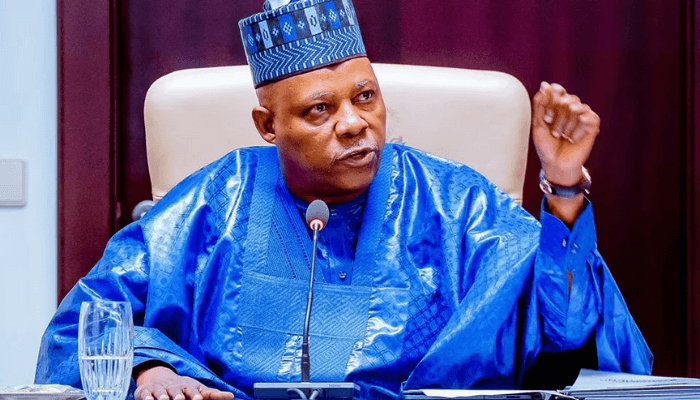
The federal government’s bold declaration to phase out diesel generators and transition toward a hybrid energy infrastructure marks a crucial moment in Nigeria’s journey toward a sustainable, resilient, and inclusive future. We welcome this overdue but commendable shift in national energy policy, as announced by Vice President Kashim Shettima at the Decarbonising Infrastructure in Nigeria (DIN) Summit.
Let us be clear: the era of diesel dependence has dragged us down for far too long. It has polluted our cities, drained our foreign reserves, inflated business costs, and anchored our development to outdated systems. Vice President Shettima was right to say, “Nigeria can no longer afford to build yesterday’s infrastructure for tomorrow.” That is not just rhetoric – it is reality.
The commitment to electrify Onne Port in Rivers State as Nigeria’s first fully green port, backed by a $60 million hybrid energy investment, is more than symbolic. It is strategic. Our ports, like our hospitals, universities, and government complexes, must lead by example if we are to scale up the infrastructure revolution this country so desperately needs.
Nigeria cannot afford to merely flirt with green policies. The statistics are grim. Over 75% of our greenhouse gas emissions stem from infrastructure-heavy sectors: energy, transportation, urban development, and agriculture. These sectors are also the lifeblood of our economy. What this means is simple – we must reform them or risk economic and ecological disaster.
The shift from diesel to hybrid and renewable energy systems must be seen not as a sacrifice, but as a smart investment. As Vice President Shettima projected, over 1.5 million green jobs could be created by 2035. That is not a dream; it is a strategic roadmap to job creation, foreign investment, and economic diversification.
But ambition without action is inertia. The challenge now lies not in the plan but in its execution.
To make this transition meaningful, the government must: Expedite regulatory reforms that unlock climate finance and attract serious private investment; implement policy harmonisation across energy, agriculture, housing, and transport sectors to avoid fragmented efforts; support subnational governments with funding and technical assistance, so that decarbonisation reaches every community – not just Abuja and Lagos; launch the promised Green Investment Portal swiftly, ensuring it is functional, transparent, and investor-friendly; and subsidise the switch for SMEs and critical public infrastructure such as schools and hospitals, ensuring the poor are not left behind.
We are especially pleased by the government’s language around equity and inclusion. Climate change is not just an environmental issue – it is a human development crisis. As Musaddiq Mustapha Adamu rightly said, “Today’s summit is not just about emissions. It is about equity, economic survival, and building a future where infrastructure restores hope.” That vision must now guide every project, every reform, and every budget allocation.
We must also confront the truth that our diesel addiction is not just an infrastructural flaw – it is a governance failure. Years of underinvestment, policy flip-flops, and vested interests have kept us shackled to fuel-hungry, smoke-belching generators. The path to liberation will be politically difficult and financially demanding. But the cost of delay is far higher.
As we march toward 2060 with a net-zero ambition, Nigeria must back its declarations with decisiveness. We applaud Vice President Shettima and the National Council on Climate Change for leading this charge. But now, we demand follow-through.
Let the Onne Port be a model, not a miracle. Let diesel fade into the pages of our history. And let every new infrastructure project – whether a port, road, market, or power plant – be judged by one simple standard: does it heal the earth or harm it?
That is the Nigeria we must build. That is the legacy we must leave. And that is the challenge the government must rise to – starting now.