
By Anita Dennis
In Nigeria’s complex fiscal landscape, where voluntary tax compliance remains one of the biggest hurdles to sustainable development, two powerful institutions are stepping up their collaboration.
The Federal Inland Revenue Service (FIRS) and the Economic and Financial Crimes Commission (EFCC) are reinforcing their alliance in a bid to close loopholes, safeguard public revenue, and restore public confidence in the nation’s tax system.
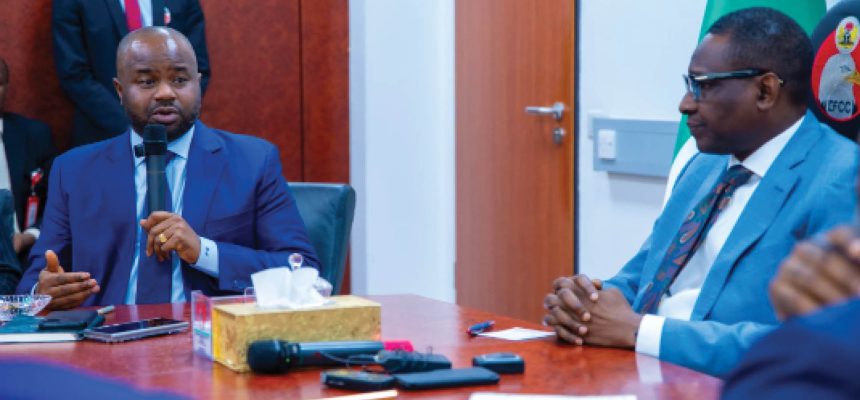
The renewed partnership was sealed recently when the FIRS Executive Chairman, Dr. Zacch Adedeji, led a delegation on a courtesy visit to the EFCC headquarters in Abuja. For Dr. Adedeji, the meeting went beyond protocol; it was a reaffirmation of the federal government’s resolve to use institutional synergy as a tool for financial stability.
“We cannot pursue 200 million Nigerians individually to do the right thing,” Dr. Adedeji said pointedly. “But we want to put a system in place that will aid compliance. You can help us by letting people know that when they violate the law, there is a place you can keep them. On behalf of the President and Nigerians, we thank you for your support and seek even deeper cooperation.”
Building Compliance Through Trust
The FIRS boss underscored a message that has become central to Nigeria’s tax reform agenda: compliance improves only when taxpayers see value for their contributions. “The main advertisement of voluntary compliance is when people begin to see what we use the money we collect for,” he explained. “In achieving that goal, you are critical- not just in arresting defaulters but in supporting our Department of Fraud Risk, Assessment and Control to ensure value for money.”
Dr. Adedeji attributed Nigeria’s success in meeting its recent revenue targets not just to the efforts of the FIRS, but to preventive strategies and inter-agency partnerships. “It was a collective effort, not one by FIRS alone,” he said, stressing that effective revenue mobilization depends on collaboration across the system.
EFCC’s Watchdog Role
In response, Mr. Ola Olukoyede, EFCC Chairman, assured Dr. Adedeji of his agency’s commitment to strengthening the revenue chain through intelligence sharing, enforcement, and prosecution. For the EFCC, the renewed partnership is not merely about chasing tax defaulters but about embedding deterrence into the system.
The commission’s role, Mr. Olukoyede suggested, is to act as a watchdog that complements FIRS’ administrative mechanisms. Where the taxman’s task ends, the EFCC’s begins – with the power to investigate, prosecute, and send the clearest possible message that tax crimes are not victimless but attacks on Nigeria’s collective wealth.
Towards a Culture of Voluntary Compliance
Analysts note that the alliance between the FIRS and EFCC comes at a critical juncture for Nigeria. With oil revenues declining and the government pushing to diversify its income sources, voluntary tax compliance has become more than an administrative concern – it is a national imperative.
For many Nigerians, however, the connection between taxes paid and public goods delivered remains tenuous. Bridging that trust deficit is what Dr. Adedeji refers to as “the main advertisement of compliance,” and it explains why the FIRS is seeking not just enforcement but a cultural shift-where paying taxes is seen as a civic duty, not a burden.
The Abuja meeting may have lasted only a few hours, but its significance could reverberate for years. If the FIRS–EFCC partnership succeeds, it may well mark the beginning of a more disciplined, accountable, and transparent tax system – one capable of funding the nation’s ambitions without perpetually leaning on debt or oil windfalls.