
By Ahmed Ahmed
In a groundbreaking move that merges traffic enforcement with anti-corruption muscle, the Federal Road Safety Corps (FRSC) and the Economic and Financial Crimes Commission (EFCC) have forged a strategic partnership to combat economic sabotage in the transport sector and slash the toll of road traffic crashes nationwide.
Announced following a recent high-level meeting in Abuja on August 26, 2025, this collaboration signals a zero-tolerance era for reckless practices that drain Nigeria’s economy and claim thousands of lives annually.
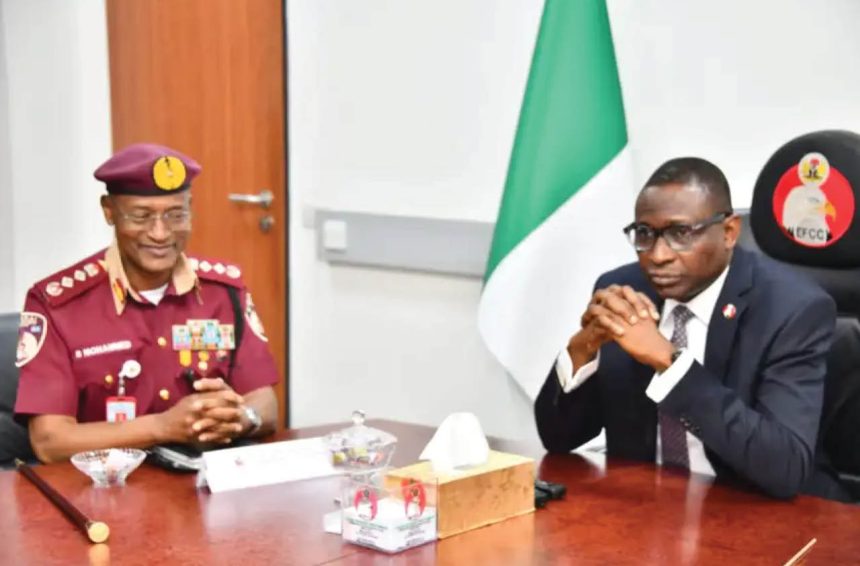
The pact was sealed during a visit by FRSC Corps Marshal, Shehu Mohammed, to EFCC Chairman, Ola Olukoyede, where both leaders underscored the intertwined threats of financial crimes and road hazards.
Nigeria loses billions in naira each year to road accidents, estimated at over 1% of gross domestic product (GDP), often exacerbated by sabotage like overloading trucks, using counterfeit vehicle parts, or evading safety regulations. This alliance aims to tackle these issues head-on, blending the FRSC’s road safety expertise with the EFCC’s prowess in rooting out economic crimes.
“Road safety is an economic imperative that requires a multi-sectoral approach to safeguard lives and stabilize Nigeria’s economic trajectory,” Mohammed declared during the discussions, framing the partnership as a national security priority.
He highlighted how reckless driving not only causes carnage but also inflicts massive financial losses through damaged infrastructure, lost productivity, and healthcare burdens. The Corps Marshal emphasized that this union marks “an end to unlawful transport practices and road carnage,” setting a new standard for inter-agency cooperation in Nigeria.
Echoing these sentiments, Olukoyede pointed out the overlapping mandates of the two agencies, which directly influence Nigerians’ safety, welfare, and prosperity. “Beyond combating financial crimes, the EFCC is also committed to tackling economic sabotage, including the harmful practices of transport operators who disregard regulations and undermine national growth,” he stated. Olukoyede, who has been lauded for his anti-corruption drive, sees this as an extension of the EFCC’s role in protecting the economy from saboteurs in the transport industry.
The partnership arrives amid alarming statistics: Nigeria records over 5,000 road deaths yearly, with economic sabotage – such as smuggling via unsafe vehicles or bribery at checkpoints – compounding the chaos. Experts view this “unusual” alliance as a game-changer, potentially leading to joint operations like targeted raids on corrupt transporters or enhanced investigations into accident-related fraud. “With this partnership, Nigerians can expect a tougher, more coordinated crackdown on economic crimes linked to the transport sector,” noted FRSC’s public education officer in a statement.
As the agencies gear up for implementation, the message is unequivocal: economic sabotage and reckless endangerment on Nigeria’s roads will face the full force of the law. This fusion of forces not only promises safer highways but also a more robust economy, proving that when institutions align, the road to progress becomes clearer.