
By Anita Dennis
At just 32, Aisha Isiyaku has lived a lifetime of trials. Widowed, impoverished, and responsible for raising seven children alone, she bore the weight of survival in one of Nigeria’s most difficult regions. But in the heart of Kaduna, where despair is often inherited, Aisha’s story is rewriting what hope can look like for millions of women like her.
For three years after her husband’s sudden death, Aisha struggled daily to provide for her family. Her home – a cramped, one-room space rented for N40, 000 a year – was part of a dilapidated compound in Rigasa, where families shared a single toilet and fetched water from a distant communal well. The walls leaked during the rainy season, the floor cracked in the dry, and the entire space could not contain the noise, stress, and dreams of seven growing children.
“I just wanted my children to be safe,” she said, her voice steady but laced with the memory of pain. “That was all. Each day was a battle between feeding them and keeping them in school.”
Her income came from petty trade – buying food items from the market and reselling them in smaller quantities. But that fragile livelihood was shattered one day during a market raid. In the chaos, she was knocked to the ground and trampled, sustaining injuries that left her with persistent chest pain and limited mobility.
“I didn’t know how we would survive. Everything hurt – my body, my heart, my hope,” Aisha recalled, blinking back tears. “Sometimes, I prayed not to wake up.”
Aisha’s story took a dramatic turn in 2024 when she was identified as a potential beneficiary of the Family Homes Funds Limited (FHFL) Social Housing Program, a national initiative designed to provide not just shelter, but stability and economic empowerment to Nigeria’s most vulnerable.
The pilot project, situated along Kaduna-Zaria Road, was built in collaboration with the Federal Ministry of Budget and Economic Planning and the Adashe Women Society – a grassroots network supporting disadvantaged women including widows, displaced persons, and the physically challenged.
From among thousands, Aisha was selected as one of 100 beneficiaries to receive a free two-bedroom energy-efficient home. But the support didn’t stop at bricks and mortar.
Through FHFL’s multi-pillar empowerment model, Aisha underwent weeks of tailoring training, received professional equipment, and was granted startup capital to launch her business right from her new home.
“Everything changed,” she says, her face breaking into a wide smile. “Now I do not just have a roof over my head – I have work. I have purpose. I have dignity.”
Her children now sleep in real beds, study in a quiet environment, and wake up to running water and working toilets. “They can dream now,” Aisha adds.
Aisha’s story is not an isolated miracle – it is a glimpse into a replicable model for tackling Nigeria’s 28 million housing unit deficit. According to the National Economic Summit Group, closing the housing gap requires N21 trillion in funding, yet most government efforts fall short of scalable, sustainable solutions.
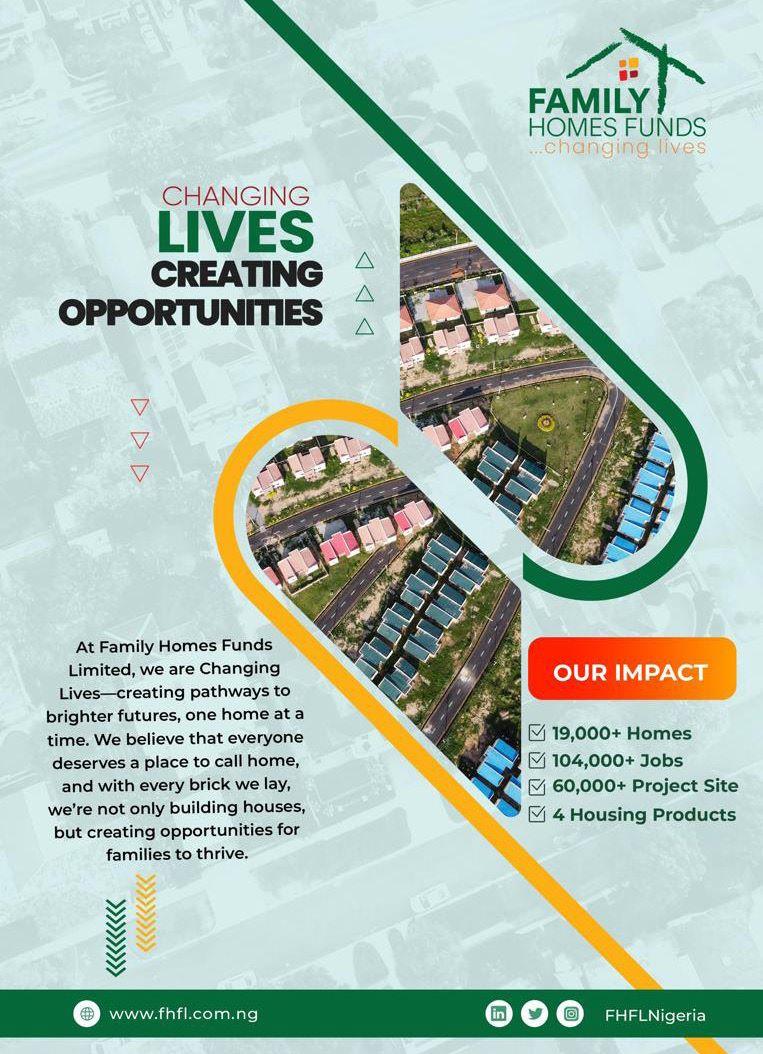
FHFL is bridging that gap by integrating green building technology, economic empowerment, and localised partnerships into every housing unit delivered. The homes use EPS prefabricated panels, reducing both construction time and carbon footprint. The communities are designed with green spaces, marketplaces, and in some cases, farmlands – deliberately engineered for self-sufficiency and social inclusion.
The program also directly aligns with national strategies like the National Poverty Reduction and Growth Strategy (NPRGS) and global mandates like the Sustainable Development Goals – notably Goal 1 (No Poverty), Goal 11 (Sustainable Cities and Communities), and Goal 5 (Gender Equality).
Today, Aisha runs a modest tailoring business from the living room of her two-bedroom home. She sews school uniforms, makes women’s wear, and is learning how to design baby clothes. She also mentors two other widows in the estate who aspire to start similar ventures.
“When people ask me how I did it, I say, I did not – we did it,” she said. “FHFL believed in me before I believed in myself.”