
As Rising Health Funding, Stronger Accountability Take Centre Stage At PHC Leadership Awards
By Enam Obiosio
For decades, primary health care has been described as the foundation of Nigeria’s health system, yet in practice it has often been the weakest link. Clinics closest to communities struggled with poor funding, limited staffing, unreliable data, and weak political attention. Grand declarations were made, but follow-through was uneven, and accountability was thin. Today, that narrative is slowly but visibly changing, as Nigeria’s governors increasingly place primary health care at the heart of governance and submit their commitments to public measurement.
That shift was on full display in Abuja at the third edition of the Primary Health Care Leadership Challenge (PHCLC) Awards, an event that has evolved beyond ceremony into a national checkpoint for health sector reform. The Nigeria Governors’ Forum (NGF), in partnership with the Federal Ministry of Health and Social Welfare, the National Primary Health Care Development Agency (NPHCDA), United Nations International Children’s Emergency Fund (UNICEF), with support from the Gates Foundation and the Aliko Dangote Foundation, the awards have become a platform where political promises are tested against data, budgets, and outcomes.
At the centre of this new momentum is a simple but powerful idea, that governors must not only commit to strengthening primary health care, but must also be willing to be measured, compared, and held accountable.
A Political Signal from the Top
The awards night, held at the Bola Ahmed Tinubu International Conference Centre, drew Vice President Kashim Shettima, governors from across the federation, senior federal and state health officials, and key development partners. The presence of the Vice President was more than ceremonial. For state leaders, it was a clear signal that primary health care reforms now enjoy sustained federal backing at the highest level.
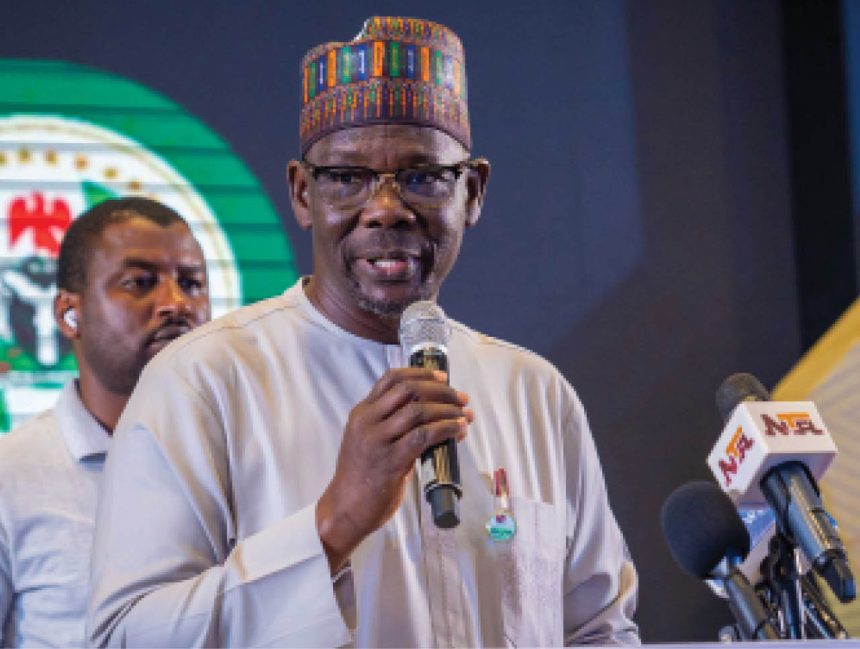
Chairman of the NGF/Governor of Kwara State, Mallam AbdulRahman AbdulRazaq, used the occasion to outline how far states have come in just three years. According to him, progress in primary health care has been driven by deliberate leadership choices and a growing culture of accountability among governors.
He pointed to funding figures that tell a striking story. Combined health budgets across the 36 states have risen from N831 billion in 2022 to N2.36 trillion in 2025. More significantly, about 30 percent of these budgets are now dedicated specifically to primary health care. This shift, he noted, has enabled facility upgrades, recruitment of frontline health workers, and early improvements in health outcomes, including reductions in institutional maternal mortality.
For a sector long starved of consistent investment, the numbers mark a turning point. They also underline a deeper change, primary health care is no longer treated as a residual item in state budgets, but as a strategic priority tied to political performance.

From Declarations to Delivery
The roots of the PHCLC lie in a high-level governors’ meeting on Human Capital Development (HCD), where state leaders collectively acknowledged that weak primary health care was undermining Nigeria’s development goals. That meeting produced the Seattle Declaration, a set of commitments aimed at transforming primary health care at the subnational level.
What made the PHCLC different from past initiatives was the decision to go beyond declarations and create a mechanism to track delivery. The challenge now functions as a national scorecard, periodically measuring and benchmarking how states perform across key primary health care indicators.
At the heart of this process is the Performance Monitoring Framework (PMF), jointly developed by primary health care stakeholders and endorsed by all states through their Commissioners for Health and Executive Secretaries. The framework evaluates performance across governance and leadership, financing, quality of care, data and evidence, and sustainability.
In practical terms, it asks tough questions. Are state health budgets informed by clear operational plans? Are governors personally engaging with primary health care performance? Are facilities stocked with essential medicines? Is data reliable enough to guide decisions? Are local governments playing their part?
Thirteen indicators, weighted across a 746-point scale, provide a detailed picture of how each state plans, funds, manages, and delivers primary health care services. For governors, the framework has turned abstract commitments into concrete metrics.
Accountability as a Political Tool
Governor AbdulRazaq described the PHCLC as proof that accountability can work when it is owned by political leaders themselves. Since the first edition of the awards, he said, states have grown more intentional in tracking performance, not just to win recognition, but to improve outcomes for citizens.
He revealed that the NGF has gone further by introducing scorecards to track state commitments across key health initiatives. An expanded scorecard focused on subnational obligations under the Health Sector Renewal Compact is expected to be released in 2026. When launched, it will allow governors, stakeholders, and the public to monitor progress with greater transparency.
The Health Sector Renewal Compact, signed two years ago by President Bola Ahmed Tinubu, all 36 governors, and development partners, has been another critical pillar of reform. According to the NGF chairman, the compact marked a turning point by aligning federal and state efforts around shared health priorities and clarifying roles across levels of government.
Working closely with the Coordinating Minister of Health and Social Welfare, Professor Muhammad Ali Pate, states have used the compact to synchronise planning, financing, and implementation, reducing duplication and focusing resources where they matter most.
Celebrating Performance, Encouraging Competition
The 2025 edition of the PHCLC Awards recognised 13 states for exceptional performance. Yobe State emerged as the overall national champion and the best-performing state in the North-East. Its victory was built on a well-balanced performance across governance, service delivery, and readiness for quality care. The state recorded nationally leading results in quality of care, patient satisfaction, and primary health care service delivery, demonstrating how focused leadership can drive results even in difficult environments.
Across the zones, Zamfara State led the North-West, buoyed by strong executive engagement and consistent oversight of primary health care performance. Nasarawa State topped the North-Central zone, reflecting high coverage of essential services, reliable data systems, and measurable reductions in mortality. In the South-East, Abia State claimed first place with standout performance in the availability of essential health commodities and strong data quality.
Rivers State emerged best in the South-South, becoming the only state to score above the national average in nine of the thirteen indicators, a signal of broad system strength rather than isolated gains. Osun State led the South-West, particularly in food and nutrition governance, accountability, and primary health care data quality.
First runners-up across the zones also showed meaningful progress. Gombe State demonstrated strong performance in human resources for health, while Kwara State stood out for improvements under the Basic Health Care Provision Fund. Kaduna State recorded strong coverage of essential health services, Anambra State ensured timely disbursement of funds to facilities, Bayelsa State strengthened health budgeting linked to operational plans, and Ogun State showed clear emphasis on quality-of-care frameworks.
For many governors, the competitive element of the awards has become a motivator. Performance is no longer hidden in technical reports, it is announced publicly, compared nationally, and tied to recognition.
Incentives Beyond Recognition
Beyond prestige, the PHCLC carries tangible incentives. Each year, awards valued at US$6.1 million are deployed to reinforce reforms and support continued progress in winning states. More importantly, the process keeps primary health care firmly on the agenda of governors, deputy governors, and local government chairmen.
By requiring governors to discuss primary health care performance at executive council meetings, visit facilities, and engage traditional leaders, the challenge pushes reform from the capital to the community level. Performance discussions are gradually moving from paper to practice.
Development partners have also played a critical role. The Gates Foundation, UNICEF, the World Health Organization (WHO), the World Bank, the European Union (EU), and GAVI continue to support financing, technical assistance, and data systems that underpin state-level reforms. Their collaboration with state governments has helped align global best practices with local realities.
A Test of Sustainability
Despite the gains, challenges remain. Nigeria’s population continues to grow rapidly, placing increasing pressure on primary health care facilities. Security challenges, inflation, and workforce constraints threaten to slow progress in some areas. Sustaining reforms will require discipline, especially as political cycles change.