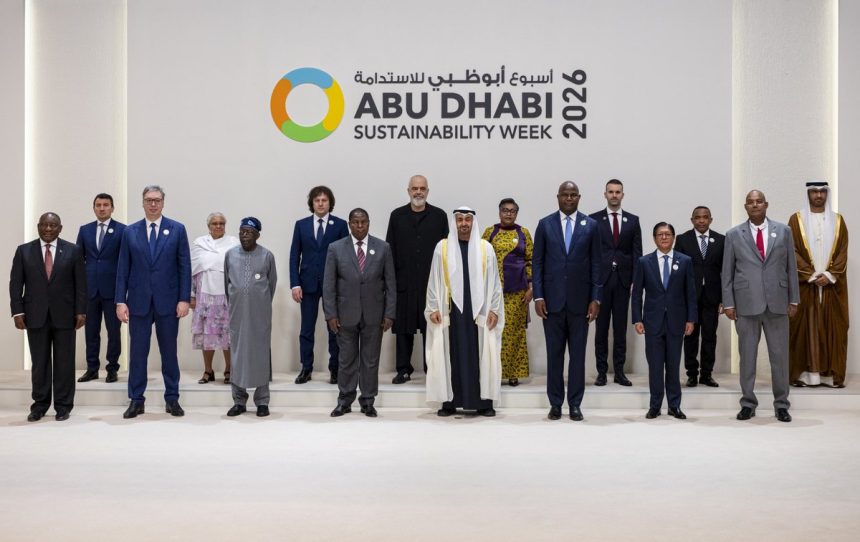
The federal government’s unveiling of a $2 billion Energy Transition and Climate Fund at the Abu Dhabi Sustainability Week is, on the surface, a reassuring signal. It suggests that Nigeria understands the scale of capital, coordination, and credibility required to move from fossil dependence to a more resilient, low-carbon economy. Yet as we examine the announcement closely, the real question is not ambition, but execution, and whether Nigeria has finally aligned policy, finance, and institutions tightly enough to deliver results.
President Bola Tinubu framed the initiative as part of a broader Climate Investment Platform, designed to mobilise $500 million initially for climate-resilient infrastructure, while targeting $25 to $30 billion in annual climate finance over time. These numbers matter. Nigeria’s Energy Transition Plan, which aims for net-zero emissions by 2060 while delivering universal energy access, cannot be funded incrementally. It requires scale, predictability, and private capital confidence.
The logic of green finance as a cornerstone is sound. Nigeria has already tested the market. The N50 billion sovereign green bond issued in 2025 attracted almost double its size in subscriptions, while Lagos State’s green bond was nearly fully oversubscribed. These signals show appetite, not charity. Investors are willing to back climate-linked projects if the governance, reporting, and project pipelines are credible. We should therefore see the new National Climate Change Fund not as a novelty, but as an attempt to institutionalise what has so far worked in fragments.
However, ambition without structural reform risks becoming performative. Nigeria’s environmental challenges remain stubborn. Gas flaring and methane emissions continue despite years of policy declarations. Grid inefficiencies still undermine industrial productivity and household energy access. Climate finance will not fix these on its own. Funds must be tied to measurable emissions reduction, grid stability, and energy access outcomes, not simply to capital deployment headlines.
The announcement of a Comprehensive Economic Partnership Agreement with the United Arab Emirates adds another layer of promise. In theory, the agreement opens channels for investment across renewable energy, aviation, logistics, agriculture, digital trade, and climate-smart infrastructure. In practice, CEPA frameworks only work when domestic regulatory systems are predictable. Trade agreements do not compensate for opaque permitting, weak dispute resolution, or policy reversals. If Nigeria wants UAE capital to flow meaningfully into green infrastructure, it must treat regulatory coherence as seriously as diplomatic optics.
One of the more encouraging elements is the emphasis on industrial policy. The proposed Climate and Green Industrialisation Investment Playbook, if properly executed, could address a longstanding gap. Investors often struggle to navigate Nigeria’s manufacturing incentives, local content rules, and regulatory overlaps. A single, intelligible framework that links climate goals with industrial competitiveness would be a genuine reform, not a branding exercise.
We also note continuity with earlier initiatives, particularly the $500 million Distributed Renewable Energy Fund launched by the Nigeria Sovereign Investment Authority in 2025. This matters because credibility in climate finance is cumulative. Markets reward governments that build on existing structures rather than constantly reinventing them. The challenge now is coordination. Multiple funds, platforms, and playbooks can confuse rather than catalyse investment if they are not aligned under a clear national financing architecture.
The President’s claim that non-oil exports have grown by 21 percent and that investment commitments exceed $50 billion across key sectors reinforces the narrative that Nigeria is repositioning itself. We should welcome this, but also interrogate it. Commitments are not cash flows. Export growth must be sustained, diversified, and linked to domestic value addition, particularly if green industrialisation is to create jobs rather than import dependence.
Technology partnerships, including grid modernisation, artificial intelligence deployment, and pilot projects in electric mobility, point in the right direction. Yet technology without institutional capacity rarely delivers transformation. We have seen smart pilots stall in unsmart bureaucracies. Climate finance must therefore be paired with public sector reform, procurement transparency, and technical capacity within ministries and regulators.