By Jennete Ugo Anya
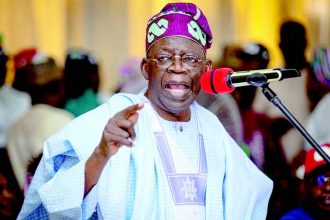
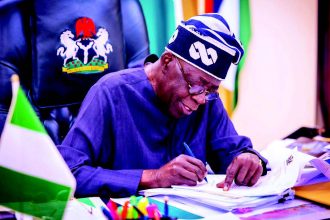
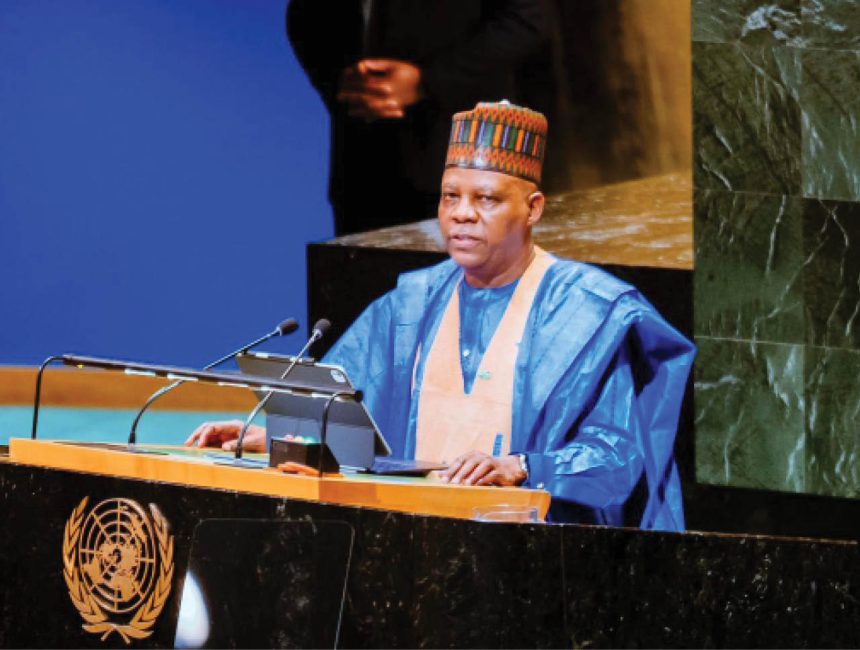
In a bold address to the 80th United Nations General Assembly (UNGA) in New York, President Bola Ahmed Tinubu, represented by Vice President Kashim Shettima, delivered a clarion call for sweeping reforms to the United Nations, warning that the global body risks irrelevance unless it adapts to the modern world.
President Tinubu’s speech underscored Nigeria’s growing influence on the global stage, advocating for a permanent UN Security Council seat and proposing transformative changes to global financial systems, while highlighting Nigeria’s economic resilience as a model for developing nations.
A Call for UN Reform
President Tinubu minced no words in criticizing the UN’s diminishing influence, pointing to the growing disconnect between its rhetoric and action. “The slow pace of progress on these hardy perennials of the UN General Assembly debate has led some to look away from the multilateral model,” he said, noting that key global events are increasingly happening outside the UN’s halls. He emphasized that the organization must reflect “the world as it is, not as it was,” to regain its credibility.
Central to Nigeria’s demands is a permanent seat on the UN Security Council, a reform President Tinubu argued is essential for the UN’s relevance. “Nigeria must have a permanent seat at the UN Security Council,” he declared, framing it as part of a broader need for institutional restructuring. He also called for urgent action on issues like nuclear disarmament, fair trade, and addressing global conflicts, describing ongoing human suffering, particularly in the Middle East, as “stains on our collective humanity.”
On the Palestinian issue, President Tinubu took a firm stance, advocating for a two-state solution. “The people of Palestine are not collateral damage in a civilization searching for order,” he said. “They are human beings, equal in worth, entitled to the same freedoms and dignities that the rest of us take for granted.”
Reforming Global Finance
President Tinubu proposed a radical overhaul of the global financial system to address the sovereign debt crisis crippling developing nations. He called for a new, binding mechanism – an “International Court of Justice for money” – to help emerging economies escape the cycle of producing unprocessed exports. “Urgent action to promote debt relief is not an act of charity but a clear path to peace and prosperity that benefits us all,” he said.
The President also highlighted Africa’s critical role in global stability, emphasizing Nigeria’s abundant strategic minerals vital for future technologies. “Investment in exploration, development, and processing of these minerals in Africa will diversify supply to the international market, reduce tensions between major economies, and help shape the architecture for peace and prosperity,” he said, stressing the need for fair benefits through local processing and job creation.
Nigeria’s Economic Transformation
Positioning Nigeria as a beacon of resilience, President Tinubu outlined the country’s ongoing economic reforms under the Renewed Hope Agenda. Despite the challenges, he expressed confidence in the power of the market to transform, citing the removal of subsidies and currency controls as necessary steps to benefit the majority. “The process of transition is difficult,” he admitted, but emphasized trusting in the ingenuity of Nigerians to drive progress.
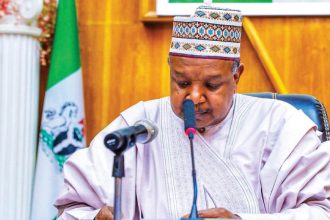
Vice President Shettima, speaking on the sidelines of UNGA, elaborated on Nigeria’s ambitious target of achieving 7% annual economic growth through macroeconomic stability, improved productivity, and investments in infrastructure, healthcare, agriculture, and education. In meetings with the Gates Foundation, Vice President Shettima sought expanded support for these sectors, particularly in education and technology, while commending the Foundation’s contributions to healthcare and financial inclusion.
Deepening Global Ties
On the diplomatic front, Vice President Shettima’s bilateral engagements underscored Nigeria’s commitment to strengthening ties with nations like Namibia. Namibian President Netumbo Nandi-Ndaitwah, during a courtesy visit, praised Nigeria’s historical support and expressed her intent to visit President Tinubu to further bilateral relations. “We are all Africans, and the Nigeria–Namibia relationship should be taken to the next level,” Vice President Shettima responded.
Nigeria also joined 15 other Digital Cooperation Organization (DCO) member states in pledging cross-border collaboration to foster inclusive digital economies. The DCO, representing over 800 million people, emphasized breaking digital barriers and promoting responsible innovation, aligning with President Tinubu’s call for closing the digital divide to ensure “A.I. stands for Africa Included.”
Empowering Women for Economic Growth
At a high-level UNGA sideline event, Nigeria’s Minister of Women Affairs, Imaan Sulaiman-Ibrahim, highlighted the government’s efforts to empower 10 million women through the Nigeria for Women Project (NFWP). The initiative has mobilized over 460,000 women into Women Affinity Groups, saving N4.9 billion and accessing livelihood grants. “Investing in women’s entrepreneurship will transform not just incomes but also nutrition, education, and community stability,” she said, outlining the Renewed Hope Social Impact Interventions to impact 50 million women and vulnerable persons nationwide.
A Vision for Multilateralism
President Tinubu’s address reaffirmed Nigeria’s unwavering commitment to multilateralism, peace, and human rights. “None of us is safe until all of us are safe,” he said, urging world leaders to make “real change that works.” His warning was clear: without meaningful reform, the UN risks being sidelined as global dynamics evolve. As Nigeria pushes for a $1 trillion economy by 2030, President Tinubu’s vision positions the nation as a leader in advocating for a fairer, more inclusive global order.