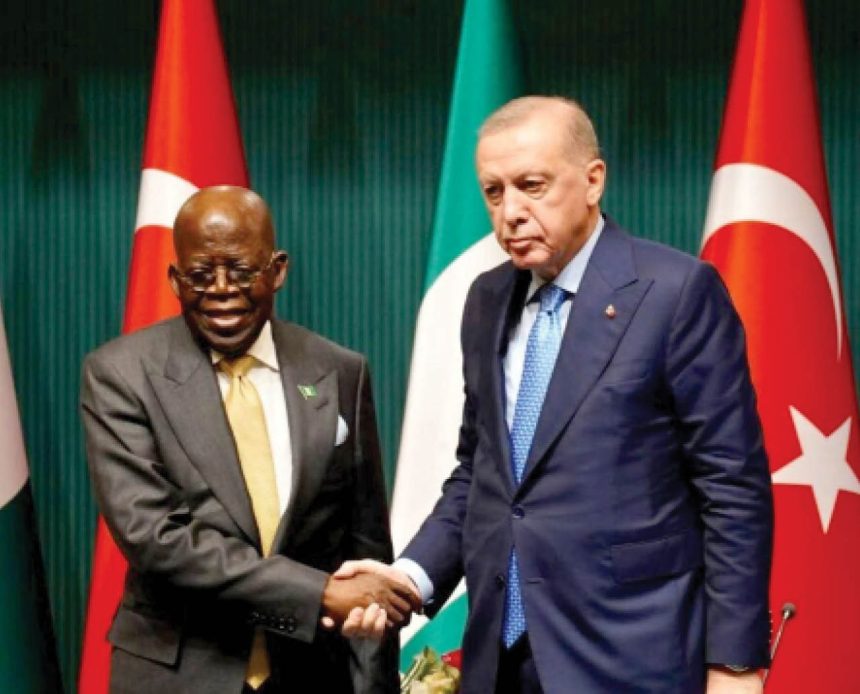
Türkiye President Recep Tayyip Erdogan’s declaration of a $5 billion trade target with Nigeria during President Bola Ahmed Tinubu’s state visit to Ankara was presented as more than a statement of intent. It reflected a convergence of political alignment, institutional preparation, and confidence anchored in ongoing reforms. With bilateral trade currently estimated at about $2 billion, the proposed expansion is substantial. However, the circumstances surrounding the announcement indicate that both governments regard the target as a practical objective, grounded in policy direction and mutual commitment, rather than a distant aspiration. Enam Obiosio writes…
The joint press briefing between both leaders revealed a partnership that has moved beyond ceremonial diplomacy into structured economic coordination. What stood out was not only the numerical target but the architecture being put in place to pursue it. Central to this is the establishment of a Joint Economy and Trade Committee, designed to translate political goodwill into executable trade and investment outcomes. For Nigeria, the engagement comes at a time when economic reform, market restructuring, and international confidence are tightly linked.
President Erdogan was explicit in outlining where the opportunity lies. Türkiye currently exports aircraft, helicopters, machinery, iron and steel products, and chemicals to Nigeria. Nigeria, in turn, exports crude oil and agricultural products. The relationship, while active, has remained largely transactional. The new direction aims to deepen it into a more diversified and investment-led partnership. The Joint Committee is expected to serve as a platform to remove bottlenecks, align standards, and support Turkish firms seeking long-term investment opportunities within Nigeria’s reforming economy.
For the President Tinubu administration, the visit reflects a broader strategy of recalibrating Nigeria’s external economic relationships around reform credibility rather than aid dependency. Since assuming office, the administration has prioritised fiscal restructuring, energy sector reform, and market-driven policy corrections. These measures have been costly in the short term but are increasingly being used as proof points in Nigeria’s international engagements. President Erdogan’s commendation of Nigeria’s energy sector reforms, and his expressed optimism about cooperation with the Turkish Petroleum Corporation, highlights how reform signals are now being converted into investment conversations.
Energy cooperation featured prominently in the Ankara discussions. Türkiye, which has expanded its energy diplomacy across Africa and Central Asia, sees Nigeria as both a supplier and a strategic partner. Nigeria’s ongoing efforts to restructure its energy economy, including reforms in pricing, governance, and investment frameworks, have altered external perceptions. President Erdogan’s remarks suggest that Türkiye is prepared to move beyond crude trade into operational collaboration, particularly if regulatory certainty continues to improve.
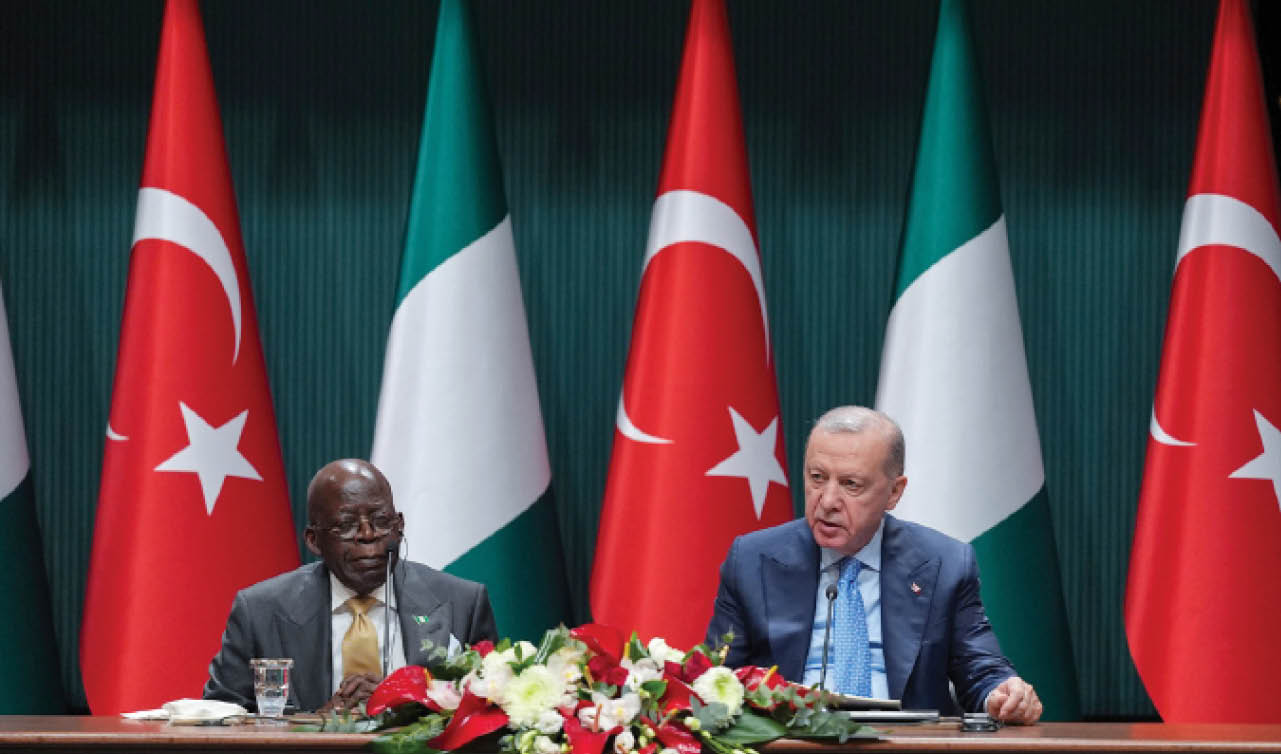
Security cooperation formed the second pillar of the engagement, reflecting shared concerns over regional instability. President Erdogan’s reference to terrorist threats in Africa’s Sahel region was deliberate. Türkiye has navigated similar internal security challenges and now positions itself as a partner capable of offering operational experience, intelligence collaboration, and defence industry support. His commitment to assist Nigeria in tackling insurgency is significant not because it introduces new rhetoric, but because it aligns security cooperation with economic stability. Trade expansion, in this framing, is inseparable from peace and institutional resilience.
President Tinubu’s remarks reinforced this linkage. His emphasis on defeating “agents of destabilisation” alongside economic inclusion reflects the administration’s attempt to frame reform as a security strategy as much as an economic one. The Nigerian President’s focus on inclusive growth, particularly for vulnerable populations, adds a domestic policy dimension to the bilateral conversation. Trade liberalisation without social stabilisation has historically produced uneven outcomes. Tinubu’s framing suggests that Nigeria is seeking partners who understand this balance.
One of the most consequential outcomes of the visit was the signing of nine bilateral agreements. While often overlooked in headline coverage, these agreements provide the operational backbone for the $5 billion target. They span diaspora policy, defence cooperation, education, media and communication, social services, and the establishment of the Joint Economy and Trade Committee. Particularly noteworthy is the agreement on Halal Quality Infrastructure, which opens a pathway for Nigeria to access broader markets within Türkiye’s established halal ecosystem, while also strengthening standards and export credibility.
The education and higher-education cooperation agreements also point to a longer-term vision. Skills development, institutional exchange, and academic collaboration are essential if trade expansion is to be sustained rather than extractive. Türkiye’s experience in vocational education and industrial training aligns with Nigeria’s growing emphasis on skills-based development as a complement to macroeconomic reform.
From a reform perspective, this partnership illustrates how Nigeria is repositioning itself within global economic networks. Rather than seeking one-sided capital inflows, the presence administration appears focused on reciprocal relationships anchored in institutional reform. President Erdogan’s observation that the presence of several Nigerian ministers and senior officials during the visit signalled political determination was not incidental. It reflected a recognition that reform credibility depends on policy coherence across government.
The trade target itself should be understood as both a goal and a test. Moving from $2 billion to $5 billion requires more than diplomatic declarations. It demands efficient ports, predictable customs processes, stable exchange rate mechanisms, enforceable contracts, and security of investments. These are precisely the areas where Nigeria’s reform agenda is under pressure to deliver tangible results. The Ankara discussions suggest that Türkiye is willing to bet on Nigeria’s reform trajectory, provided the momentum is sustained.
For Türkiye, Nigeria represents more than a large market. It is a gateway to West Africa, a regional anchor, and a test case for Türkiye’s expanding Global South diplomacy. President Erdogan’s reference to shared prosperity and his praise of Tinubu’s leadership reflect a pragmatic alignment rather than ideological affinity. Both leaders are operating within domestic reform constraints and external economic pressures. Their convergence lies in mutual benefit and institutional cooperation.
The symbolism of the visit is also relevant. Nigeria’s renewed diplomatic assertiveness signals a departure from reactive engagement towards agenda-driven partnerships. President Tinubu’s commendation of President Erdogan’s peace efforts in Somalia places Nigeria within a broader conversation on African stability, even as it grapples with internal security challenges. This dual positioning reinforces Nigeria’s intent to remain a continental stabiliser while reforming its domestic economy.
As implementation begins, attention will shift from communiqués to outcomes. The effectiveness of the Joint Economy and Trade Committee will be closely watched. So will the pace at which signed agreements translate into projects, investments, and measurable trade flows. For Nigeria, success will depend on whether reform promises can withstand domestic pressures and political resistance. For Türkiye, it will depend on navigating Nigeria’s complex operating environment while aligning investments with long-term value creation.
Ultimately, the $5 billion trade target is less about the number and more about the signal it sends. It indicates that Nigeria’s reform narrative is beginning to resonate beyond traditional partners. It suggests that emerging economies see value in Nigeria’s market correction efforts, even amid adjustment costs. And it emphasizes a strategic shift in Nigeria–Türkiye relations, from episodic engagement to structured economic partnership.