
Nigeria’s persistent housing deficit may receive a modest but important intervention following a new partnership between Sterling Bank and the Ministry of Finance Incorporated Real Estate Investment Fund (MREIF), a government-backed financing vehicle designed to expand access to housing finance.
The collaboration introduces a long-term mortgage facility structured to make homeownership more attainable for Nigerians through lower interest rates, longer repayment tenures, and reduced upfront equity requirements.
The agreement was formalised at Sterling Bank’s headquarters in Lagos, marking a new phase of cooperation between private financial institutions and government-backed investment structures aimed at stimulating the mortgage market.
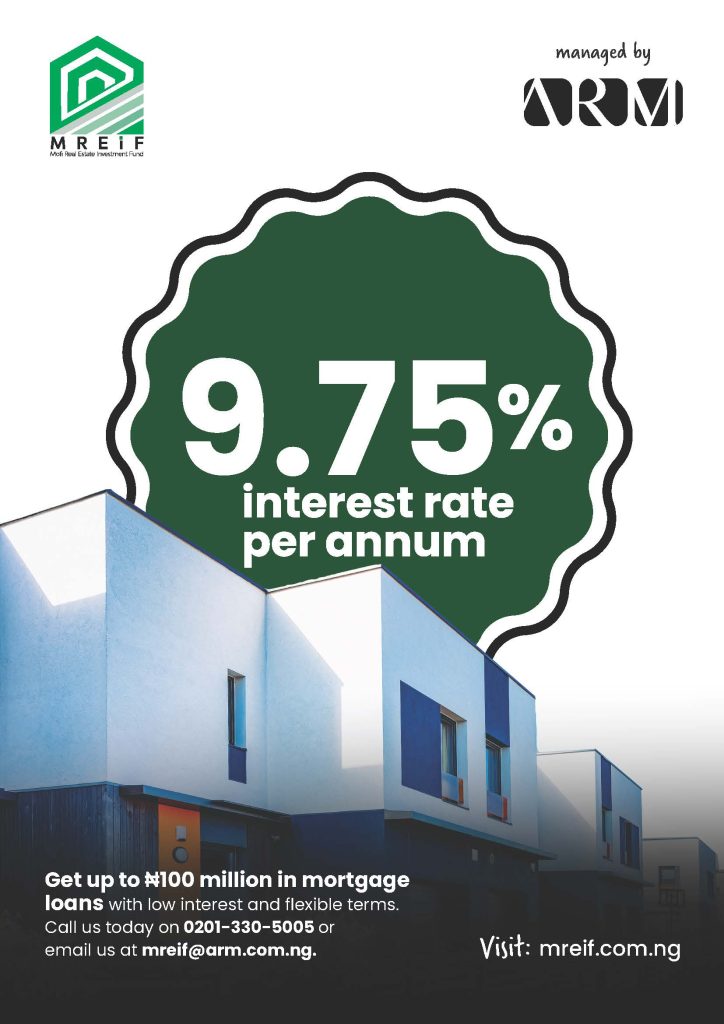
Under the arrangement, qualified applicants will be able to access mortgage loans of up to N100 million. The loans will carry a fixed interest rate of about 9.75 percent per annum and will be repayable over a period of up to 20 years.
The financing structure also lowers the initial financial burden on prospective homeowners. The facility covers up to 90 percent of the value of a property, requiring borrowers to provide only a 10 percent equity contribution.
David Adebayo, Vice President of Consumer Banking at Sterling Bank, described the initiative as a deliberate effort to expand financial inclusion while addressing structural barriers that have long constrained access to mortgage financing in Nigeria.
According to Adebayo, the collaboration is designed to deploy long-term capital in ways that enable more Nigerians to sustainably acquire homes.
“This collaboration reflects our commitment to providing patient capital that enables more Nigerians to own homes sustainably. By combining competitive pricing with longer tenors and high loan-to-value ratios, we are lowering the barriers to homeownership and strengthening financial inclusion,” Adebayo said.
Mounir Bouba, Executive Director of ARM Investment Managers, the firm serving as fund managers for the MREIF, said that the partnership represents a practical example of how public and private sector collaboration can unlock structured solutions to Nigeria’s housing challenge.
Bouba noted that expanding access to affordable mortgages remains critical to deepening the country’s housing finance ecosystem.
“This MoU aligns with broader efforts to make mortgages more affordable and accessible at scale. Through strategic partnerships such as this, we can catalyse private capital, deepen the mortgage market and drive structured solutions to Nigeria’s housing challenge,” Bouba stated.
He also disclosed that the initiative begins with an initial N10 billion commitment, but has been structured with provisions for expansion as demand grows.
The mortgage programme is designed to accommodate a broad category of potential homeowners. Eligible applicants include salary earners with verifiable income, business owners with documented financial records, and Nigerians in the diaspora. Both existing and new Sterling Bank customers are able to apply for the facility.
The MREIF serves as the central financing platform for the initiative. The fund was established by the federal government to mobilise private capital and provide lower-cost mortgage funding aimed at addressing the structural constraints that have historically limited housing finance in Nigeria.
Nigeria faces one of the largest housing deficits in Africa, with estimates often exceeding 20 million units. Access to long-term mortgage financing has remained limited due to high interest rates, short loan tenures, and stringent equity requirements.
Industry observers argue that initiatives such as the Sterling Bank and MREIF partnership could help deepen the mortgage market if implemented at scale and replicated across financial institutions.
For policymakers and housing sector stakeholders, the challenge remains how to translate such financing programmes into large-scale housing delivery capable of narrowing the country’s widening housing gap.