By Jennete Ugo Anya
Nigeria has earned global recognition for its steady and credible economic reform programme, with the World Bank describing the country as an emerging reference point for disciplined policy implementation.
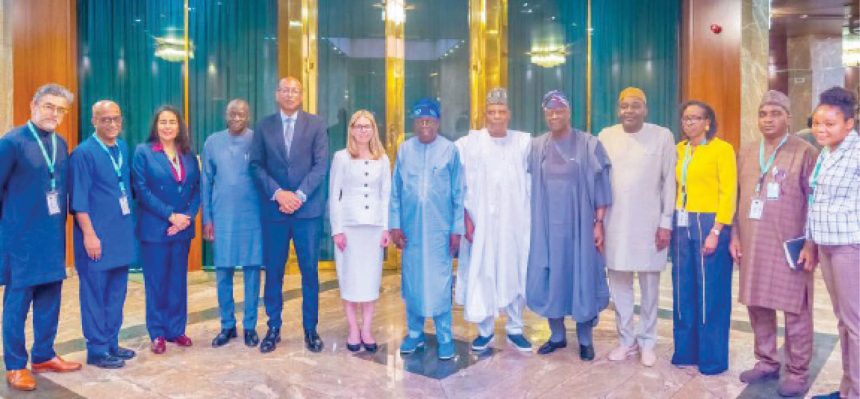
The commendation came during a meeting at the State House, Abuja, where President Bola Tinubu received the World Bank delegation led by Managing Director of Operations, Anna Bjerde.
President Tinubu reaffirmed his administration’s commitment to sustaining structural reforms despite the initial challenges they posed. “Since we’ve gone into this tunnel of reform, we have our hands on the plough and we’re never going to look back,” he said. He highlighted that Nigeria has already navigated the most difficult phase of implementation and remains determined to maintain long-term stability and growth.
President Tinubu emphasised the centrality of Nigeria’s youthful population and vast agricultural resources to economic transformation. He outlined government initiatives to establish zonal mechanisation centres, expand access to improved seedlings, and leverage rising petrochemical output to increase local fertiliser production. These interventions are designed to transition farmers from subsistence production to large-scale cooperatives, generating wealth and creating employment.
The President also emphasized the significance of difficult policy decisions, such as fuel subsidy removal and exchange-rate unification, describing them as necessary sacrifices for long-term gains. “We gave up short-term benefits so that the world and the country can benefit from a stable currency,” he said, noting that inflation has since eased and the naira has stabilised, enhancing investor confidence.
Global Recognition
World Bank Managing Director Anna Bjerde lauded Nigeria as a global example of credible and consistent reform leadership. She cited policy consistency, positive investor sentiment, and structural improvements as factors underpinning Nigeria’s growing reputation. The World Bank’s forthcoming Country Partnership Framework will align with Nigeria’s development goals, including the $1 trillion gross domestic product (GDP) target and the seven percent growth agenda. Bjerde highlighted the importance of improving access to finance for small, medium, and large enterprises, particularly mid-sized firms that drive employment.
Economic Outlook and Reform Agenda
Honourable Minister of Finance and Coordinating Minister of the Economy, Mr. Wale Edun, said Nigeria is on track to achieve sustained economic growth of at least seven percent between 2027 and 2028. He attributed this to ongoing macroeconomic and structural reforms aimed at restoring stability, boosting productivity, and deepening inclusion.
Mr. Edun stressed that domestic reforms are crucial amid shifting global trade dynamics, rising protectionism, and tightening financial conditions. “For Africa, growth must be domestically driven, private-sector led, and productivity-focused,” he said. He called for mobilisation of domestic resources, adoption of technology, and investment in human capital to ensure Nigeria capitalises on its demographic advantage.
Private Sector and Investment Support
Umaru Kwairanga, Chairman of the Nigerian Exchange Group (NGX), pledged the Exchange’s role in supporting Nigeria’s growth agenda by connecting capital to opportunities and enabling businesses to expand transparently and sustainably. He emphasised the importance of platforms like the African Business Convention in fostering partnerships that translate dialogue into tangible investment outcomes.
Banking Sector Outlook
S&P Global Ratings projected nominal credit growth for Nigerian banks between 20 and 25 percent in 2026, driven by investments in oil and gas, agriculture, and manufacturing. The ratings agency expects real GDP growth to average 3.7 percent over 2025-2026, with stable asset quality and marginal declines in profitability. Non-performing loans, which rose to seven percent in 2025, are expected to stabilise between six and seven percent. Banks’ capitalisation is anticipated to improve as they meet new regulatory requirements, while continued growth in transaction fees and commissions will support overall profitability.
Building Resilience
The World Bank’s recognition, coupled with strong policy alignment and proactive private sector engagement, positions Nigeria as a model for consistent, productivity-led economic growth in Africa, highlighting the country’s potential to achieve its ambitious development targets while deepening inclusion and stability.