
By Anita Dennis
Nigeria has been urged to take a frontline role in reshaping the global political and economic order, with the United Nations describing the country as uniquely positioned to champion Africa’s collective ambition for greater influence on the world stage.
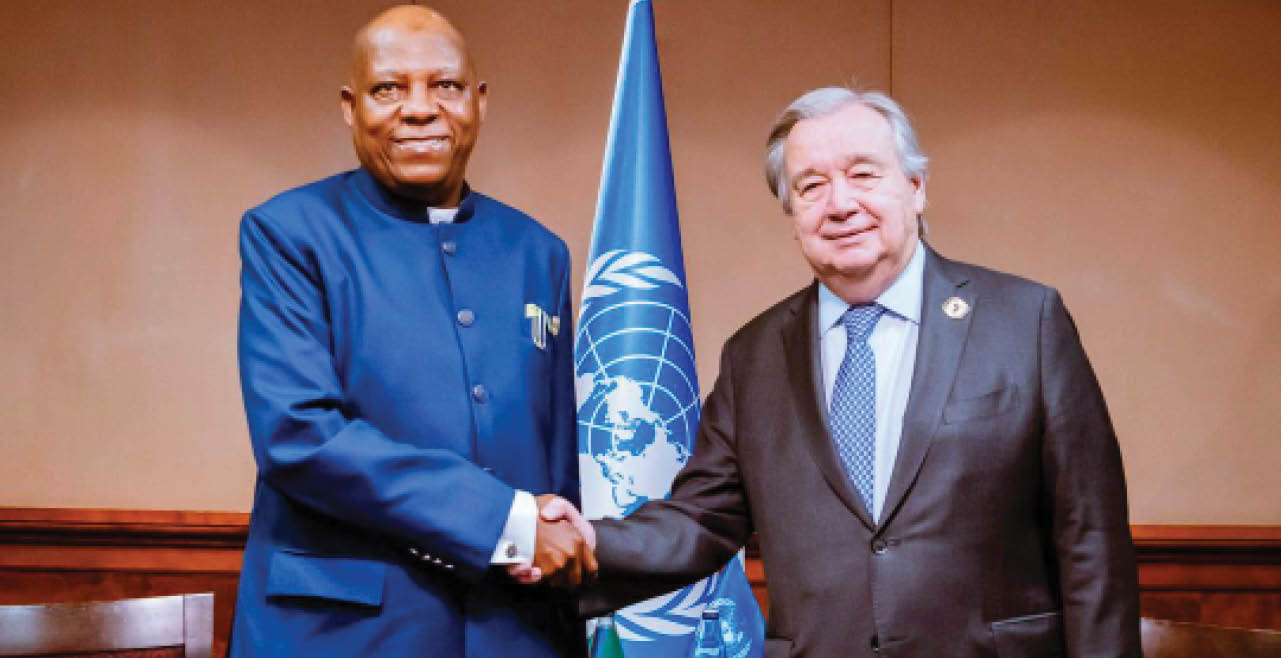
The call was made by the United Nations Secretary-General, António Guterres, during a high-level bilateral meeting with Vice President Kashim Shettima on the sidelines of the 39th African Union Summit in Addis Ababa, Ethiopia.
The meeting, held against the backdrop of shifting global power dynamics and growing calls for reform of international institutions, focused on Nigeria’s expanding leadership role within Africa and beyond. Guterres described Nigeria as central to the continent’s future, citing its demographic strength, democratic continuity, and depth of natural and human resources.
According to the UN Secretary-General, these attributes place Nigeria in a rare position to steer Africa’s push for a restructured global order that reflects contemporary realities rather than post-World War II arrangements. He said Nigeria’s size and influence give it the capacity not only to advocate for Africa but also to shape outcomes in an increasingly multipolar world.
Guterres also commended the economic reforms of the administration of President Bola Ahmed Tinubu, describing them as bold steps that have strengthened Nigeria’s continental standing. Despite internal security and economic pressures, he noted, Nigeria has continued to play a stabilising role in West Africa and the Sahel, particularly within the Economic Community of West African States.
In his remarks, the UN chief said Nigeria’s sustained democratic governance and commitment to multilateralism set it apart at a time when democratic backsliding and unilateralism are rising globally. He argued that Africa’s aspiration for greater representation in global decision-making would be difficult to achieve without Nigeria’s active leadership.
The discussions between both leaders extended beyond symbolism. They covered Nigeria’s domestic reform trajectory, regional security efforts, and the country’s engagement with multilateral institutions. Guterres acknowledged Nigeria’s contributions to peacekeeping and regional diplomacy, especially in fragile contexts across the Sahel, where instability has continued to pose humanitarian and security risks.
For the United Nations, Nigeria’s role is viewed as strategic. As Africa’s most populous country and one of its largest economies, Nigeria serves as both a bellwether and a convening force. Guterres said Nigeria’s ability to balance domestic reforms with regional responsibilities has reinforced its credibility as a continental leader.
Vice President Shettima, in response, thanked the UN Secretary-General for his leadership in promoting global peace and cooperation. He said Africa had benefitted significantly from Guterres’ tenure, even as the United Nations itself undergoes internal restructuring to remain effective in a changing world.
Shettima reaffirmed Nigeria’s commitment to multilateralism and to strengthening partnerships with the United Nations and other global institutions. According to him, global challenges such as climate change, insecurity, migration, and economic inequality require coordinated responses rather than fragmented national efforts.
The Vice President also used the opportunity to restate Nigeria’s longstanding position on the need for comprehensive reform of the United Nations system. He argued that existing global governance structures no longer reflect present-day economic, demographic, and political realities, particularly the growing weight of Africa in global affairs.
Central to Nigeria’s position is the demand for stronger African representation in global decision-making bodies. Shettima emphasized that Africa’s absence from permanent membership of the United Nations Security Council remains a historical injustice. He declared that Nigeria, given its population, contributions to peacekeeping, and leadership within Africa, deserves a permanent seat on the Council.
This call aligns with broader African Union positions advocating for Security Council reform, including expanded permanent representation for Africa. For Nigeria, the issue is both symbolic and practical, tied to the continent’s ability to influence decisions on peace, security, and development that directly affect African states.