
By Anita Dennis
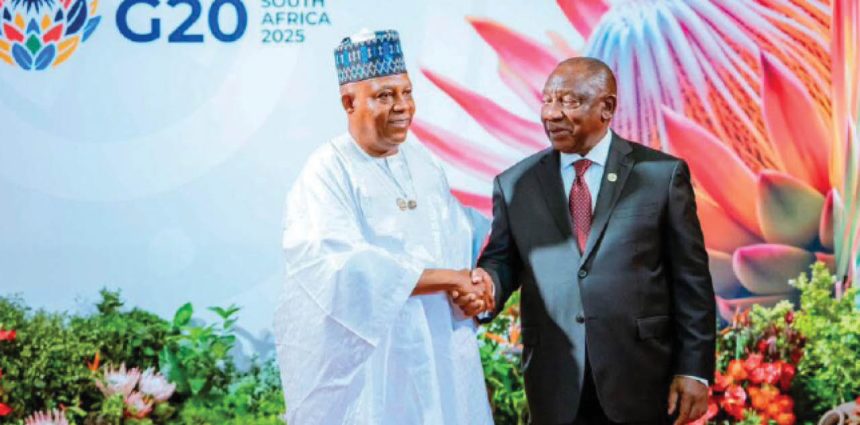
At the Johannesburg Expo Centre, where the world’s most powerful economies gathered for the 2025 G20 Leaders’ Summit, Nigeria used its seat at the table to deliver a pointed message about the future of global development.
President Bola Tinubu, represented by Vice President Kashim Shettima, urged fellow leaders to rethink how technology, capital, and natural resources are shared in a rapidly changing world. His argument cut through the diplomatic language that usually defines such meetings: progress, he insisted, cannot continue on old terms.
The summit, themed “A Fair and Just Future for All: Critical Minerals, Decent Work, Artificial Intelligence,” gave Nigeria the platform to push for reforms that link technological advancement with human dignity.
His central concern was the widening gap between nations that innovate and nations that supply the raw materials and labour that sustain global industries. As artificial intelligence sweeps across sectors, he warned that the technology must remain firmly in service of humanity, not morph into a force that sidelines vulnerable economies.
“Our task is to make sure AI becomes a tool of empowerment,” he said, adding that global systems must prevent the technology from “reshaping society at the expense of those it ought to uplift.” That framing reflected a larger anxiety about how innovation could either deepen inequality or create shared opportunity.
The President pressed a familiar point for African leaders: the continent should no longer be viewed as a supplier of raw minerals that fuel global industries, from batteries to electronics. He argued that a new global framework is needed to ensure value addition at the source, so that communities in Nigeria and across Africa benefit from the minerals under their feet. To him, these mineral deposits represent more than economic potential; they are catalysts for industrial transformation if handled with fairness, transparency, and accountability.
The Nigerian delegation’s message on critical minerals tied into a broader call for reforming multilateral financial systems.
President Tinubu told the summit that many developing countries remain stuck behind systemic barriers that slow growth, weaken trade, and hamper financial inclusion. Existing global frameworks, he said, “were built in an era far removed from” the realities of today’s world and no longer reflect the complexities nations face. He pushed for an overhaul that would allow countries in the Global South to escape cycles of fragile growth and recurring debt crises.
President Tinubu’s remarks on debt were especially stark. He noted that rising debt burdens continue to drag countries back into vulnerability, turning regional challenges into global risks. For him, no conversation on inclusive development is complete unless debt sustainability is placed at the centre of global decision making. He urged the G20 to ensure its Leaders’ Declaration includes firm commitments to equitable financial reforms and responsible management of critical mineral resources.
While the structural issues dominated his speech, President Tinubu also spotlighted Nigeria’s efforts to prepare its own population for the shifts taking place. He pointed to investments under the Renewed Hope Agenda, particularly digital literacy, vocational training, and entrepreneurship programmes designed to equip young people with future-ready skills. He added that Nigeria supports the creation of global ethical standards for artificial intelligence that protect safety and transparency and prevent exclusion.
His appeal for stronger partnerships captured the tone of many African interventions at the summit. He called for deliberate cooperation between developed and developing nations, between public and private sectors, and between innovation and inclusion. The goal, he said, should be an economy that measures its success not only in growth figures but in the dignity it offers its people.
President Tinubu reminded the G20 that Africa cannot transform its development trajectory without a collective commitment from the world’s leading economies. Aspirations alone will not lift the continent, he said, unless they are matched with fairer financing, responsible resource governance, and an inclusive global economic order.