
By Anita Dennis
The country’s fiscal reform agenda moved into sharper focus recently as President Bola Ahmed Tinubu declared that outdated tax laws had long constrained economic growth and deepened inequality, while new reforms are now positioning the country for broader prosperity.
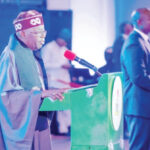
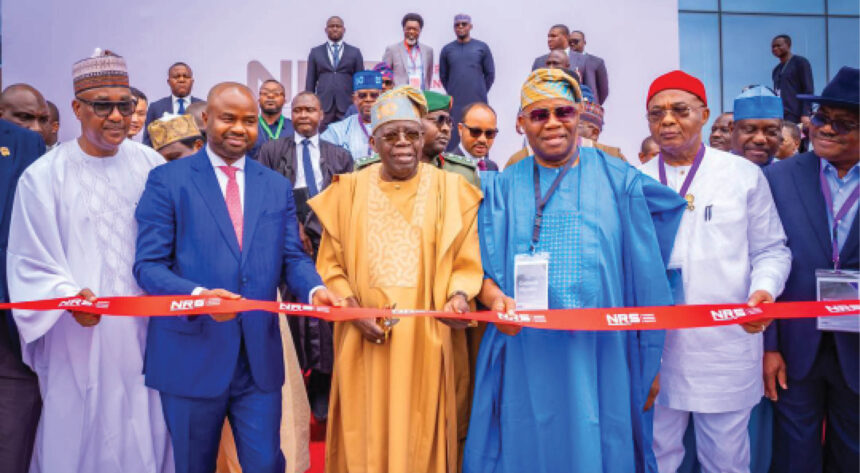
Speaking at the commissioning of the 16-storey headquarters of the Nigeria Revenue Service (NRS), the President framed the moment as more than a ceremonial milestone. It was, in his words, a turning point in Nigeria’s effort to rebuild its revenue architecture and restore confidence in public institutions.
President Tinubu traced the roots of the problem to colonial-era tax frameworks, describing them as fragmented and inconsistent. According to him, these structural weaknesses limited efficiency, reduced compliance and ultimately weakened the economic potential of both individuals and businesses. “We are not gathered here merely to commission an edifice. We are here to mark a milestone in a larger national journey,” he said.
At the fundamental of the administration’s response is a redesigned tax system that seeks to simplify processes, eliminate distortions and create a more transparent environment for taxpayers and investors. The President emphasised that the reforms are not driven by higher tax burdens but by improved structure and governance.
“The reforms are designed to simplify our system, eliminate distortions and create a fair, transparent and investment-friendly environment,” Tinubu stated, adding that early indicators point to improved fiscal stability and rising investor confidence.
The new framework, which became fully operational in January, consolidates more than 60 previously fragmented tax laws into a unified system. This restructuring aims to improve predictability, reduce administrative bottlenecks and strengthen compliance across sectors.
For the President, the reform agenda is tied directly to his broader economic commitments. He reiterated that his administration’s objective is to move Nigeria toward a system anchored on discipline, equity and opportunity. “I stand before you to reaffirm that these words were not rhetoric; they were a covenant with the Nigerian people,” he said.
The commissioning of the NRS headquarters provided a physical symbol of this transition. Completed within 30 months after decades of delay, the facility is designed to support a modern revenue system, with capacity for about 3,000 staff and integrated infrastructure including a data processing centre and training facilities.
President Tinubu also used the occasion to underline institutional expectations. He urged the revenue agency to go beyond collection and focus on trust-building. According to him, credibility in taxation depends not only on efficiency but also on fairness and accountability.
Supporting the President’s position, Senate President Godswill Akpabio called for patience, arguing that the administration’s reforms are beginning to yield visible results. He pointed to improvements in fuel availability and increased domestic production as indicators of policy impact.
Similarly, Speaker of the House of Representatives, Hon. Tajudeen Abbas, described the reforms as a shift from fragmented policy frameworks to a more coherent system. “We operated multiple regimes and overlapping mandates. The result was high effort and low yield,” he said, noting that the new approach aligns rules, institutions and incentives.
At the implementation level, Executive Chairman of the NRS, Dr. Zacch Adedeji, provided insight into the scale of transformation underway. He described the reforms as comprehensive, extending beyond taxation to broader fiscal governance.
Dr. Adedeji noted that revenue collection has grown significantly, from N6.8 trillion five years ago to N28.7 trillion in 2025. He also pointed to improvements in federation revenue, which rose from N711 billion in May 2023 to N3.6 trillion by September 2025, attributing the increase to policy coherence and improved financial management.
Beyond revenue figures, he highlighted structural reforms such as the launch of the National Single Window, aimed at modernising trade processes and reducing inefficiencies. These measures, he argued, are reinforcing transparency and strengthening Nigeria’s position as a market-driven economy.
The broader message from the event is one of transition. Nigeria is moving from a legacy system defined by fragmentation to a more integrated and technology-driven model. The success of this shift will depend on sustained policy discipline and institutional performance.