By Jennete Ugo Anya
Nigeria’s public finance outlook is entering a more delicate phase, with new projections from the International Monetary Fund (IMF) pointing to a gradual rise in the country’s debt burden relative to its economic output. In its latest Fiscal Monitor Report, the IMF estimates that Nigeria’s debt-to-GDP ratio will climb to 33.1 percent by 2027, a politically significant year as the country prepares for general elections.
While the figure represents a downward revision from the Fund’s earlier 35.3 percent estimate, it still signals a steady upward trajectory from the 32.3 percent projected for 2026. The shift suggests that, although debt growth may be moderating, fiscal pressures remain firmly in place.
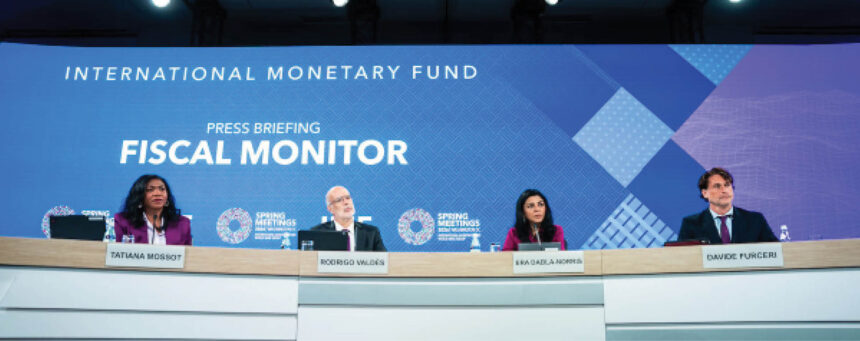
The report was unveiled in Washington DC during the recent IMF-World Bank Spring Meetings, where policymakers are assessing the resilience of economies against a more uncertain global backdrop.
Recent domestic data highlights the scale of Nigeria’s debt expansion. According to the Debt Management Office (DMO), total public debt rose to N159.27 trillion at the end of the fourth quarter (Q4) of 2025. This marks an increase of N5.98 trillion within a single quarter and a N14.6 trillion rise compared to the same period in 2024. The pace of accumulation reflects both new borrowing and the fiscal demands of a large and growing economy.
At the federal level, financing needs remain high. President Bola Ahmed Tinubu has already sought legislative approval for external loans totalling $6 billion, signalling continued reliance on borrowing to support budgetary obligations and development priorities.
Beyond Nigeria, the IMF’s report paints a broader picture of mounting fiscal strain. Global public debt reached nearly 94 percent of GDP in 2025 and is projected to approach 100 percent by 2029. The Fund notes that such levels were last seen in the aftermath of the Second World War, highlighting the scale of current fiscal exposure.
More concerning is the concept of “debt-at-risk,” which captures the likelihood of debt rising sharply under adverse conditions. The IMF places global debt-at-risk at around 117 percent of GDP over the next three years, with significant downside risks driven by geopolitical and financial uncertainties.
Among these risks is the potential escalation of conflict in the Middle East, which could push up food and fuel prices, tighten financial conditions and force higher government spending. The Fund warns that a prolonged conflict could add up to four percentage points to global debt-at-risk levels.
Another emerging vulnerability lies in financial markets, particularly around technology valuations. A sharp correction in artificial intelligence-related assets, especially if accompanied by a 20 percent drop in US equities, could ripple across global markets and further raise debt risks by an estimated 2.4 percentage points.
Against this backdrop, the IMF is urging governments to act with discipline. Rodrigo Valdés emphasised the importance of rebuilding fiscal buffers once immediate economic pressures ease. His message is rooted in timing and credibility. Countries that delay consolidation, he warned, risk entering future crises with limited room to respond.
“Crisis require emergency support, but the ability to respond depends on pre-existing fiscal space,” Valdés said, noting that postponing reforms only tightens constraints over time.
For developing economies such as Nigeria, the Fund’s guidance is specific. Strengthening domestic revenue mobilisation is critical, both to sustain public spending and to reduce reliance on external financing. This becomes more urgent as global aid flows remain uncertain.
At the same time, the IMF cautions against policy choices that could worsen fiscal imbalances. Broad-based energy subsidies and tax reductions, often used to ease short-term pressures, are described as inefficient and difficult to reverse. According to Valdés, such measures distort price signals, strain public finances and tend to benefit higher-income groups disproportionately.
The policy direction, therefore, is one of balance. Governments must protect vulnerable populations while maintaining credible medium-term fiscal frameworks. Clear communication, the IMF argues, is essential to anchor expectations and sustain investor confidence.
For Nigeria, the implications are immediate. The projected rise in debt-to-GDP may still sit below some peer economies, but the course matters more than the level. As borrowing continues and global risks intensify, the margin for policy error narrows.