
By Musa Ibrahim
President Bola Tinubu has commended Lagos State’s latest wave of infrastructure delivery, describing the projects as evidence of sustained institutional capacity and a continued push toward urban modernisation in Nigeria’s commercial capital.
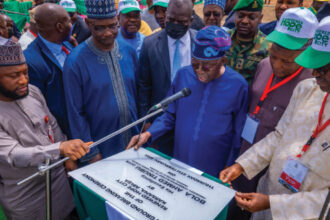
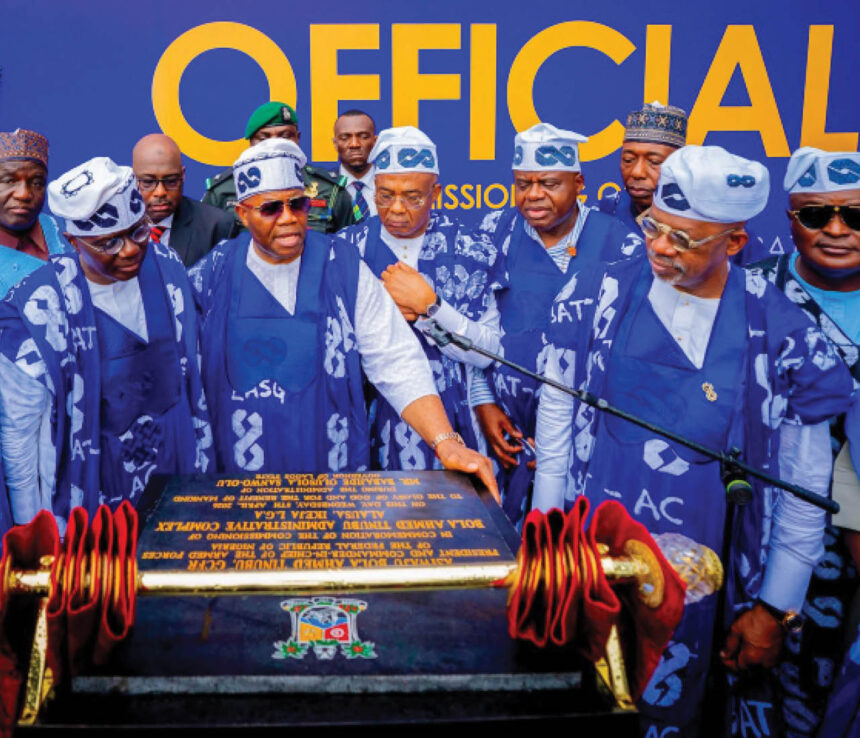
President Tinubu made the remarks last Wednesday during the commissioning of three major projects in Lagos: the Ojota – Opebi Link Bridge, the Lagos State Geographic Information Service (LAGIS) Building, and the Lagos Multi-Agency Administrative Complex in Alausa.
The President, who governed Lagos State from 1999 to 2007, revisited a long-standing policy ambition with the inauguration of the Ojota – Opebi Link Bridge, a 5.04-kilometre transport corridor first conceived during his tenure in 2002 but only completed under Governor Babajide Sanwo-Olu.
Represented by Senate President Godswill Akpabio, President Tinubu said the projects reflect a governance model that places citizens at the centre of infrastructure planning and execution.
“The Ojota-Opebi Link Bridge is more than an infrastructure; it is a bridge to opportunities,” he said. “In a busy city like Lagos, vehicular movement is more than just commuting; it is associated with the city’s economic wellbeing.”
He argued that efficient mobility directly translates into productivity gains, business efficiency and improved living standards, positioning transport infrastructure as an economic multiplier rather than a standalone public asset.
“When traffic flows, productivity improves. When time is saved, businesses grow. When access is made easier, living standards get improved,” the President said.
The President also used the occasion to frame Lagos as a model of sustained urban governance within Nigeria, noting that continued infrastructure delivery has helped the state manage chronic mobility pressures associated with rapid population growth.
“This is an achievement that speaks to the importance of making the well-being of the people the centre of development,” he stated.
A key feature of the day’s events was the commissioning of the LAGIS Building, a five-storey facility designed to modernise land administration through digital systems. The project is positioned as part of a broader shift away from manual, paper-based processes that have historically slowed land registration, constrained property rights and limited the monetisation of real estate assets.
President Tinubu described the facility as central to Nigeria’s broader governance modernisation agenda, particularly in areas where data and technology intersect with economic planning.
“The LAGIS Building represents the future of an effective and transparent land administration system,” he said, stressing that digital integration in land management is no longer optional but necessary for economic efficiency.
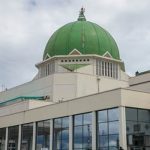
The third project, the Lagos Multi-Agency Administrative Complex, is designed to consolidate multiple government agencies within a single operational environment. The objective is to improve coordination, reduce administrative delays and enhance service delivery efficiency across public institutions.
Governor Babajide Sanwo-Olu said the three projects, while distinct in function, are structurally interconnected in their developmental intent. He noted that the infrastructure package reflects a governance approach focused on mobility, data systems and administrative efficiency.
According to him, the Ojota – Opebi Link Bridge is expected to ease congestion along the Ikeja – Maryland – Ojota corridor, with wider implications for traffic distribution across Lagos’ transport network.
He said the design of the bridge incorporates pedestrian walkways, bicycle lanes, solar-powered lighting systems and embedded service ducts, reflecting a shift toward multi-use and future-ready infrastructure planning.
“We have built, not just for today’s needs, but with a clear eye on the ever-expanding demands of the future,” Gov. Sanwo-Olu said. “We have integrated a comprehensive stormwater management system to address the long-standing challenge of flooding along the Odo-Iya-Alaro corridor.”
The governor framed the LAGIS initiative as a structural reform in land governance, describing it as a transition from legacy administrative systems to a digital framework capable of improving transparency and unlocking dormant economic value in land assets.
At the institutional level, Gov. Sanwo-Olu said the Multi-Agency Administrative Complex addresses long-standing inefficiencies in public service coordination by centralising operations across multiple departments.
“By bringing multiple agencies into a single, well-designed environment, we are enabling the integration and responsiveness of public service delivery in Lagos,” he said.
He stated that the decision to rename the administrative complex after President Tinubu reflects recognition of his historical role in shaping Lagos’ institutional architecture and governance trajectory.
The commissioning ceremony attracted a wide political and administrative presence, including APC governors, state cabinet members, legislators, local government officials and party stakeholders, underscoring the political significance of infrastructure delivery in Lagos.
For the federal leadership, the projects were framed as aligned with the administration’s broader reform agenda, particularly under the Renewed Hope framework, which emphasises infrastructure expansion, digital governance and urban efficiency.