The way people invest is changing rapidly across the world. Financial decisions that were once driven mainly by human brokers, traditional market research, and manual trading systems are increasingly being shaped by artificial intelligence, automated analytics, digital platforms, and real-time data systems.
From stock exchanges in New York and London to emerging markets across Asia and Africa, technology is gradually transforming how investments are priced, traded, monitored, and regulated. Algorithms now execute transactions within seconds, digital platforms connect millions of retail investors to financial markets, and artificial intelligence systems increasingly assist with risk analysis, portfolio management, fraud detection, and market forecasting.
Nigeria’s capital market regulators believe the country cannot remain outside that transformation.
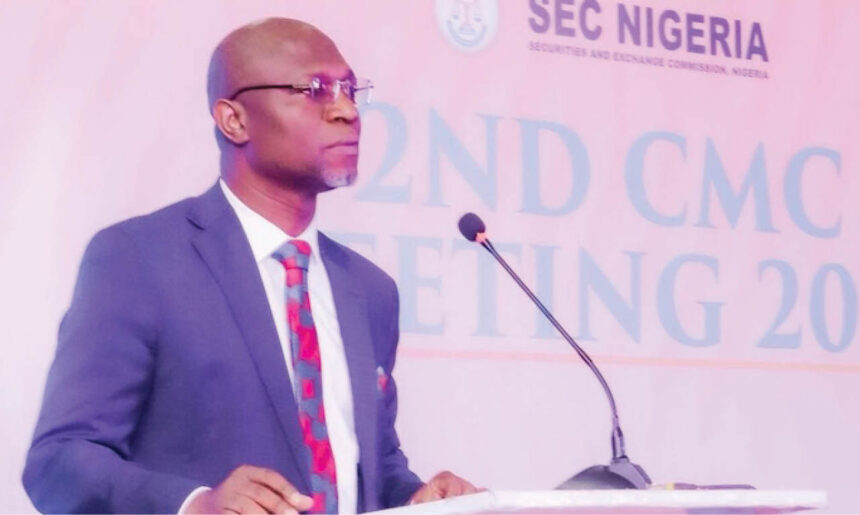
At the FSDH Investor Conference 2026 in Lagos, the Director-General of the Securities and Exchange Commission (SEC), Dr. Emomotimi Agama, outlined what he described as one of the Commission’s most extensive reform programmes aimed at repositioning Nigeria’s capital market around technology-driven regulation, artificial intelligence systems, digital investment infrastructure, and broader market modernisation.
According to Agama, the Nigerian capital market is increasingly being redesigned to support what he repeatedly described as the era of “intelligent investing,” a financial environment where investment decisions are heavily influenced by data analytics, automated systems, and digital infrastructure.
“The era of intelligent investing has already arrived,” Agama stated during the conference.
He described a rapidly evolving investment environment driven by “artificial intelligence, real-time analytics, distributed ledger technology and algorithmic systems.”
For regulators, the shift represents more than a technological upgrade. It reflects the growing challenge of supervising financial systems that are becoming increasingly automated, data-intensive, and digitally interconnected.
Traditionally, capital market regulation focused heavily on disclosure requirements, transaction monitoring, fraud prevention, licensing, and investor protection within relatively conventional trading systems. But the rise of artificial intelligence and digital investment tools is forcing regulators globally to rethink how financial markets should be governed.
According to Agama, investment systems are entering a period where data itself is becoming an active participant in financial decision-making rather than merely a source of information.
“We are at the threshold of what scholars and practitioners are calling the era of intelligent investing, a paradigm in which data does not merely inform decisions, but actively participates in them,” he said.
The SEC’s reform plans include faster settlement systems, expansion of derivatives markets, fintech integration, tokenised securities frameworks, and broader deployment of digital infrastructure across capital market operations.
Settlement systems, which determine how quickly financial transactions are completed after trades are executed, have become increasingly important in modern capital markets where speed, liquidity, and operational efficiency directly influence investor confidence and market competitiveness.
The commission’s emphasis on tokenised securities also reflects growing international interest in digital representations of financial assets using distributed ledger technologies.
Globally, tokenisation is increasingly being explored as a mechanism for improving liquidity, widening investor participation, reducing transaction friction, and modernising financial asset ownership structures.
The proposed expansion of derivatives markets similarly signals an effort to deepen the sophistication of Nigeria’s investment ecosystem by introducing more advanced financial instruments capable of supporting risk management and broader capital mobilisation.
Agama explained that the commission’s reforms are intended to create “a forward-looking market structure capable of supporting intelligent investing.”
One of the most significant aspects of the reform programme is the Commission’s decision to begin developing artificial intelligence governance frameworks for capital market participants.
According to the SEC, the proposed governance systems will focus on explainability, accountability, and algorithmic fairness within financial market operations.
The issue of algorithmic accountability has become increasingly important globally as financial institutions adopt automated systems capable of making or influencing investment decisions with limited direct human involvement.
Regulators in several countries have expressed concerns that poorly supervised algorithms could introduce bias, reduce transparency, distort trading activity, or expose investors to risks they may not fully understand.
For the SEC, the challenge appears to be balancing innovation with investor protection.
“We are developing AI governance frameworks for capital market participants, frameworks that demand explainability, accountability and algorithmic fairness,” Agama stated.
He added: “An investor in Nigeria deserves to know not only what decisions were made on their behalf, but how those decisions were reached.”
The commission’s focus on inclusion also featured prominently during the conference discussions.
While technology-driven investing is often associated with institutional investors and sophisticated financial firms, the SEC said it intends to widen access to retail investors and previously underserved groups.
According to Agama, the commission’s fintech-bank integration strategy is targeting approximately 20 million retail investors across Nigeria.
The broader objective is to expand participation in formal investment markets among ordinary Nigerians, including small business owners, artisans, and lower-income earners who have historically remained outside traditional capital market structures.
Agama argued that technology-driven investment systems could help democratise access to wealth creation opportunities by reducing barriers associated with conventional financial participation.
The strategy reflects wider changes occurring within Nigeria’s financial system, where mobile banking, fintech applications, digital payments, and online investment platforms are already reshaping how millions of people interact with financial services.
At the same time, rapid digitisation also introduces new risks.
As financial systems become more technology-dependent, concerns around cyber security, digital literacy, algorithmic bias, data protection, and regulatory capacity become increasingly significant.
Uneven technological adoption across market participants could also create gaps between larger institutional operators and smaller firms lacking advanced digital infrastructure.
For regulators, the challenge is no longer simply encouraging market growth, but ensuring that technological transformation occurs within systems capable of protecting investors and maintaining market integrity.
The SEC’s reform agenda therefore reflects a broader global reality. Financial markets are no longer evolving only through economic policy or investor sentiment. Increasingly, they are being reshaped by technology itself, changing not only how people invest, but also how markets are supervised, accessed, and understood.