By Kingsley Benson
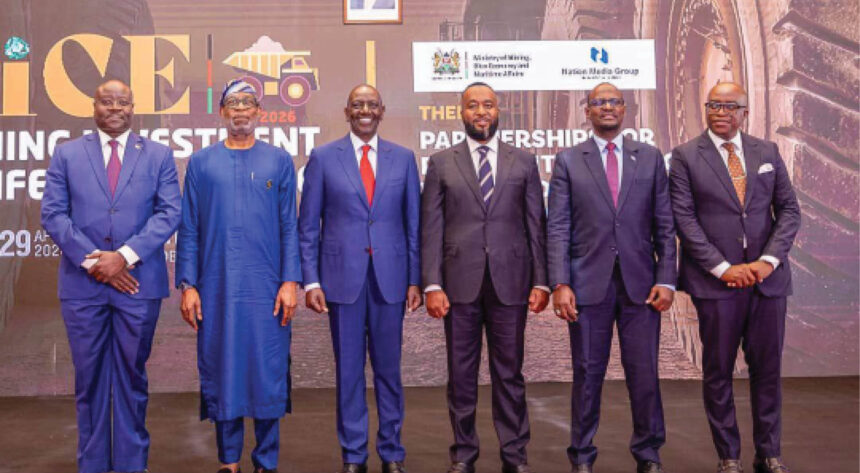
At the Kenya Mining Investment Conference and Exhibition 2026, the Honourable Minister of Solid Minerals Development, Dr. Dele Alake, urged African countries to halt the export of raw minerals and prioritise value addition through coordinated continental policies.
Alake, who also chairs the Africa Minerals Strategy Group, said that Africa’s long-standing reliance on exporting unprocessed resources has limited industrial growth and weakened the continent’s position in global mineral markets. He argued that rising global demand for minerals used in clean energy technologies and digital infrastructure presents an opportunity for Africa to reposition itself within global supply chains.
“For decades, Africa has remained largely an exporter of raw materials,” Alake said, noting that this model has constrained economic transformation and reduced the continent’s ability to capture higher value from its natural resources.
He warned that fragmented national policies continue to undermine Africa’s bargaining power with international buyers and investors. According to him, individual country strategies lack the scale required to influence pricing or negotiate favourable terms with multinational off-takers.
Alake called for harmonised mining regulations, coordinated policy frameworks, and the development of cross-border infrastructure to support processing and refining activities. He also emphasised the role of the African Continental Free Trade Area in enabling intra-African trade and supporting the emergence of regional value chains.
The push aligns with a broader shift in policy thinking across the continent, where minerals are increasingly viewed as a foundation for industrialisation rather than a standalone export sector. Key resources such as lithium, cobalt, manganese, graphite, and rare earth elements have become central to global energy transition and technology supply chains, increasing the strategic importance of Africa’s mineral reserves.
Membership of the Africa Minerals Strategy Group has expanded from 16 countries in 2023 to 31 countries, reflecting growing interest in coordinated approaches to resource management. However, analysts note that translating this alignment into practical outcomes will depend on sustained political commitment and institutional capacity.
Efforts to move into processing and refining face structural constraints, including limited infrastructure, energy supply challenges, and financing gaps. In many cases, African countries continue to export raw materials while importing finished or semi-processed products, resulting in significant value loss.
Alake’s remarks indicate a policy direction that favours regional cooperation over isolated national interventions. The approach seeks to strengthen economic sovereignty by retaining more value within the continent, while also positioning Africa as a more competitive player in global mineral supply chains.
The proposed transition carries implications for multiple stakeholders. Governments could benefit from higher revenues and industrial expansion, while local industries may see opportunities in processing and manufacturing. At the same time, countries and businesses reliant on raw mineral exports may face adjustment pressures, particularly if policy changes are implemented unevenly.
Observers also point to execution risks, including the challenge of aligning regulations across jurisdictions, financing large-scale infrastructure, and maintaining policy consistency. Without these elements, the shift from extraction to value addition may remain limited in scope.
Despite these constraints, the call for coordinated action reflects increasing recognition that Africa’s mineral wealth, if strategically managed, could play a central role in driving long-term economic transformation.