

By Jennete Ugo Anya
The Lagos Chamber of Commerce and Industry (LCCI) has raised fresh concerns over Nigeria’s fiscal management framework, warning that persistent weaknesses in budget execution and delays in the release of approved funds are undermining economic growth and stalling critical capital projects across the country.
The chamber said unless urgent reforms are introduced to improve the implementation of public spending plans, the nation’s ambitious economic targets may remain largely unattainable.
Speaking during the chamber’s quarterly media conference on the state of the economy held in Lagos, LCCI President, Engr. Leye Kupoluyi, called on the federal government to adopt a more efficient fiscal management strategy, including the introduction of a new template for capital budget releases.
According to him, delayed disbursement of capital allocations has become one of the most significant constraints to infrastructure delivery, private sector productivity and broader economic expansion.
Engr. Kupoluyi noted that despite the scale of approved capital spending in recent budgets, implementation has consistently fallen short due to bureaucratic bottlenecks, institutional inefficiencies and weak coordination across key arms of government.
“Historical weaknesses in Nigeria’s budget execution capacity, delays in fund releases, bureaucratic bottlenecks and inefficiencies remain critical challenges,” he said.
He pointed to the rollover of N7.71 trillion worth of unimplemented 2025 capital projects as a stark reflection of the systemic flaws in public expenditure management.
According to him, the huge volume of delayed projects underscores the urgent need for stronger fiscal discipline, deeper public-private sector collaboration and more effective coordination between the executive and legislative arms of government.
“The rollover of N7.71 trillion in unimplemented 2025 capital projects underscores the need for improved fiscal management, effective public-private partnerships and stronger collaboration between the executive and legislature to ensure timely project completion,” he stated.
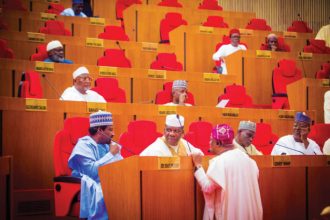
The LCCI president also revealed growing concern over reports from Ministries, Departments and Agencies (MDAs) during budget defence sessions at the National Assembly, where several agencies disclosed receiving only a small fraction of the funds approved for capital projects in the 2025 fiscal year.
He warned that such funding gaps create severe disruptions across project delivery chains, with direct implications for contractors, employment and investor confidence.
“We have followed budget defence sessions at the National Assembly and have noted concerning moments when Ministries, Departments and Agencies disclosed that they received only a tiny fraction of the funds approved for capital projects in the 2025 fiscal year,” Engr. Kupoluyi said.
According to him, the impact extends far beyond delayed infrastructure.
“When contractors are owed large sums of capital, their operations are stifled, and jobs within their domains are threatened. The government must create a new template for capital budget releases to ensure capital projects are adequately funded.”
The chamber also used the conference to highlight the strategic importance of Nigeria’s manufacturing sector, urging the government to address structural constraints limiting the sector’s growth despite its expanding contribution to public revenue.
Engr. Kupoluyi disclosed that the manufacturing sector contributed N1.17 trillion in value added tax (VAT) in 2025, representing a 45.61 percent increase from the N803.53 billion recorded in 2024.
He stated that company income tax (CIT) contributions from the sector rose to N881.29 billion, marking a 32.83 percent increase from N663.46 billion in the previous year.
The strong performance, he said, reflects the sector’s resilience and growing role in Nigeria’s industrial development and fiscal sustainability.
“The manufacturing sector’s contribution to tax revenue collections in Nigeria maintained an upward trend in 2025,” he noted.
He argued that the sector’s expanding tax contributions should compel policymakers to channel greater investments into productive infrastructure and introduce economic policies that lower production costs.
“Following these results, we call on the government to invest more in productive infrastructure and economic policies that drive growth through job creation, lower production costs and fiscal interventions,” he said.
A major concern raised by the chamber was the continued instability in electricity supply, which it described as one of the most serious threats to business competitiveness.
Engr. Kupoluyi lamented that unreliable power distribution, rising generator dependence and high energy costs continue to erode productivity across industries.
“Frequent outages, high generator costs and unreliable distribution networks are crippling productivity and raising the cost of doing business. Without urgent reforms in the power sector, Nigeria cannot achieve meaningful industrialisation,” he stated.
The chamber maintained that Nigeria’s economic ambitions will remain constrained unless fiscal execution improves and structural barriers to private sector growth are decisively addressed.
For many stakeholders, the warning reinforces a familiar concern: that ambitious budgets mean little without timely implementation and efficient delivery.