
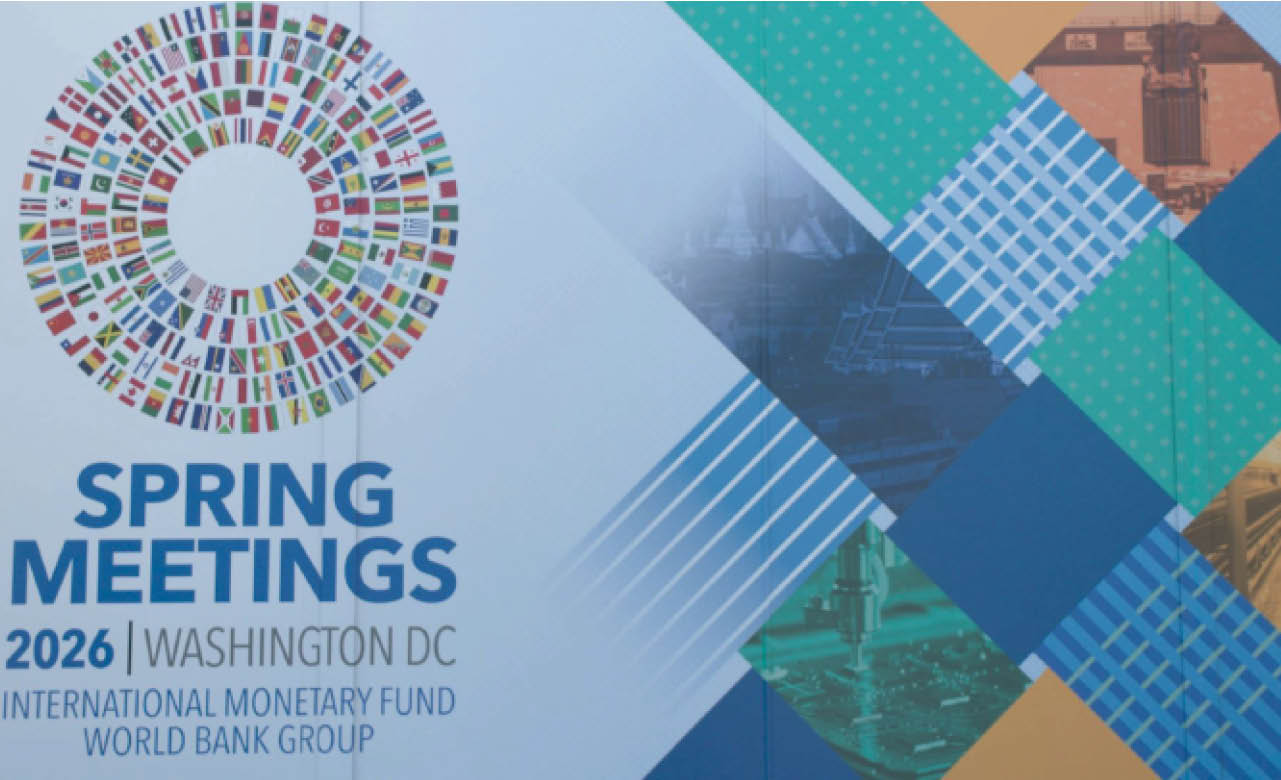
At a moment defined by intersecting crises rather than isolated disruptions, Nigeria’s engagement at the 2026 Spring Meetings of the International Monetary Fund and World Bank reflects a recalibration of both urgency and strategy. The country is not merely seeking financing, it is negotiating its position within a shifting global financial architecture where geopolitical volatility, debt asymmetries, and capital flight increasingly define outcomes for emerging economies. Enam Obiosio captures how the meetings, held in Washington, D.C., function less as routine multilateral dialogue and more as a contested arena over cost of capital, access to liquidity, and structural fairness.
Nigeria’s presence at the recent Spring Meetings is framed by a convergence of pressures, external shocks triggered by escalating Middle East tensions and internal adjustments following a cycle of aggressive macroeconomic reforms. The federal government’s position is explicit and calibrated, it seeks cheaper funding, fairer financial conditions, and accelerated global support as it navigates what it describes as a fragile transition phase.
At the centre of this engagement is Mr. Wale Edun, Honourable Minister of Finance and Coordinating Minister of the Economy, whose intervention reflects both advocacy and caution. His framing is direct: “We are navigating a convergence of reforms and external shocks. What Nigeria requires is not just access to funding, but access at a fair cost.” The emphasis here is structural, not transactional. Nigeria is not arguing for exceptional treatment, but for a recalibration of how risk is priced against developing economies.
Edun’s argument extends into the operational realities of the crisis. “Volatility in global energy markets is already transmitting into domestic inflation, while shifts in global capital are tightening financial conditions for emerging markets,” he notes. The implication is clear, external shocks are being internalised through inflation, liquidity constraints, and weakened investment flows. His conclusion sharpens the policy demand: “Lower cost of capital, fairer financial architecture, and timely support for economies in transition.”
This position is would be reinforced at the highest political level by President Bola Ahmed Tinubu who has framed the issue as one of systemic imbalance rather than cyclical difficulty. “African countries continue to pay an unjustifiable premium on borrowed funds, and this undermines development,” he asserts. The language is deliberate, it situates Nigeria’s challenge within a broader continental grievance.
Tinubu’s domestic policy choices provide the counterpoint to this external critique. “We have taken difficult but necessary decisions, subsidy removal, foreign exchange reforms, and fiscal adjustments,” he states. These reforms are positioned as prerequisites for stability, but they come with immediate social costs. “Without a supportive global environment, the burden on citizens becomes excessive.” The tension between reform and welfare is therefore not abstract, it is central to Nigeria’s negotiating logic.
The immediate catalyst for these positions is the economic fallout from the US –Israel – Iran conflict. Oil prices have surged sharply, with Nigeria’s Bonny Light crude rising above $110 per barrel. Ordinarily, this would imply fiscal relief. However, the domestic transmission has been inflationary. Petrol prices have climbed by more than 50 percent, diesel by over 70 percent, compressing household consumption and raising production costs across sectors.
This dynamic exposes a structural paradox. Higher oil prices increase government revenues but simultaneously elevate domestic costs, particularly in a deregulated pricing regime. The government identifies three key transmission channels, energy prices, capital flow reversals, and logistics inflation. Each channel reinforces the others, creating a compounded effect on inflation and growth.
The capital flow dimension is especially critical. As global risk rises, investors shift toward safe-haven assets, reducing exposure to emerging markets. For Nigeria, this creates a contradiction. Reform measures have improved macroeconomic fundamentals, yet external sentiment constrains capital inflows. The result is tighter financial conditions and elevated borrowing costs.
This is where Mr. Yemi Cardoso, Governor of Central Bank of Nigeria, becomes central. His focus is on preserving financial system credibility amid volatility. “Nigeria’s monetary and financial positioning is anchored on credibility and coordination,” he explains. The emphasis is on aligning monetary policy with fiscal reforms to stabilise expectations.
Cardoso’s position underscores the technical dimension of Nigeria’s strategy. “The reforms in the foreign exchange market and broader policy alignment are designed to restore investor confidence and improve capital flow dynamics.” In effect, while fiscal authorities negotiate externally, the central bank is tasked with maintaining internal coherence.
The broader global context reinforces Nigeria’s concerns. According to the United Nations Conference on Trade and Development (UNCTAD), a United Nations (UN) body responsible for trade, investment and development issues, external debt across developing economies has reached $11.7 trillion, with debt servicing costs nearing $920 billion. More critically, dozens of countries now allocate more resources to debt servicing than to health or education.
It is within this context that a significant institutional response has emerged. The launch of a Borrowers’ Platform, coordinated by UNCTAD and endorsed by António Guterres, Secretary-General of UN, signals a shift toward collective negotiation. Guterres describes it as “a platform in which borrowing countries sit together, learn from each other, and speak with a collective voice.”
This development aligns with Nigeria’s evolving strategy. Rather than isolated engagement, the country is positioning itself within a coalition of developing economies seeking systemic reform. The objective is not only to reduce borrowing costs but also to influence the architecture of global finance.
Parallel to its global positioning, Nigeria is advancing a regional strategy anchored on financial integration. The proposed African Monetary Institute, to be hosted in Abuja, represents a key element of this approach. Muhammad Sani Abdullahi, Deputy Governor (Economic Policy) at CBN, frames its significance in operational terms: “This is not a symbolic project, it is a practical instrument… Nigeria has moved beyond declarations to execution.”
At the administrative level, Raymond Omachi, Permanent Secretary at Nigeria’s Federal Ministry of Finance, reinforces this commitment. “The infrastructure is in place, the institutional commitment is clear, and the timeline is defined,” he states. The emphasis is on readiness, positioning Nigeria as both a participant and a driver of continental financial reform.
From the African Union’s perspective, Francisca Tatchouop Belobe, Commissioner for Economic Development, Trade, Tourism, Industry and Minerals at the African Union Commission, frames the initiative in broader terms. “A single African currency is not merely an ambition, it is a strategic necessity,” she argues. Monetary fragmentation, in her view, continues to constrain economic integration and policy coordination.
This position is reinforced by Professor Kevin Urama, Chief Economist and Vice President at the African Development Bank Group, who situates the Institute within a longer-term structural framework. “Without monetary coordination, issues such as inflation convergence, debt sustainability, and exchange rate stability will remain unresolved,” he notes. The implication is that regional integration is not optional, it is foundational to resilience.
Despite these strategic layers, the immediate challenge remains domestic. Inflationary pressures continue to erode purchasing power, raising concerns about the social impact of ongoing reforms. Edun acknowledges this tension directly, noting that the critical question is how reforms translate into tangible welfare improvements.
Nigeria’s position at the Spring Meetings is therefore both defensive and strategic. Defensive in its effort to mitigate the impact of external shocks, strategic in its attempt to reshape the terms of engagement within the global financial system. The emphasis on fairness, coordination, and systemic reform reflects a shift from passive participation to active negotiation.
The outcome of this engagement remains uncertain. It will depend on the responsiveness of multilateral institutions, the cohesion of developing country coalitions, and the trajectory of geopolitical tensions. What is evident, however, is that the traditional framework of global finance is under strain.
Nigeria’s intervention is part of a broader redefinition. As developing economies confront overlapping crises, debt, inflation, and capital volatility, the demand for a more equitable system is intensifying. The Spring Meetings, in this sense, are less about immediate resolutions and more about setting the terms of future engagement.
For Nigeria, the stakes are clear. The question is not whether support will come, but whether it will come on terms that reflect the realities of a changing global economy.