
By Ahmed Ahmed
The Bank of Industry (BOI) has called for stronger collaboration between government, financial institutions, development partners and businesses to accelerate Nigeria’s transition towards a greener and more competitive industrial economy, highlighting the need to make sustainable investments commercially viable.
The call was made at the second edition of the BOI Sustainability Conference held in Lagos on November 17, 2026, under the theme, ‘Green, Resilient, Profitable: Redefining Nigerian Businesses for a Sustainable World.’
Speaking at the conference, Dr. Olasupo Olusi, Managing Director/Chief Executive Officer of BOI, said rising energy costs, climate disruptions and changing global market expectations were making sustainability increasingly important to business survival and growth.
“Businesses must find ways to operate more efficiently, withstand economic and environmental shocks, and remain profitable. These objectives are interconnected, and the ability to achieve them will shape the future of Nigerian industry,” he said.
Dr. Olusi noted that manufacturers continued to face high energy costs, dependence on alternative power generation and inefficient production systems. He argued that investments in renewable energy, energy-efficient equipment and cleaner production technologies could reduce operating expenses while improving productivity.
He disclosed that BOI’s 2025 – 2027 strategy commits at least 10 percent of its financing interventions to climate and sustainability-focused projects, including renewable energy, climate-smart agriculture and energy-efficient manufacturing.
Representing the Federal Ministry of Industry, Trade and Investment, Dr. Christopher Isokpunwu, Permanent Secretary of the Ministry of Industry, Trade and Investment, described sustainability as a business imperative influencing access to capital, market opportunities and operational efficiency.
“Simply put, green business is increasingly smart business,” he said, stating that Nigeria’s ambition to build a $1 trillion economy must rest on productive, innovative and globally competitive industries. He also urged BOI to expand green financing and technical assistance without excluding small and medium-sized enterprises.
However, Nigeria Country Manager of Agence Française de Développement (AFD), Jackie Amprou, cautioned that strong environmental, social and governance (ESG) performance did not automatically translate into access to finance.
He identified project bankability, institutional capacity and perceived financial risks as persistent barriers to green investment.
“We must move beyond simply rewarding green performance. We must actively finance green transformation,” Amprou said.
He explained that AFD’s partnership with BOI under the Transforming Financial Systems for Climate programme combines a €100 million credit facility, co-financed with the Green Climate Fund, and a €2.5 million technical assistance grant to strengthen climate financing and risk management.
Beyond financing commitments, BOI said its accreditation by the Adaptation Fund enables it to access up to $25 million for climate adaptation projects. Its interventions also include a solar energy programme and financing for what it described as Nigeria’s first 11MW solar power plant for a steel manufacturer.
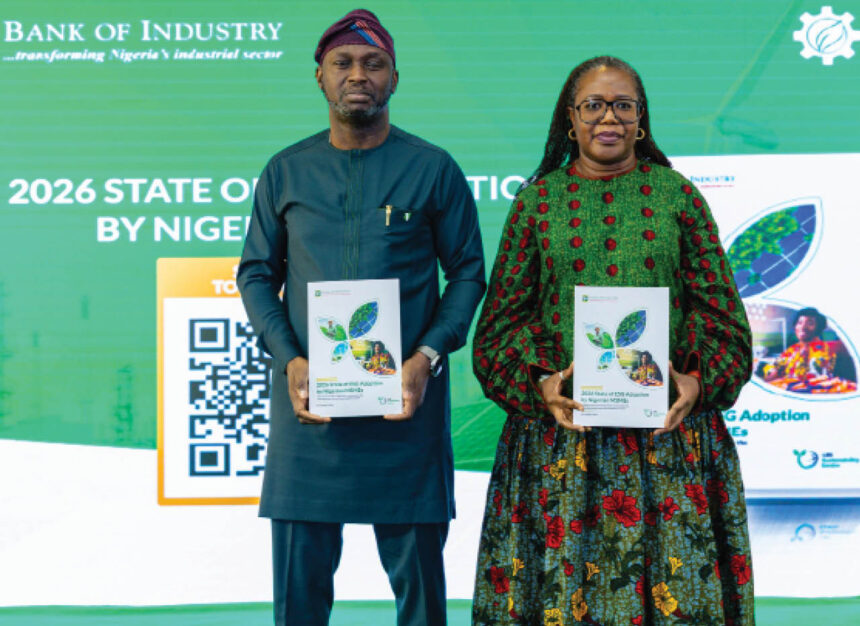
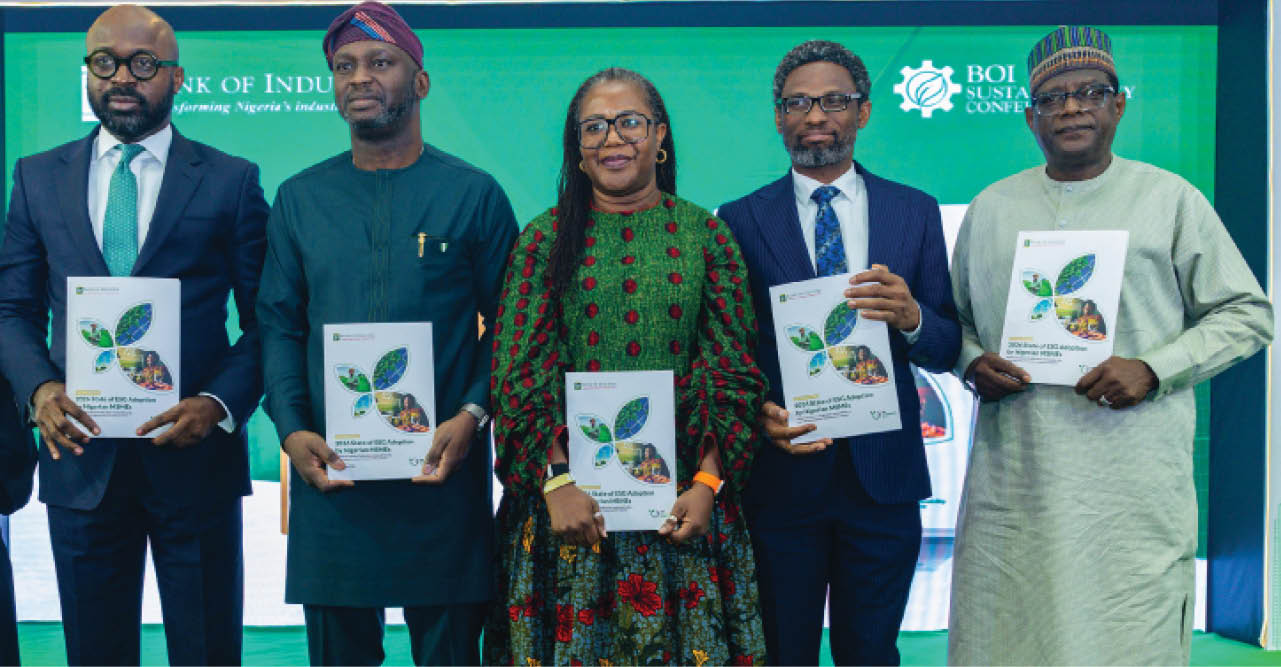
The conference also featured the launch of the second State of ESG Adoption Report, produced with the Lagos State Business School.
While these initiatives demonstrate growing institutional commitment, the conference highlighted a broader challenge: translating sustainability ambitions into bankable projects that businesses, particularly smaller manufacturers, can afford to adopt.
Ultimately, Nigeria’s green industrial transition will depend not only on financing commitments but also on whether investments deliver measurable reductions in production costs, stronger industrial capacity and sustainable profitability.