By Musa Ibrahim
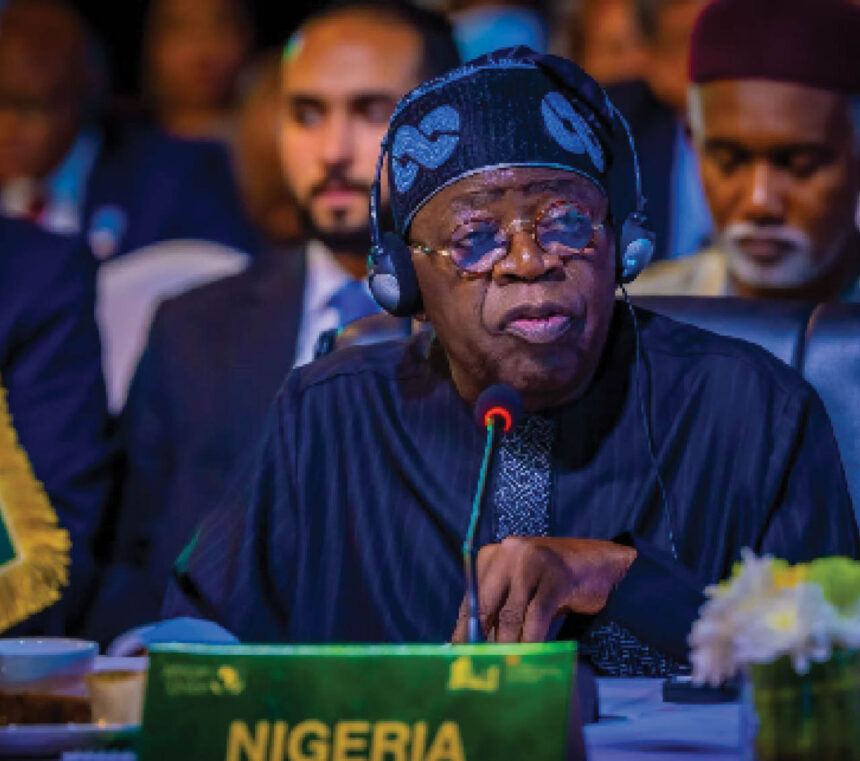
President Bola Ahmed Tinubu has thrown his weight behind Central Bank of Nigeria (CBN), led by Mr. Olayemi Cardoso, commending his leadership of ongoing banking sector reforms and describing recent policy actions as critical to rebuilding confidence in Nigeria’s financial system.
The President’s endorsement comes as the country’s banking recapitalisation programme enters a decisive phase following the March 31, 2026 deadline set by the apex bank for compliance with new minimum capital requirements.
Speaking on the broader economic reform agenda of his administration, President Tinubu commended Mr. Cardoso for steering what he described as difficult but necessary reforms aimed at restoring long-term stability to the Nigerian economy.
He singled out the CBN governor for recognition, citing the bank’s monetary policy recalibration, foreign exchange reforms and tighter regulatory oversight as central to strengthening macroeconomic fundamentals.
“I must single out one man here, Olayemi Cardoso. Thank you very much for all that you are doing for the country,” the President said while highlighting progress under the government’s economic stabilisation programme.
In what many observers interpreted as a strong vote of confidence in Mr. Cardoso’s stewardship, President Tinubu said he trusts the CBN governor’s judgement and capacity to navigate the complex financial reforms required to reposition the economy.
The endorsement comes at a critical moment for Nigeria’s banking sector as lenders race to align with one of the most far-reaching recapitalisation exercises since the consolidation reforms of 2004.
The latest recapitalisation framework raised minimum capital thresholds to N500 billion for banks with international authorisation and N200 billion for nationally licensed institutions.
The policy is designed to strengthen bank resilience, deepen lending capacity and position the sector to support larger-scale economic growth.
While many banks have made significant progress toward compliance through fresh capital raises, mergers and strategic restructuring, a handful of institutions remain under close regulatory supervision as they work to complete the process.
Among them are Union Bank of Nigeria, Polaris Bank and Keystone Bank, all of which are navigating unique legal and regulatory complications.
The Central Bank has, however, repeatedly assured depositors and market participants that the affected institutions remain stable, operational and fully capable of meeting their obligations.
Union Bank’s recapitalisation efforts have drawn particular attention following regulatory intervention triggered by concerns uncovered during a CBN audit.
The audit reportedly identified material issues within the bank’s financial records, leading to the removal of its board and senior management in January 2024.
That action has since become the subject of legal contestation, with the apex bank pursuing an appeal against a judgement that questioned the legality of the removals.
Despite the ongoing litigation, regulators insist the institution remains under effective oversight and on course to meet recapitalisation requirements.
The proposed merger between Providus Bank and Unity Bank has also encountered legal obstacles, though industry sources indicate that the issues are nearing resolution.
Market analysts view the merger as a potentially significant restructuring move that could strengthen the competitive position of both institutions.
For Polaris Bank and Keystone Bank, recapitalisation remains ongoing under direct regulatory monitoring.
Both institutions have histories shaped by past CBN interventions and are now expected to complete their capital restructuring once pending matters are resolved.
The recapitalisation programme forms part of a broader reform strategy being pursued by Cardoso’s leadership at the apex bank.
Since assuming office, the CBN governor has introduced a series of measures aimed at tightening monetary discipline, improving transparency in foreign exchange markets and restoring investor confidence.
These reforms, while initially disruptive, have been positioned as necessary corrections to long-standing structural distortions in Nigeria’s financial architecture.
Tinubu’s public endorsement suggests strong alignment between the Presidency and the apex bank on the direction of economic policy.
That alignment is particularly significant as Nigeria seeks to attract fresh investment, stabilise its currency and strengthen institutional confidence in the wake of major fiscal and monetary adjustments.
Analysts say the success of the recapitalisation drive will be measured not only by banks meeting numerical capital thresholds but by the extent to which the exercise creates a stronger, more resilient financial system capable of supporting productive sectors of the economy.