
By Jennete Ugo Anya
President Bola Tinubu has disclosed that the federal government released only about 17 percent of the 2025 capital budget by the end of the third quarter, amounting to approximately N3.1 trillion, as fiscal authorities focused on completing priority projects carried over from the 2024 budget cycle.
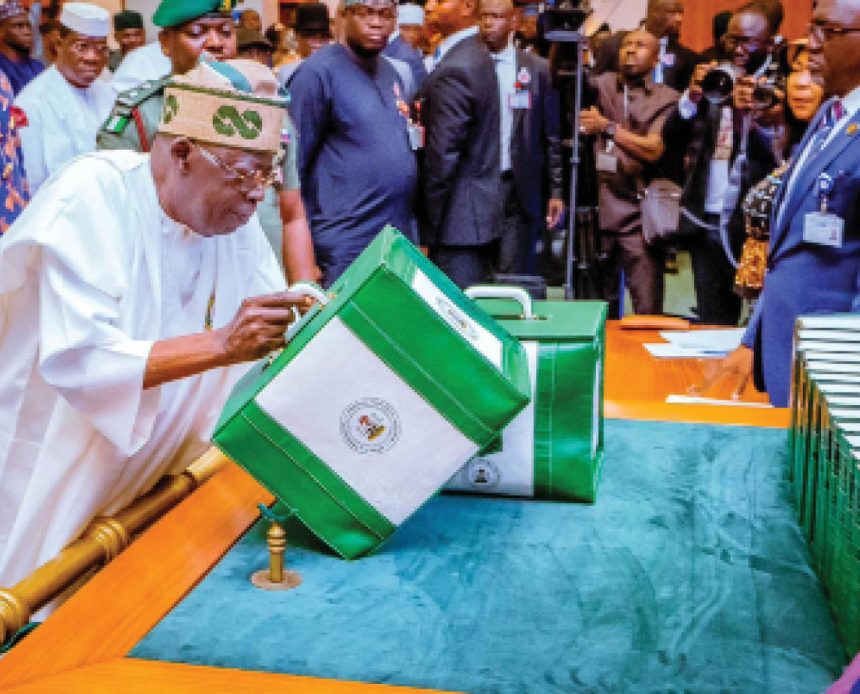
The disclosure was made recently during the presentation of the 2026 Appropriation Bill to a joint session of the National Assembly, where the president outlined the fiscal realities that shaped budget implementation in the outgoing year. According to him, the pace of capital releases in 2025 was influenced largely by the decision to extend the execution of the 2024 budget into the current fiscal year, in order to ensure continuity and value for money on critical projects.
President Tinubu explained that as of June 2025, the government had released N2.23 trillion specifically for capital projects captured under the 2024 budget, whose implementation timeline was extended to December 2025. This overlap, he said, created competing execution demands that affected the rollout of new capital allocations under the 2025 framework.
He noted that the transition between fiscal cycles posed coordination challenges, particularly in aligning cash releases with project readiness and contractor mobilisation, a situation the government sought to manage by prioritising completion of ongoing infrastructure and social investment projects rather than spreading limited resources thinly across new commitments.
Beyond capital spending, the president provided lawmakers with an overview of aggregate fiscal performance for the year. He said total government revenue for 2025 stood at N18.6 trillion, representing about 61 percent of the full year target, while total expenditure reached N24.66 trillion, or roughly 60 percent of projected spending.
These figures, President Tinubu said, reflected the difficult balance between sustaining economic recovery, servicing legacy obligations, and managing revenue constraints in a period of adjustment. He stressed, however, that lessons from the 2025 fiscal year were already informing a more disciplined approach to the 2026 budget.
“Let me be clear, 2026 will be a year of stronger discipline in budget execution,” the president told lawmakers, signalling a shift toward tighter coordination, improved monitoring, and stricter adherence to approved timelines.
To that end, President Tinubu said he had issued direct instructions to key fiscal authorities, including the minister of finance and coordinating minister of the economy, the minister of budget and economic planning, the accountant-general of the federation, and the director-general of the budget office. Their mandate, he said, is to ensure that the 2026 budget is implemented strictly in line with legislative approvals, cash plans, and execution schedules.
Looking ahead, the president expressed confidence that revenue performance would improve, driven by the rollout of the new National Tax Acts and ongoing reforms in the oil and gas sector. He said these reforms are designed to enhance transparency, strengthen efficiency, and support long-term fiscal sustainability, particularly by reducing leakages and improving compliance.
President Tinubu also issued a firm warning to government-owned enterprises, directing them to meet their assigned revenue targets. He announced plans to accelerate the digitisation of revenue mobilisation systems across federal agencies, a move aimed at tightening controls and improving accountability.
According to him, the digitisation drive will involve standardised electronic collections, automated reconciliation processes, and real-time monitoring of revenue performance. Revenue targets, he added, will now form part of performance evaluations for agencies and their leadership.
“Nigeria can no longer afford inefficiencies or revenue leakages,” the president said, emphasising that fiscal stability requires coordinated effort across all institutions of government.
The budget presentation came amid ongoing legislative deliberations on fiscal adjustments. Earlier in the week, the Senate commenced consideration of a bill seeking to repeal and re-enact the 2024 and 2025 Appropriations Act, proposing a revised budget size of N43.56 trillion.
President Tinubu has formally transmitted the Appropriation, Repeal and Re-enactment Bill 2024 to the National Assembly, setting the stage for legislative review and alignment with the government’s broader fiscal strategy.
Taken together, the disclosures underscore the administration’s emphasis on fiscal consolidation, project completion, and institutional discipline, as Nigeria prepares to enter the 2026 budget year with renewed focus on execution efficiency and sustainable public finance management.