For years, Nigeria’s electricity market revolved around a single structural bottleneck, liquidity. Power was generated, transmitted and distributed, but payments stalled in the middle of the chain. That middle was the Nigerian Bulk Electricity Trading Plc (NBET) the market’s clearing house and the institution that accumulated unpaid invoices across the value chain.
Now the same institution sits at the centre of the sector’s largest financial restructuring. Enam Obiosio Writes…
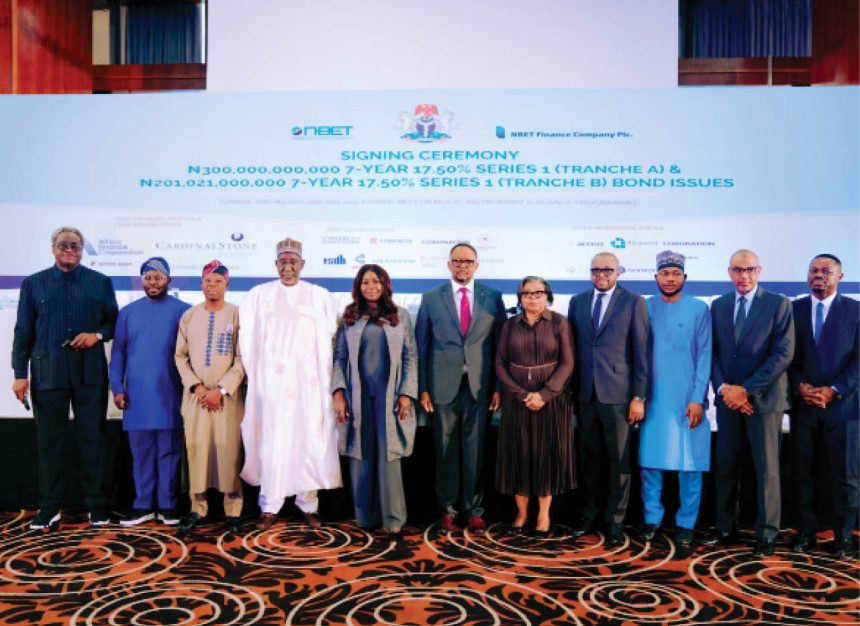
The federal government confirmed it will pay power generation companies (Gencos) N501.02 billion after a successful capital market issuance designed to begin unwinding more than N6 trillion in legacy debt in the electricity industry. The funding was raised through two seven-year instruments, a N300 billion Series 1 Tranche A bond and a N201.02 billion Series 1 Tranche B bond, both priced at 17.50 percent.
The securities were issued by NBET Finance Company Plc, a special purpose vehicle created by NBET specifically for the transaction and backed by a full sovereign guarantee under the Presidential Power Sector Debt Reduction Programme (PPSDRP).
At the signing ceremony in Lagos, the President’s Special Adviser on Energy, Mrs. Olu Verheijen, described the structure as a market reset rather than a conventional bailout, explaining that the programme addresses accumulated arrears while imposing financial discipline on the market.
She said the framework covers verified receivables for electricity supplied between February 2015 and March 2025, negotiated directly with generators.

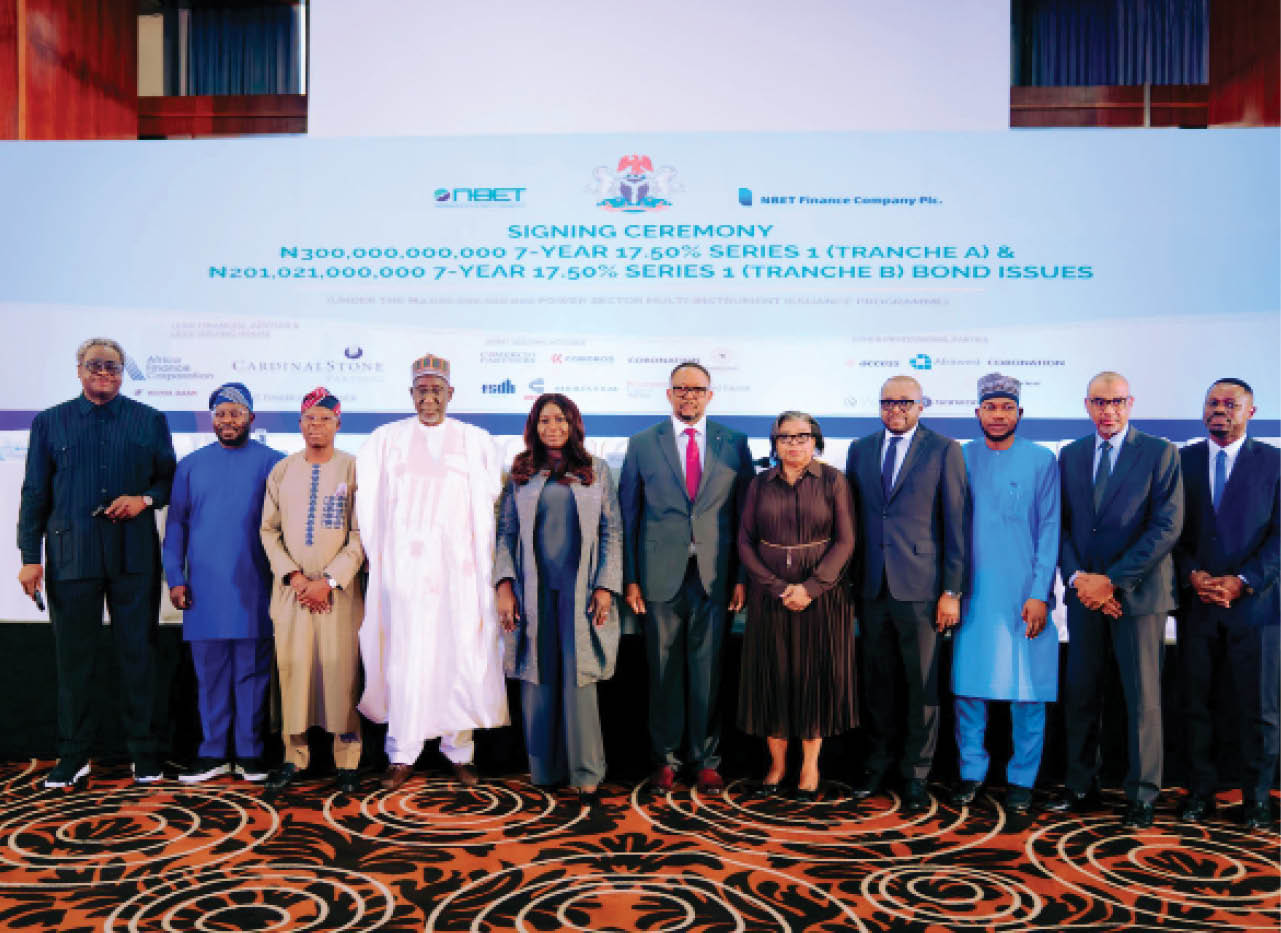
“Today’s signing marks the outcome of that process. Fourteen generation companies have executed Full and Final Settlement Agreements, with a total negotiated value of approximately N827 billion. These agreements reflect discipline, compromise, and a shared commitment to closing the chapter on legacy arrears.”
She added that the objective goes beyond settlement into restoring commercial functionality across the sector.
“The significance of this milestone lies not only in clearing the past, but in what it unlocks going forward. Resolving these liabilities restores liquidity across the value chain, strengthens payment certainty for gas suppliers, and creates the financial headroom required for operators to stabilise assets, improve availability, and plan new investment.”
Under the structure, proceeds from the Series 1 issuance will finance the first and second instalments to participating generation companies estimated at about N421.42 billion, roughly half of the negotiated settlement value, delivered through a combination of cash and notes.
The transaction forms the first phase of a broader N4 trillion power sector financing programme coordinated through NBET in collaboration with the Debt Management Office (DMO) and backed by the Federal Government.
From Market Debtor to Market Stabiliser
NBET was originally designed as a creditworthy intermediary, purchasing electricity from generation companies (Gencos) and selling to distribution companies (Discos). Persistent remittance shortfalls from DisCos, however, turned the organisation into the sector’s largest accumulation point of unpaid obligations, weakening the entire value chain from gas suppliers to lenders.
The Acting Managing Director (MD) of NBET, Mr. Johnson Akinnawo, framed the bond issuance as a structural turning point rather than a financial event.
“The successful close of the N501 billion bond represents a major step forward in resolving the long-standing challenge that has constrained the power sector for years. This intervention will significantly improve liquidity across the value chain, enable operators to stabilize their operations and support renewed investment in the Nigerian power sector.”
The bonds consist of a N300 billion cash tranche and a N201.02 billion non cash tranche, both seven-year instruments fully guaranteed by the Federal Government.
For NBET, the change is institutional, shifting from carrying arrears to managing structured obligations priced by the capital market.
What Is Being Settled
The payments address electricity supplied between February 2015 and March 2025 under negotiated settlement agreements with fourteen generation companies valued at about N827 billion.
NBET confirmed proceeds from the first issuance will fund roughly half of the settlement through a mix of cash and notes.
Sovereign Backing and Fiscal Strategy
The DMO coordinated the sovereign guarantee that converts NBET’s obligations into tradable securities within the financial system.
Representing the Minister of Finance and Coordinating Minister of the Economy, Mr. Wale Edun, Director-General (DG) of DMO, Ms. Patience Oniha, said that the conversion was necessary for sector recovery.
“Resolving the debt issue was not optional but a critical step to grow the sector. By settling legacy debts in a structured manner, we are enabling Gencos to stabilise operations, improve maintenance, and attract new investment.”
From a fiscal standpoint, unpredictable contingent liabilities are replaced with scheduled coupon payments, making the exposure measurable to investors.
Reaction From Generators
The companies signing the agreements include Geregu Power Plc, Niger Delta Power Holding Company, Ibom Power Company and First Independent Power Limited.
For operators, the immediate effect is investment certainty.
Mr. Kola Adesina, Group Managing Director (GMD) of Sahara Power Group, said that unpaid receivables had prevented expansion plans.
“Capital formation can only come when there is confidence, when you can truly see a line of sight in recovering investments previously made. Because we were being owed so much, it was a bit of a problem for us to put in more money.”
He added that expansion will now resume.
“Once this process is over, construction will commence immediately on the second phase of our Egbin Power Plant.”
Market Signal and Implications
The bonds were fully subscribed by institutional investors including banks, pension funds and asset managers.
The Ministry of Finance described the programme as a signal of policy credibility, stating that the government is committed to honouring obligations and deploying financial solutions to resolve systemic challenges.
The restructuring converts Nigeria’s electricity crisis from a payment backlog to a financing framework. If sustained, NBET transitions from a liquidity sink into a stabilisation platform enabling predictable generator revenue, gas supply stability and bankable project finance cash flows.
Sustainability, however, depends on preventing new arrears, meaning distribution efficiency and tariff discipline remain unresolved variables.
For now, the sector’s central institution has changed posture. NBET is no longer only where debts accumulated, it is now the mechanism through which they are being systematically cleared and potentially the foundation for the next phase of electricity market reform.