By Anita Dennis
One of the most contentious chapters in Nigeria’s oil sector has finally been closed. After more than a decade of legal battles and regulatory uncertainty, the federal government has reached a settlement with Italian energy major ENI and its subsidiary, Nigerian Agip Exploration Limited, over the disputed Oil Prospecting Licence 245.
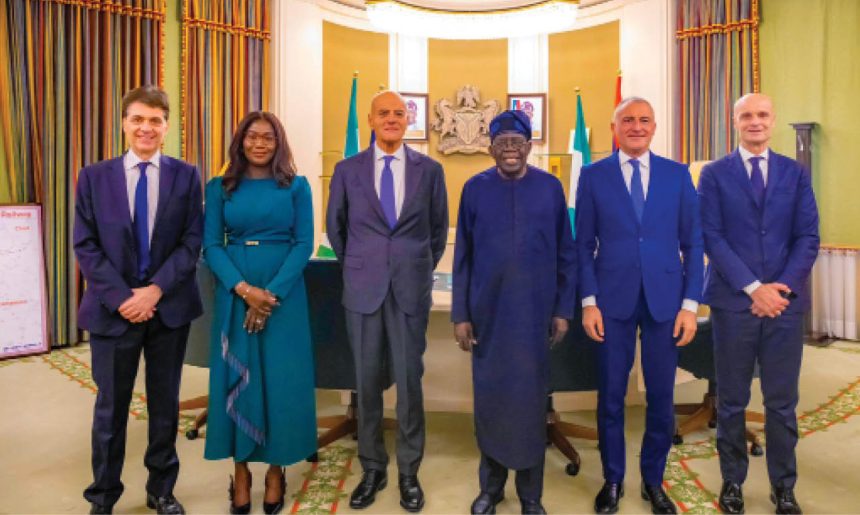
President Bola Tinubu presided over the signing of the agreement at the State House in Abuja, bringing an end to a dispute that has lingered for over 15 years and cast a shadow over the development of one of Nigeria’s most commercially promising deepwater oil assets.
The meeting, held behind closed doors, brought together senior government officials and top executives of ENI. Among those present were the company’s Chief Executive Officer, Claudio Descalzi, Chief Operating Officer Guido Brusco, Head of the Sub-Saharan Region Mario Bello, and Managing Director of Nigerian Agip Exploration Limited, Fabrizio Bolondi. The President’s Special Adviser on Energy, Olu Verheijen, also participated in the discussions.
According to Mr. Bayo Onanuga, the Presidential Spokesman, in a statement noted that the resolution effectively clears the way for the development of the Zabazaba–Etan deepwater project located within the OPL 245 block. Once operational, the project is expected to add roughly 150,000 barrels per day to Nigeria’s oil production capacity.
For policymakers, the settlement represents more than the resolution of a legal dispute. It removes a major obstacle that had delayed investment in the block and signals a renewed attempt by the government to rebuild investor confidence in Nigeria’s upstream petroleum sector.
President Tinubu described the agreement as a strategic milestone within the administration’s broader economic reform programme. According to him, resolving long standing disputes in the energy industry is necessary if Nigeria hopes to attract the scale of investment required to expand production and strengthen government revenue.
He said the resolution sends a clear message to international investors that Nigeria is committed to addressing legacy issues, strengthening regulatory certainty, and maintaining a stable environment for long term capital.
The President also acknowledged the role played by several institutions in facilitating the agreement. These include the Office of the Attorney General of the Federation, the Ministry of Petroleum Resources, the Nigerian Upstream Petroleum Regulatory Commission, the Nigerian National Petroleum Company Limited, and the leadership of ENI.
Energy analysts note that OPL 245 has long been regarded as one of the most valuable deepwater assets in Nigeria’s offshore basin. However, prolonged litigation and competing claims over ownership delayed exploration and investment for years.
With the dispute now settled, industry attention is shifting toward the anticipated Final Investment Decision for the Zabazaba–Etan development. The project could become a significant addition to Nigeria’s deepwater production portfolio at a time when the country is seeking to stabilise output and strengthen its position in global oil markets.
The President’s Special Adviser on Energy, Olu Verheijen, said the terms of the new settlement represent a significant improvement over the earlier resolution agreement reached in 2011. She explained that the revised framework aligns with the fiscal and governance provisions established under the Petroleum Industry Act.
According to her, the agreement balances investor interests with the need to secure stronger value for the federation. It also introduces greater clarity and predictability for companies operating within Nigeria’s upstream sector.
Verheijen stated that resolving the OPL 245 issue removes one of the most visible legacy risks affecting Nigeria’s oil industry. Addressing such disputes, she said, forms part of the government’s broader effort to strengthen regulatory transparency and make the country more competitive in attracting global energy investment.
The settlement comes at a time when Nigeria is pursuing a wider set of reforms designed to revitalise the oil and gas sector. Since 2023, the administration has introduced policy adjustments aimed at improving fiscal terms, accelerating project approvals, and restoring investor confidence in the industry.