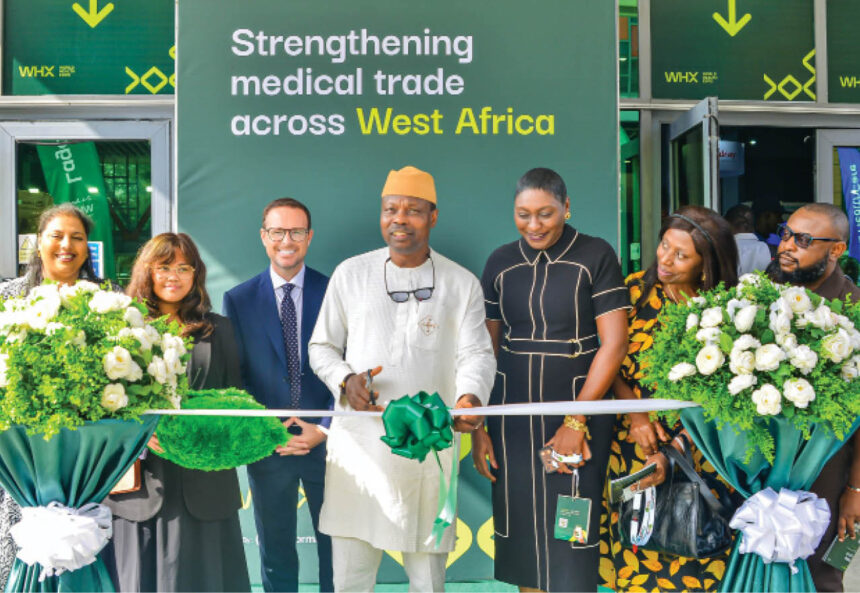
The federal government, led by President Bola Ahmed Tinubu, is increasingly positioning healthcare not only as a public service sector but also as a strategic pillar of Nigeria’s economic transformation agenda. At the opening of the World Health Expo (WHX Lagos 2026) in Lagos, the Minister of State for Health and Social Welfare, Dr. Iziaq Adekunle Salako, outlined a policy direction aimed at expanding healthcare manufacturing, diagnostics, medical technology deployment and infrastructure development as drivers of investment, job creation and industrial growth. Enam Obiosio highlights the development at the event and the government’s ongoing reforms seeking to reduce import dependence, strengthen local healthcare value chains and position Nigeria as a leading healthcare investment destination in Africa.
For decades, discussions about healthcare often focused on access to treatment, shortages of equipment, inadequate infrastructure and the challenges faced by patients seeking quality care. Currently, a broader conversation is beginning to emerge. Rather than treating healthcare solely as a social service, policymakers are increasingly presenting it as a potential driver of industrial development, investment attraction, technological advancement and economic growth.
That shift was evident at the World Health Expo (WHX Lagos 2026), where government officials, healthcare professionals, investors, manufacturers and policymakers gathered to discuss the future of healthcare in Nigeria and across Africa.
Addressing an audience of more than 8,000 healthcare professionals, over 500 exhibitors from more than 40 countries and a wide range of local and international stakeholders, the Minister of State for Health and Social Welfare, Dr. Iziaq Adekunle Salako, outlined what appears to be a significant evolution in the Federal Government’s healthcare strategy.
At the centre of that strategy is the idea that healthcare can become more than a sector that consumes public resources. It can also become a sector that produces economic value. The government’s vision involves expanding domestic pharmaceutical manufacturing, strengthening healthcare technology deployment, increasing diagnostic capacity, encouraging medical innovation and building infrastructure capable of supporting both healthcare delivery and economic activity.

According to Salako, one of the challenges confronting the region is its heavy dependence on imports.
“Across West Africa, between 85 and 99 percent of medical equipment and in vitro diagnostics are imported. Nigeria must move from being primarily a consumer market to becoming a strategic hub for healthcare manufacturing, diagnostics, innovation, and medical technology deployment,” he said.
The statement reflects a concern that has become increasingly prominent in recent years.
The COVID-19 pandemic exposed vulnerabilities within global healthcare supply chains. Countries that depended heavily on imported medicines, equipment and diagnostic tools often faced shortages and disruptions when international supply routes came under pressure.
For Nigeria, those experiences highlighted the risks associated with relying extensively on imported healthcare products. The issue extends beyond emergency situations.
Foreign exchange fluctuations, rising import costs and global supply constraints can all affect the availability and affordability of healthcare products. As a result, policymakers have increasingly focused on developing local production capabilities as a way of strengthening resilience.
The strategy being pursued by the Federal Government seeks to address these concerns through a combination of industrial policy, infrastructure development and private-sector participation. Several initiatives form the foundation of the effort.
These include the Presidential Initiative to Unlock Healthcare Value Chains, the Presidential Executive Order for the Pharmaceutical and Allied Sectors, the Sector-Wide Approach (SWAp) to health sector reform and infrastructure partnerships involving the Nigeria Sovereign Investment Authority.
Together, these programmes are intended to support the development of local healthcare value chains while expanding healthcare infrastructure and attracting investment into the sector. The scale of the ambition is substantial.
Government plans include the establishment of 22 diagnostic centres, six oncology and nuclear medicine centres and seven cardiac catheterisation laboratories distributed across Nigeria’s six geopolitical zones.
In addition, N402 billion has been allocated to healthcare infrastructure, while the Sector-Wide Approach reform initiative is backed by approximately $1.2 billion in support.
These projects target areas that have traditionally required Nigerians to seek services abroad or travel long distances within the country.
Diagnostic services, cancer treatment and specialised cardiac care remain among the most resource-intensive aspects of healthcare delivery. Expanding domestic capacity in these fields could influence both healthcare access and healthcare-related economic activity. The focus on diagnostics is particularly noteworthy.
Modern healthcare systems increasingly rely on accurate and timely diagnosis as the foundation for effective treatment. Investments in diagnostic infrastructure can therefore affect outcomes across multiple medical disciplines while also creating demand for technology, equipment, maintenance services and specialised expertise. Similarly, pharmaceutical manufacturing has emerged as a strategic priority.
Nigeria remains one of Africa’s largest pharmaceutical markets, yet much of the industry’s inputs and finished products continue to originate from outside the country. Expanding local production has long been viewed as a pathway toward reducing import dependence while strengthening industrial capacity.
The government’s current policy framework appears to place renewed emphasis on this objective.
The broader significance of the strategy lies in how healthcare is being linked to economic development.
Traditionally, healthcare expenditure has often been regarded as a cost necessary to maintain public welfare. Increasingly, however, countries are recognising healthcare as a sector capable of generating investment, employment, innovation and industrial growth.
Hospitals require equipment, pharmaceuticals, logistics networks, information technology systems, engineering services and specialised personnel. The expansion of healthcare infrastructure can therefore create economic activity across multiple industries simultaneously.
In this context, healthcare becomes connected not only to patient outcomes but also to manufacturing, technology development and workforce growth.
Salako underscored this investment dimension when addressing participants at the expo.
“Nigeria is open for healthcare investment. Our hospitals require modern technologies, diagnostic systems, therapeutic equipment, digital infrastructure, and scalable innovations capable of improving care delivery for millions of Nigerians,” he said.
The invitation reflects an increasing reliance on public-private collaboration as a mechanism for sector expansion.
Governments around the world frequently partner with private investors, manufacturers, technology providers and healthcare operators to expand healthcare systems. Such partnerships can provide access to capital, technical expertise and operational capabilities that may be difficult to develop solely through public resources.
For Nigeria, attracting such investment could become an important factor in determining whether healthcare infrastructure ambitions are translated into operational facilities. Yet significant challenges remain.
Building healthcare infrastructure is only one part of the equation. Advanced facilities require highly trained specialists, technicians, biomedical engineers, pharmacists, laboratory scientists and support personnel capable of operating sophisticated technologies.
Workforce development therefore remains a critical component of any healthcare transformation strategy.
Financing also presents an ongoing consideration. While substantial commitments have been announced, the successful implementation of healthcare projects often depends on sustained funding, efficient procurement processes and long-term operational planning.
Questions surrounding affordability will also influence outcomes. Expanding access to advanced healthcare services requires not only physical infrastructure but also financing mechanisms that enable patients to utilise those services.
Furthermore, local manufacturing ambitions may still depend on imported components, raw materials and technologies in the near term. Developing fully integrated domestic value chains typically requires years of investment, skills development and industrial coordination. Despite these challenges, the direction of policy is becoming increasingly clear.
Healthcare is being positioned as part of a broader economic transformation agenda.
Rather than viewing the sector solely through the traditional lens of public health expenditure, policymakers are increasingly treating healthcare as a platform for industrialisation, technology adoption, investment attraction and job creation.
This shift mirrors developments in several emerging economies where healthcare has evolved into a significant contributor to economic output while continuing to serve its primary role of improving health outcomes.
For Nigeria, the approach represents an attempt to address multiple objectives simultaneously: improving healthcare access, reducing import dependence, attracting investment, expanding domestic manufacturing and strengthening economic resilience.
Whether these ambitions are fully realised will depend largely on implementation, financing and institutional coordination.
What is clear, however, is that healthcare is increasingly being discussed not only as a social necessity but also as a productive economic sector.
As hospitals, laboratories, pharmaceutical facilities and healthcare technology platforms become more closely linked to industrial policy and investment strategies, the sector’s role within the national economy may expand considerably.
The transformation being proposed is therefore about more than healthcare delivery alone. It is about redefining healthcare as a source of economic opportunity, industrial capability and long-term national development, while continuing to meet the fundamental objective of improving the health and wellbeing of millions of Nigerians.