
By Musa Ibrahim
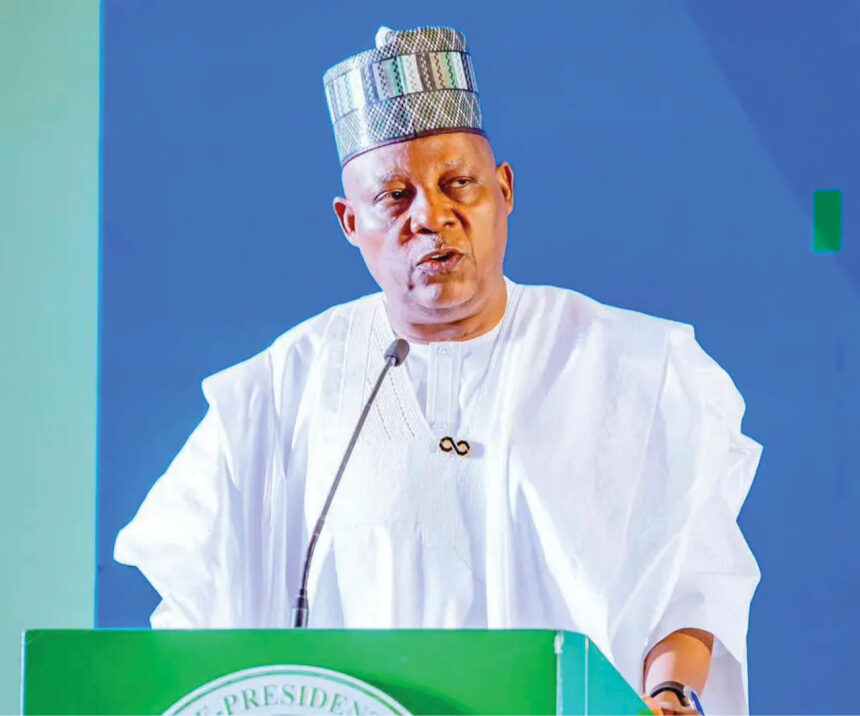
Vice President Kashim Shettima has reaffirmed the federal government’s commitment to creating a more business-friendly environment, declaring that no administration can truly understand or grow the economy if it ignores the concerns of employers.
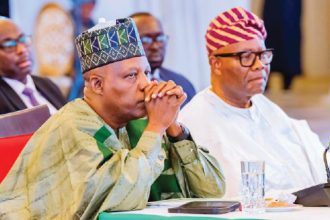
Addressing the 5th Nigerian Employers’ Summit in Abuja, Vice President Shettima said sustained engagement between government and the organised private sector remains indispensable to achieving economic growth, job creation and long-term national prosperity.
Represented by the President’s Special Adviser on General Duties, Dr. Aliyu Modibbo Umar, the Vice President acknowledged that businesses are operating in a challenging environment but insisted that ongoing reforms are intended to rebuild the economy on a more sustainable foundation.
“No government that ignores employers can fully understand the economy,” he said, stressing that government policies must continue to reflect the realities confronting businesses across the country.
His remarks come as the President Tinubu administration presses ahead with sweeping economic reforms, including the removal of fuel subsidy, foreign exchange liberalisation and tax restructuring, policies that have attracted both praise and criticism over their short-term impact on businesses and households.
According to the Vice President, the summit comes at a critical period in Nigeria’s economic journey because it provides a platform for frank conversations on the challenges facing enterprises.
“It is honest because reform demands difficult conversations about production costs, access to credit, exchange rates, taxation and investment.
“It is necessary because the private sector cannot compete on sentiment. It competes on functional infrastructure, predictable policies, fair taxation and reliable energy,” he said.
The Vice President argued that while reforms often come with immediate costs, history has shown that lasting prosperity is built on the courage to confront structural weaknesses rather than postpone difficult decisions.
Commending President Bola Tinubu’s economic direction, Vice President Shettima said countries that have achieved sustained economic success did so by combining strategic vision with the political will to implement difficult but necessary reforms.
“Foresight without courage produces fine speeches and empty outcomes. Courage without foresight produces motion without progress. What a nation requires is the marriage of both: the vision to see what must change and the resolve to change it, even when the path is steep. That is the burden of responsible leadership,” he stated.
He recalled that when President Tinubu assumed office, Nigeria faced deep structural economic challenges, including an unsustainable fuel subsidy regime, a fragmented foreign exchange market, weak government revenues and declining investor confidence.
According to him, delaying difficult decisions would only have prolonged the country’s economic vulnerabilities.
“The easy option at that time was to postpone difficult decisions. But leadership is tested when the right decision is also the difficult one,” he said.
Vice President Shettima explained that the Renewed Hope Agenda was designed to correct long-standing distortions that had constrained investment, productivity and employment.
“We cannot build prosperity on distortions, attract investment when foreign exchange remains uncertain, or create jobs when enterprises are suffocated by multiple taxation, poor logistics and insecurity,” he said.
Defending the removal of fuel subsidy and reforms in the foreign exchange market, the Vice President argued that both policies are central to creating a more transparent and efficient economy.
“The subsidy crowded out investment while encouraging inefficiency and rent-seeking. The foreign exchange reforms are delivering a more transparent and market-reflective system,” he noted.
On taxation, the Vice President acknowledged longstanding complaints from businesses and said the government’s objective is not to increase the burden on compliant companies but to simplify the tax system and broaden the revenue base.
“Businesses do not reject taxation. They reject multiple taxation, harassment and systems that punish compliance while rewarding informality,” he said.
Recognising that policy reforms achieve little without efficient implementation, the Vice President assured the business community that the federal government is working to eliminate bureaucratic delays that raise the cost of doing business.
Earlier, Director-General of the Nigeria Employers’ Consultative Association (NECA), Mr. Adewale Oyerinde, described the summit as an important platform that has consistently strengthened dialogue between government and the organised private sector.
He noted that since its inaugural edition, the summit has generated practical policy recommendations that successive administrations have found useful.
“From the inaugural edition at Transcorp Hilton Abuja to this fifth edition at Abuja Continental Hotel, the summit has shaped national conversations and strengthened confidence between government and the organised private sector,” Mr. Oyerinde said.
The discussions at this year’s summit reflect a growing consensus that while Nigeria’s economic reforms remain challenging, sustained consultation with employers and effective implementation will be critical to translating policy intentions into improved productivity, increased investment and broader economic growth.