
By Ahmed Ahmed
Satellites now shape how we connect, travel, monitor the planet, and prepare for emergencies. With so much at stake, nations are turning to cooperation as the foundation of global space governance.
Decisions relating to space sustainability, satellite operations, emerging technologies and the peaceful use of outer space are increasingly shaped through multilateral institutions where technical expertise and policy coordination intersect. Within this framework, countries seek representation not only to contribute to global discussions but also to participate in the development of standards and priorities that influence the future of space activities.
Nigeria’s latest leadership role within the United Nations Committee on the Peaceful Uses of Outer Space (UN COPUOS) reflects its continuing participation in these international processes.
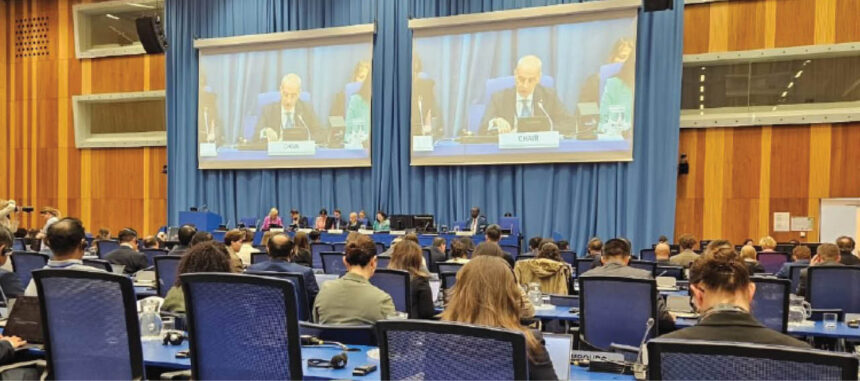
At the ongoing 69th session of UN COPUOS in Vienna, Austria, a senior official of the National Space Research and Development Agency (NASRDA), Prof. Akeem Rabiu, assumed office as 2nd Vice Chair and Rapporteur of the Scientific and Technical Subcommittee (STSC).
The appointment places a Nigerian representative within the leadership structure of one of the committee’s principal technical bodies, which is responsible for facilitating discussions on scientific and engineering issues related to the peaceful exploration and use of outer space.
UN COPUOS serves as the primary international platform for cooperation on space governance, bringing together member states to examine developments in space science, policy, technology and regulation. The committee also addresses issues relating to space sustainability, safety, international collaboration and the expanding range of applications derived from space technologies.
The current session in Vienna is reviewing a broad range of issues connected to global cooperation in outer space, including space safety, scientific advancement and emerging technological applications.
Prof. Rabiu, a space physicist and Research Director at NASRDA, will perform his responsibilities within the Scientific and Technical Subcommittee, which functions as one of the key technical arms of the UN COPUOS system.
The subcommittee plays a significant role in shaping discussions on scientific research, engineering developments and technical cooperation among member states engaged in space activities.
The appointment also continues a pattern of Nigerian participation in leadership positions within the United Nations space governance architecture.
Over the years, Nigerian experts have occupied several senior positions within the committee’s leadership framework.
Among them was the late Dr. Adigun Ade Abiodun, who served as Chair of UN COPUOS from 2004 to 2006. More recently, Dr. Francis Dubem Chizea served as Vice-Chair of the committee between 2019 and 2021.
The latest appointment therefore represents continuity in Nigeria’s engagement with international space policy discussions and technical cooperation initiatives conducted under the United Nations system.
Speaking on the sidelines of the Vienna session, the Director General of NASRDA, Dr. Matthew Adepoju, said that Nigeria’s participation reflects the agency’s sustained contribution to global discussions on space science and technology.
He noted the importance of institutional capacity-building efforts and acknowledged the continued presence of Nigerian professionals within key international working groups and committees.
According to him, such participation provides opportunities for technical engagement and contributes to the country’s involvement in ongoing global conversations relating to space development and governance.
Nigeria’s delegation to the 69th session includes several senior technical officials from NASRDA.
Among them are Dr. Godstime James, Director of Strategic Space Applications; Dr. Ikpaya David Ikpaya, Director of Engineering and Space Systems; and Dr. Rakiya Babamaaji, Acting Director of International Cooperation and Linkages.
The delegation is participating in discussions covering a range of subjects, including space sustainability, satellite applications and international cooperation frameworks.
These issues have become increasingly important as governments and space agencies seek to address challenges associated with growing space activity, expanding satellite networks and the long-term management of orbital environments.
The Vienna session continues to serve as a platform for member states, international organizations and space agencies to review developments in space science and technology while examining policy approaches to emerging opportunities and challenges.
As deliberations continue, Nigeria’s presence within the leadership structure of the Scientific and Technical Subcommittee adds another chapter to the country’s participation in multilateral space governance processes. The appointment of Prof. Akeem Rabiu as 2nd Vice Chair and Rapporteur reflects an ongoing role for Nigerian experts within international discussions on the peaceful use of outer space, scientific cooperation and the technical issues that increasingly shape the future of global space activities.