By Ahmed Ahmed
Housing has long occupied a difficult place in Nigeria’s development landscape. Despite decades of policy interventions, the challenge of affordable homeownership has remained largely unresolved, constrained by issues ranging from land administration and construction costs to limited access to long-term financing.
As a result, millions of Nigerians have remained outside the formal housing market, relying instead on rental accommodation or informal arrangements. In this case, the Tinubu administration has sought to position housing not only as a social objective but also as a broader economic strategy, linking construction, finance, manufacturing and job creation within a single policy framework.
In a statement outlining the administration’s housing performance under the Renewed Hope Agenda, shared on X recently, President Bola Tinubu said that the government’s housing reforms were beginning to translate into measurable progress, with thousands of housing units currently under construction across the country.
According to the President, the housing programme was conceived as a direct response to the need for affordable homeownership and was built around a commitment to provide Nigerians with a realistic pathway from renting to owning homes.
“When I placed the Renewed Hope Agenda before Nigerians, I did not speak of housing in vague terms. I gave my word that this administration would work to make decent homes affordable again, and that a hardworking family, after years of paying rent, would finally have a path to a house of its own,” he said.
Tinubu explained that the programme was designed on a national scale, with a target of 100,000 housing units across the country.
The first phase, he noted, consists of 50,000 housing units distributed through city-scale developments across the six geopolitical zones and the Federal Capital Territory, alongside estates of up to 500 units in each of the remaining 30 states.
“We promised a programme built on a national scale, 100,000 homes in all, with 50,000 in the first phase through cities of 1,000 units in every geopolitical zone and the Federal Capital Territory, and estates of up to 500 units in the remaining 30 states.”
The President stated that implementation has advanced beyond the planning stage, pointing to several projects currently underway.
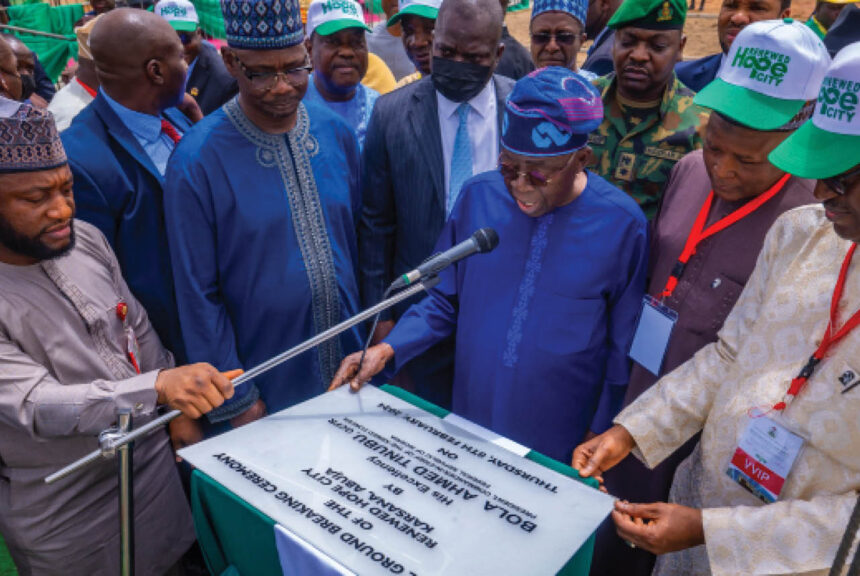
According to him, more than 3,000 housing units have been initiated at Karsana in Abuja, while the 2,000-unit housing city at Ibeju-Lekki in Lagos State has reached an advanced stage of completion, with sales already underway.
He added that construction activities are currently ongoing on more than 15,000 housing units across different parts of the country.
“What stands today is no longer a drawing. We broke ground on more than 3,000 homes at Karsana in Abuja, the 2,000-unit city at Ibeju-Lekki in Lagos has reached advanced completion with sales already underway, and across the country, more than 15,000 units are rising as I write this.”
Beyond housing construction itself, the President argued that the administration’s approach has focused on addressing structural issues that have historically constrained the sector.
“A house does not begin at its walls, and we refused to govern as though it did. We promised to confront the foundation, the tools and the cost of building itself.”
One of the areas identified for reform is land administration.
According to Tinubu, the government is working with the World Bank to expand formal land registration and increase the proportion of titled land nationwide.
“So we have moved to title land that sat for generations as dead capital, working with the World Bank to lift this nation from fewer than one plot in ten formally registered toward one in two.”
The President also pointed to reforms in the equipment leasing framework, which he said were intended to improve access to construction machinery and strengthen legal certainty for contractors and financiers.
“We have strengthened the framework that governs equipment leasing, so that a builder or contractor can secure the machines a project needs with legal certainty and the confidence of those who finance them, and no site stands idle for want of a crane.”
Another component of the reform programme involves efforts to improve transparency and reduce costs within the housing market.
According to Tinubu, government has introduced uniform pricing mechanisms for housing units while also establishing regional materials hubs across the six geopolitical zones.
“And, we have published uniform prices on our homes, so that no Nigerian pays a bribe to learn the cost of a roof, while raising materials hubs in all six zones so that we build with our own hands and our own resources.”
The President argued that housing delivery cannot be separated from housing finance, noting that affordability ultimately depends on access to long-term funding.
“But a home that is built and cannot be bought is only a monument, and on this point, Nigeria has stumbled for decades. So, we turned to the question of money.”
In this regard, Tinubu highlighted the role of the MOFI Real Estate Investment Fund (MREIF), which he said has expanded access to mortgage financing.
According to him, 1,859 families across 25 states have accessed N128 billion in mortgages through the fund, with repayment terms fixed at 9.75 percent over 20 years.
“Through the MREIF, 1,859 families across 25 states have now drawn N128 billion in mortgages, fixed at 9.75 per cent and repayable over 20 years, terms our people were told for a generation they would never see.”
The President also referenced the Family Homes Funds programme, describing it as an important component of efforts to expand access to housing for lower-income Nigerians.
“Through Family Homes Funds, we have kept faith with the poorest, housing widows and low-income earners, under a mandate to reach 500,000 homes and the 1.5 million jobs that rise with them.”
Despite outlining the progress recorded so far, Tinubu acknowledged the scale of Nigeria’s housing challenge and stated that addressing the deficit would require sustained effort over a prolonged period.
“I will not stand before you and declare the work finished, because it is not. The housing deficit this nation carries is counted in the millions, and it will take years of steady labour to close, and I would rather say that to you plainly than flatter you with a lie.”
Nevertheless, he maintained that a key difference between current efforts and previous interventions is the attempt to coordinate all elements of the housing ecosystem simultaneously.
“But the difference now is real. For the first time in a generation, the whole housing value-chain is moving together: the land and its title, the building, the materials, the equipment, the finance, and the family at the end of it, and no part waits idle on another.”
The President further argued that housing should be viewed not solely as a welfare issue but as an economic growth strategy capable of stimulating multiple sectors of the economy.
“Housing has moved from a welfare conversation to a national growth strategy. Real estate and construction now sit among Nigeria’s major GDP contributors, proving that every affordable home financed is also a factory order, a labour contract, a mortgage asset, a household balance sheet and a contribution to national output.”
Summing up his assessment of the programme, Tinubu said the objective remains the delivery of affordable housing opportunities for Nigerians while strengthening the broader housing ecosystem.
“That is what I promised for our housing sector, and that is what is now being delivered. Renewed Hope was never charity. It is the right of every Nigerian to a place called home.”