
By Kingsley Benson
Nigeria’s inflation rate recorded a marginal decline in June 2026, offering another indication that the broad pace of price increases may be stabilising. Yet for millions of households, the latest figures also underline a more familiar reality, the struggle to afford everyday food items remains far from over.
According to the National Bureau of Statistics (NBS), the country’s headline inflation rate eased to 15.91 percent in June from 15.93 percent recorded in May. Although the reduction of just 0.02 percentage points is modest, it represents the first decline in headline inflation after three consecutive months without improvement.
For economists and policymakers, even a slight moderation is noteworthy because it suggests that overall price pressures may be easing gradually. For consumers, however, the experience of inflation is measured less by national averages than by what happens at the market, the neighbourhood shop and the family dining table.
The NBS Consumer Price Index (CPI) report shows that prices continued to rise in June, only at a slightly slower pace than in the previous month. Month-on-month inflation stood at 1.66 percent, compared with 1.75 percent in May, meaning prices still increased but not as rapidly as before.
The distinction is important. A lower inflation rate does not mean prices are falling. Rather, it means prices are rising more slowly. Goods and services remain more expensive than they were a year ago, and consumers continue to adjust household budgets in response.
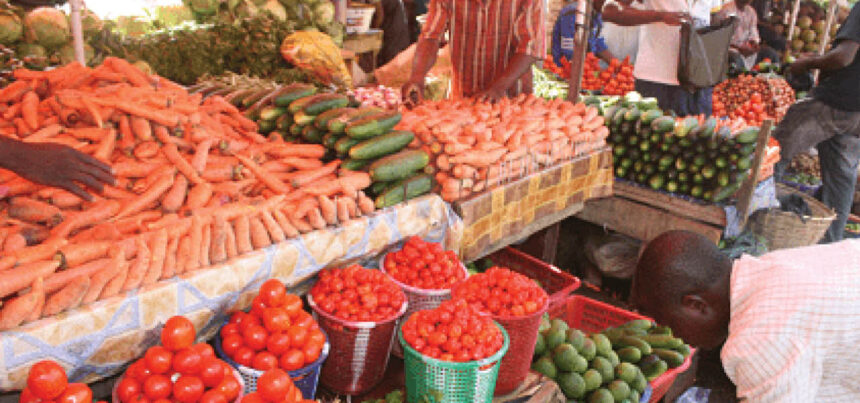
Food remains the greatest source of financial pressure for many Nigerians. While headline inflation edged downward, food inflation moved in the opposite direction. The annual food inflation rate rose to 17.52 percent in June, up from 16.96 percent in May, reflecting persistent increases in the prices of essential food commodities.
The NBS identified several products that contributed to the rise, including fresh tomatoes, fresh pepper, crayfish, dried green peas, yam flour, water yam, beef, bananas, cassava flour, cowpeas, garri, Irish potatoes and yam tubers. These are staple items consumed across much of the country, making their rising prices particularly significant for household welfare.
Despite the increase, food inflation remains considerably lower than the 25.41 percent recorded during the corresponding period in 2025, suggesting that the intensity of food price growth has moderated over the past year. Nevertheless, the latest figures indicate that supply constraints, seasonal factors and distribution costs continue to affect food affordability.
Regional differences also reveal that inflation is far from uniform across the country. Kogi State recorded the highest year-on-year food inflation at 53.02 percent, followed by Niger at 43.83 percent and Benue at 40.83 percent. By contrast, Katsina recorded the lowest increase at 19.15 percent, while Rivers and Imo posted comparatively lower rates of 23.81 percent and 24.60 percent respectively.
These variations reflect differences in agricultural production, transportation networks, market accessibility and local economic conditions. They also demonstrate that inflation can have very different consequences depending on where people live.
The report also highlights contrasting experiences between urban and rural communities. Urban inflation stood at 16.08 percent on a year-on-year basis, while rural inflation was slightly lower at 15.48 percent. On a monthly basis, however, urban inflation accelerated to 2.13 percent, whereas rural inflation slowed significantly to 0.52 percent.
The figures suggest that residents of cities continue to face stronger short-term price pressures, possibly reflecting higher housing, transportation and service costs. Rural households, while not insulated from inflation, experienced a slower pace of monthly price increases during June.
Another encouraging indicator is the decline in average annual inflation over the past twelve months. Average food inflation for the twelve months ending June 2026 stood at 16.42 percent, substantially below the 31.93 percent recorded during the corresponding period in 2025. Similar improvements were observed in both urban and rural inflation averages, pointing to a broader easing in inflationary momentum over the longer term.
The latest data arrive at a time when policymakers continue efforts to strengthen macroeconomic stability through monetary tightening and wider economic reforms. Lower inflation, even if gradual, is generally viewed as supportive of consumer confidence, investment planning and business decision-making.