By Ahmed Ahmed
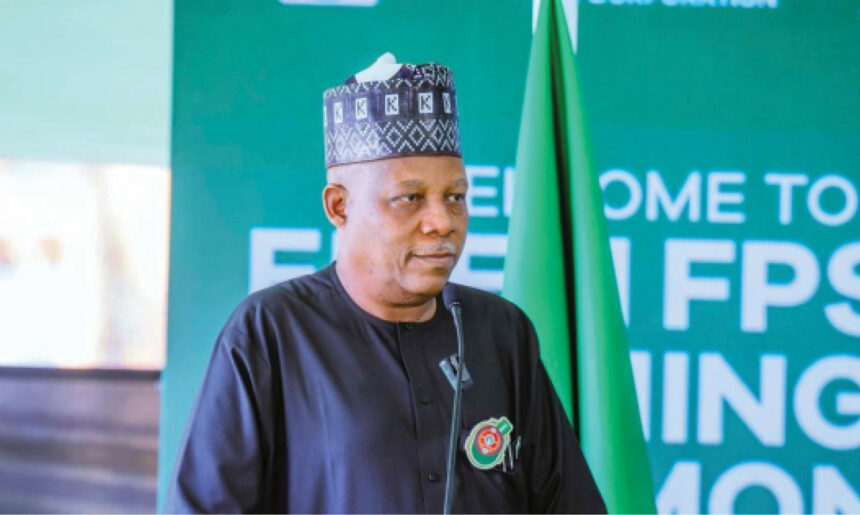
Vice President Kashim Shettima has said the economic reforms of the President Bola Tinubu administration are creating conditions for Nigerian companies to expand beyond the domestic market and emerge as globally competitive brands.
Vice President Shettima cited Flutterwave, Moniepoint, Andela and other indigenous companies as examples of businesses leveraging opportunities created by reforms across different sectors of the economy to scale their operations.
The Vice President spoke in Abuja when he received a delegation from Flutterwave, led by its Chief Executive Officer and Co-Founder, Olugbenga Agboola, during a courtesy visit.
Flutterwave, an indigenous fintech company providing payment infrastructure for global merchants and payment service providers, has become one of the most prominent Nigerian technology companies operating across international markets.
For the Vice President, the emergence of companies such as Flutterwave represents more than individual corporate success. It demonstrates the possibility of Nigerian businesses developing solutions to local problems and subsequently exporting those solutions to other markets.
“We have to support and promote our own. We have to make our companies stronger,” Vice President Shettima said.
He commended Flutterwave for building what he described as one of Africa’s most compelling technology stories from Nigeria, attributing the company’s progress to committed leadership and expertise.
He particularly highlighted its ability to develop an indigenous response to a problem affecting businesses across the continent.
The company’s payment infrastructure, he noted, demonstrates how Nigerian firms can identify challenges within African markets and develop solutions capable of serving customers beyond their original market.
That distinction is important for Nigeria’s economic ambitions. Moving indigenous businesses from local operations to international scale requires more than entrepreneurial ability. It depends on access to capital, reliable infrastructure, predictable regulation, skilled talent, digital connectivity and a business environment that allows companies to reinvest and expand.
The Vice President said the federal government would continue to support Flutterwave within and outside Nigeria, signalling its interest in strengthening Nigerian companies as they compete in international markets.
Agboola told the Vice President that Flutterwave’s ambition is to achieve substantial growth over the coming years and strengthen its position as a leading payments and banking technology company in Africa and globally.
He recognized President Tinubu, Shettima and the federal government for the confidence placed in the company, describing the engagement as “a strategic signal of how Nigeria is supporting Nigeria” and an important milestone for Flutterwave.
Agboola also positioned the company as a partner in the administration’s economic agenda, rather than simply a beneficiary of government policy.
“Your Excellency, it’s my honour to be here today. Like I said, our goal is to partner with you and your team to reason how we can do more to advance the administration’s amazing economic agenda that we have seen working right now in the country,” he said.
“We want to be a part of that positive story.”
He stressed the company’s Nigerian identity and its commitment to contributing to the country’s development.
“We are very much a Nigerian company. I’m very much Nigerian. Nigeria is our home,” Agboola said, adding that the company wanted to do its part to move the country forward.
The government’s challenge now is to ensure that the conditions supporting a handful of successful technology companies can be replicated across a wider pool of indigenous businesses.
Nigeria has thousands of enterprises with the potential to compete regionally and internationally, but many remain constrained by financing costs, infrastructure gaps, regulatory complexity and limited access to international markets.
The success of Flutterwave therefore offers a useful benchmark for the broader reform agenda. If economic reforms are working as intended, their impact should increasingly be visible in the ability of Nigerian companies to invest, hire, innovate, export and compete for customers beyond the country.
For the administration, supporting indigenous firms also offers a route towards a more diversified economy in which growth is driven not only by commodities but by technology, financial services, manufacturing, professional services and other knowledge-intensive sectors.
The presence of Stanel Group CEO Stanley Uzochukwu and other business executives at the meeting further underscored the government’s engagement with indigenous enterprise.
The emerging policy question is therefore no longer simply whether Nigeria can produce successful companies. It is whether the country can build an economic environment capable of producing hundreds of them, with enough scale and resilience to become African and global brands.
Flutterwave’s trajectory shows that Nigerian companies can build solutions with international relevance. The longer-term test for the reforms will be whether more indigenous businesses are given the conditions to follow that path.