
By Ahmed Ahmed
Nigeria’s inflation rate eased marginally in August 2026, with the headline rate falling to 15.39 percent from 15.43 percent in July. The modest decline was accompanied by a more pronounced slowdown in monthly price increases, particularly across food items, offering some evidence that the pace of price pressures is beginning to moderate.
The latest figures, released by the National Bureau of Statistics (NBS) in its Consumer Price Index report, show that inflation remains elevated, but the direction of movement in August was softer than in the preceding month.
Headline inflation declined by 0.04 percentage points between July and August. More significantly, the month-on-month inflation rate dropped to 0.71 percent from 1.57 percent in July, a reduction of 0.86 percentage points.
The distinction is important. A lower monthly inflation rate does not mean that prices have fallen across the economy. Rather, it indicates that prices increased at a slower pace during August than they did in July.
The NBS explained that the August figure means “the rate of increase in the average price level was lower than the rate of increase in the average price level in July 2026.”
Food prices provided a stronger indication of the moderation in price pressures.
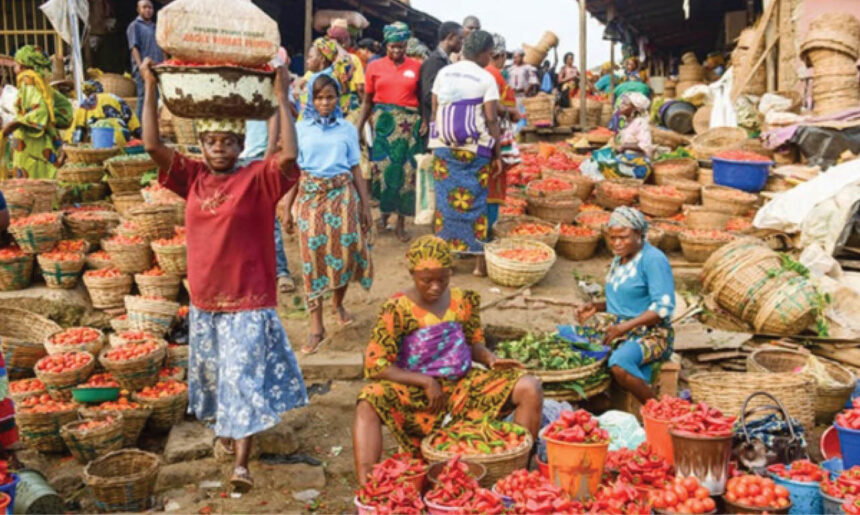
Food inflation fell to 19.57 percent year-on-year in August, substantially below the 25.30 percent recorded in August 2025. On a month-on-month basis, the decline was even sharper, with food inflation dropping to 1.02 percent from 5.56 percent in July.
The NBS described the movement as evidence that “the average prices of food items are increasing at a decreasing rate in August 2026.”
The moderation was associated with changes in the average prices of several food items. These included palm oil, carrots, pepper, onions, cassava flour, beef, yam flour, water yam, melon, fresh ginger, fresh fish, Irish potatoes, wheat grain, frozen chicken and turkey meat.
For households, however, the significance of the figures depends heavily on where they live and what they consume. The national average masks substantial differences in food-price pressures across states.
Adamawa recorded the highest year-on-year food inflation rate in August at 38.85 percent, followed by Zamfara at 37.96 percent and Bayelsa at 36.20 percent. At the other end of the distribution, Borno recorded -4.04 percent, Jigawa -0.23 percent and Kebbi 3.47 percent.
The monthly picture was similarly uneven. Katsina recorded the highest month-on-month food inflation at 9.48 percent, followed by Rivers at 8.86 percent and Osun at 8.32 percent.
Meanwhile, some states recorded significant monthly declines. Taraba posted -12.42 percent, followed by Borno at -12.15 percent and Bauchi at -8.88 percent.
These differences underline an important feature of Nigeria’s inflation challenge. National inflation provides a broad measure of price movements, but the pressure experienced by households can vary significantly depending on location, food supply conditions and consumption patterns.
The August figures therefore provide two different messages. At the national level, the slower monthly increase suggests that the intensity of recent price pressures has weakened. At the household level, particularly in states where food inflation remains high, the cost-of-living burden can remain substantial.
The year-on-year food inflation figure also shows why a slowdown should not automatically be interpreted as a return to lower prices. Prices can continue to rise while doing so at a slower rate. For consumers whose incomes have already been squeezed by previous increases, even slower price growth can continue to affect purchasing power.
For businesses, the direction of inflation also matters. Slower price increases can improve the predictability of operating costs, procurement and household demand. Sustained moderation could therefore become more significant if it continues across subsequent months.
The August data consequently shifts attention from whether inflation has fallen to whether the moderation can be sustained. Food prices will remain particularly important because of their direct impact on household welfare and their wider influence on consumer spending.
The latest CPI report offers a measure of relief in the pace of price increases, but the underlying economic question remains whether the moderation can translate into more stable living costs and improved purchasing power over time.