By Majeed Salaam
Nigeria’s regional development commissions were established to do more than administer public funds. They were created to address long-standing development gaps, unlock regional economic strengths and ensure that growth is driven by the unique comparative advantages of each geopolitical zone.
Their ultimate value, however, will not be measured by the number of meetings held or policies drafted. It will be judged by whether they improve infrastructure, expand economic opportunities and raise living standards.
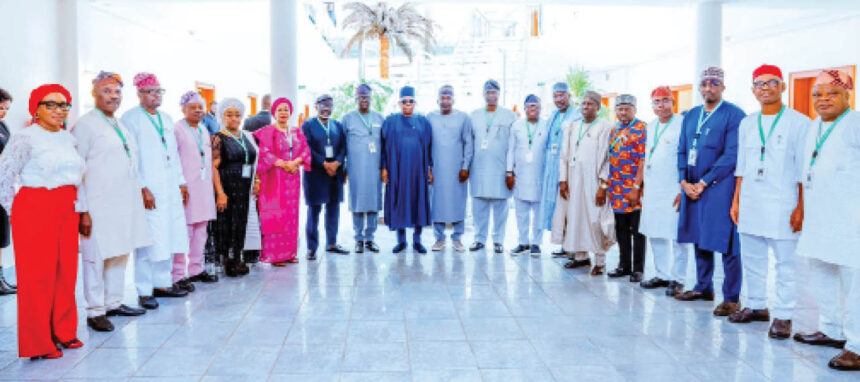
That was the central message from Vice President Kashim Shettima as he recently received the Chairman, management and board members of the South West Development Commission (SWDC) at the Presidential Villa in Abuja.
His remarks provide an indication of how the Federal Government expects the newly established regional development commissions to operate under the Renewed Hope Agenda.
Rather than functioning as conventional government agencies, the commissions are expected to become development institutions capable of mobilising partnerships, attracting investment and accelerating economic transformation within their respective regions.
Addressing the delegation, Shettima urged the South West Development Commission to work closely with state governments, traditional institutions, the private sector and development partners in delivering sustainable development.
The emphasis on collaboration reflects an increasingly accepted principle in development planning.
Complex economic challenges rarely fall within the capacity of any single institution. Infrastructure, education, industrial development and investment promotion require coordination across different levels of government as well as active participation by businesses and local communities.
The Vice President also reminded the commission that public expectations would be shaped by tangible outcomes rather than institutional structures.
He stressed that its success would ultimately be determined by visible projects and measurable improvements in the lives of the people.
That observation reflects a wider shift in public sector governance.
Increasingly, government institutions are expected to demonstrate impact through service delivery rather than administrative processes. Development commissions, in particular, face growing pressure to produce projects that generate employment, improve infrastructure and stimulate regional economic activity.
Shettima further called for transparency, innovation and the implementation of projects capable of attracting private investment.
His remarks underscore the changing role of public institutions in economic development.
With fiscal resources under increasing pressure, governments are relying more heavily on private capital to finance infrastructure and productive investments. Regional commissions are therefore expected not merely to spend public funds but to create conditions that encourage businesses and investors to participate in regional development.
That approach aligns with broader efforts to diversify Nigeria’s economy by leveraging regional strengths.
Each geopolitical zone possesses distinct economic advantages ranging from agriculture and manufacturing to solid minerals, tourism and maritime commerce. The commissions are intended to identify those opportunities and coordinate investments that maximise local potential while contributing to national growth.
Earlier, Chairman of the SWDC, Senator Olubunmi Adetunmbi, commended the Tinubu administration for establishing the regional development commissions and implementing broader economic reforms.
He also acknowledged Vice President Shettima’s leadership of the National Economic Council, describing it as an important platform for coordinating development priorities between the Federal Government and the states.
Outlining the commission’s priorities, Adetunmbi said that it intends to invest in infrastructure, human capital development and other strategic projects capable of supporting long-term growth across the South West.
Those priorities mirror the broader objectives behind the establishment of regional commissions.
Infrastructure provides the physical foundation for economic expansion, while investments in education, skills and human capital strengthen productivity and improve competitiveness over time.
Ultimately, the success of Nigeria’s regional development commissions will depend less on their statutory mandates than on their ability to convert regional potential into measurable economic progress.
For the SWDC, the task ahead is therefore not simply to implement projects, but to demonstrate that regional institutions can become effective vehicles for inclusive growth, private investment and sustainable development.