
By Anita Dennis
Nigeria will require about $410 billion in additional investment by 2060 to achieve its net-zero pathway, putting pressure on government and private-sector stakeholders to turn climate ambitions and infrastructure plans into projects capable of attracting long-term capital.
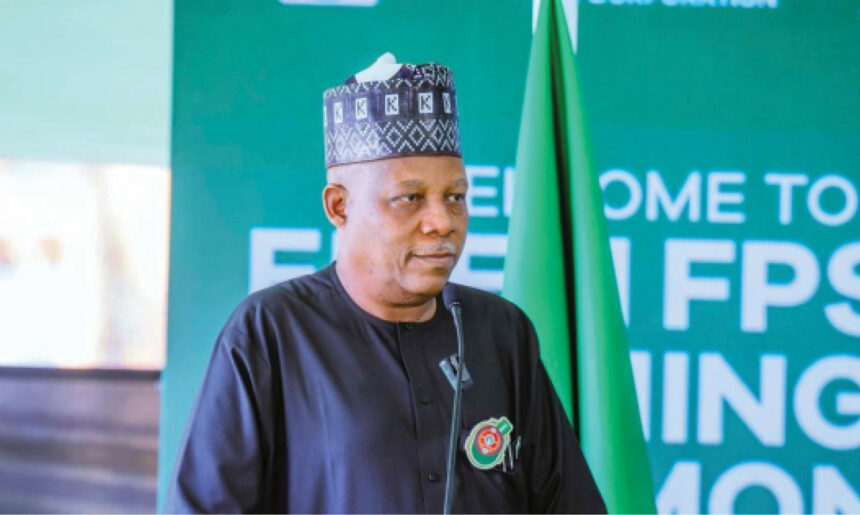
Vice President Kashim Shettima made the case for greater private investment last Tuesday at the second edition of the Decarbonising Infrastructure in Nigeria (DIN) Summit in Abuja, where policymakers, development finance institutions, investors, climate experts and members of the diplomatic corps examined ways to close the financing gap facing the country’s green transition.
Represented by his Deputy Chief of Staff, Senator Ibrahim Hadejia, Shettima said the scale of financing required should be viewed not only as a challenge but also as a substantial investment opportunity.
“Our Energy Transition Plan estimates that Nigeria will require about $410 billion in additional investment above business-as-usual through 2060 to achieve its net-zero pathway,” he said.
“That is a significant financing requirement. But it also tells us something else: there is a very large investment opportunity ahead of us.”
The scale of the requirement, however, means government funding alone cannot deliver the infrastructure needed for the transition. Vice President Shettima said Nigeria would need capital from domestic and international investors, development finance institutions, financial institutions and institutional investors.
“We need the private sector. We need development finance institutions. We need domestic financial institutions and institutional investors. And, perhaps most importantly, we need projects that are properly prepared and capable of attracting that capital,” he said.
That emphasis on project preparation emerged as one of the central themes of the summit, held at the United Nations House in Abuja and organised by the Office of the Vice President with support from the National Council on Climate Change and the United Nations Industrial Development Organisation (UNIDO).
With the theme, ‘De-risking Green Infrastructure Investment in Nigeria: Enabling Policy, Project Readiness and Risk-Sharing Solutions,’ the summit focused on a practical constraint facing green infrastructure: investors need more than ambitious targets before committing capital.
The Vice President said investors would want clarity on the policy environment, the credibility of revenue models, the quality of technical preparation and how risks would be distributed among project stakeholders.
“These are practical questions. And I believe that is where DIN Summit 2.0 can make a useful contribution,” he said.
The financing challenge was further illustrated by UNIDO’s Sub-Regional Representative in Nigeria and ECOWAS, Ambassador Philbert Abaka Johnson. He said Nigeria’s physical infrastructure investment requirements were estimated at about $3 trillion by 2050, while tracked climate finance flows averaged only $2.5 billion annually in 2021 and 2022.
Against estimated annual requirements of $29.7 billion, he put the annual financing gap at about $27.2 billion.
Johnson identified policy and regulatory uncertainty, fragmented approval processes, unclear institutional responsibilities and inadequate revenue or offtake arrangements as factors limiting the ability of otherwise credible projects to secure financing.
“These projects sit at very different stages of maturity, from concepts which require feasibility work to projects ready to seek finance,” he said.
The implication is that closing the green financing gap will require a stronger project-development pipeline, rather than simply greater commitments of capital.
The DIN initiative is already seeking to build that pipeline. Musaddiq Adamu, Personal Assistant to the President on Subnational Infrastructure, said pre-summit workshops had been conducted across energy, transport, urban development and agriculture.
He cited the outcome of discussions following last year’s summit, when APM Terminals presented plans around port electrification. According to Adamu, the engagement subsequently contributed to a $60 million agreement with the Nigerian Ports Authority to advance port electrification, with Onne Port positioned to become Nigeria’s first green port.
“For me, that is an important lesson. The objective is not simply to have a good conversation. The goal is to create real investment opportunity,” Adamu said.
He said Nigeria had “no shortage of ambition”, but the greater challenge was turning policies, plans and ideas into projects that investors could understand, finance and deliver.
That challenge has implications for how climate projects are developed and presented to the market. Nigeria’s NDC 3.0 recognises the need for a stronger pipeline of viable projects, increased private-sector participation and improved access to climate finance.
Across the continent, blended finance and early-stage project preparation are also being used to reduce barriers to private investment. The African Development Bank’s Alliance for Green Infrastructure in Africa, for instance, is seeking to mobilise $500 million in early-stage blended finance to develop projects capable of attracting substantially larger investments.
The summit also heard that green infrastructure could create more than 300,000 jobs, while participants called for standardised public-private partnership agreements and dedicated early-stage funding for projects in areas such as mini-grids, clean transportation and green buildings.
For investors, the message emerging from the summit was therefore not simply about the size of Nigeria’s green opportunity. It was about whether projects can be developed to a point where risks, revenues, contracts and technical requirements are sufficiently clear to support investment decisions.