By Anita Dennis
Africa has become increasingly familiar with climate warnings. Every year brings fresh forecasts of droughts, floods, heatwaves and food shortages. Yet the continent’s greatest vulnerability is no longer the absence of scientific knowledge. It is whether governments can transform early warnings into timely action before disasters unfold.
That challenge dominated discussions at an Extraordinary Ministerial Consultative Meeting on El Niño Preparedness and Continental Response convened by the African Union in Addis Ababa, where policymakers were presented with one of the starkest climate projections in decades.
According to the African Union Commission, scientific forecasts indicate a 90 percent probability that the 2026 to 2027 El Niño will become the strongest recorded since 1950, with peak intensity expected between November 2026 and February 2027.
For a continent where agriculture remains heavily dependent on rainfall and millions rely on climate-sensitive livelihoods, the warning carries implications that extend well beyond weather patterns. It is a test of governance, economic resilience and humanitarian preparedness.
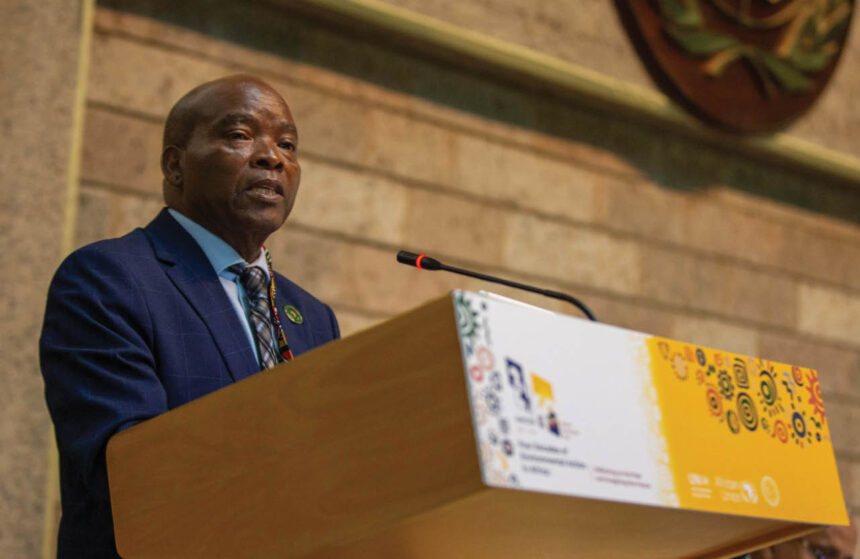
Opening the meeting, African Union Commissioner for Agriculture, Rural Development, Blue Economy and Sustainable Environment, Moses Vilakati, framed the gathering as an opportunity for Africa to prepare collectively rather than react individually.
“It gives me great pleasure to welcome you to this Extraordinary Ministerial Consultative Meeting on El Niño preparedness and continental response,” he said.
But his message quickly shifted from protocol to urgency.
“It is an imminent risk that demands immediate preparation,” Vilakati warned.
His concern reflects lessons from the continent’s recent experience.
The 2023 to 2024 El Niño devastated large parts of Southern Africa, forcing Botswana, Lesotho, Malawi, Namibia, Zambia and Zimbabwe to declare national disasters. Across the Southern African Development Community, more than 71 million people were affected, prompting a humanitarian appeal valued at US$5.5 billion.
The consequences extended beyond agriculture.
Food production declined sharply, hydropower generation weakened, food insecurity intensified and millions required emergency assistance. At the same time, severe flooding displaced communities across Eastern Africa, while climate-related disruptions spread into Central and West Africa.
Those experiences demonstrated that climate shocks rarely remain confined to one sector. Agricultural losses quickly affect food prices, electricity generation, public health, government finances and regional stability.
Vilakati argued that Africa now possesses something it lacked in previous decades: advance warning.
Forecasts from global, continental and regional climate centres now provide governments with months of notice before extreme weather events occur. Institutions such as the African Centre of Meteorological Applications for Development, regional climate centres and national meteorological agencies have significantly improved seasonal forecasting and early warning systems.
Yet the commissioner cautioned that scientific information alone cannot prevent disasters.
“The difference between a manageable crisis and a humanitarian disaster will be determined by what we do before the impacts arrive,” he said.
His observation highlights a broader challenge confronting climate governance across Africa.
Early warning systems have improved considerably, but preparedness often lags behind. Forecasts frequently fail to translate into budget allocations, emergency planning, investment in resilient agriculture or coordinated disaster response.
For many countries, the weakest link is no longer predicting climate events but acting on the predictions.
Supporting that assessment, African Union Commission Director for Sustainable Environment and Blue Economy, Harsen Nyambe, said the ministerial meeting had been convened specifically to strengthen continental preparedness before the anticipated El Niño reaches peak intensity later this year.
Similarly, the ClimSA Programme Coordinator at the African Union Commission, Dr Jolly Wasambo, warned that the projected climate event could trigger widespread disruptions across the continent if governments fail to prepare adequately.
The challenge is particularly acute because Africa contributes relatively little to global greenhouse gas emissions while bearing a disproportionate share of climate-related losses.
With agriculture employing a large share of the continent’s workforce and food systems remaining highly dependent on rainfall, prolonged droughts or excessive flooding can rapidly evolve into economic and humanitarian crises.
For policymakers, therefore, climate resilience has become as much an economic priority as an environmental one.
The African Union’s appeal ultimately goes beyond responding to a single weather event. It calls for stronger institutions, greater investment in resilience, improved regional cooperation and political leadership capable of acting before emergencies overwhelm national capacities.
The forecast may predict another powerful El Niño, but the scale of its consequences will depend less on the weather than on Africa’s preparedness. This time, the continent has advance notice. The question is whether it will use it.