By Jennete Ugo Anya
The transfer of two federal digital facilities to the Enugu State Government is opening a new phase in the state’s ambition to build an economy driven by technology, skills and globally traded digital services.
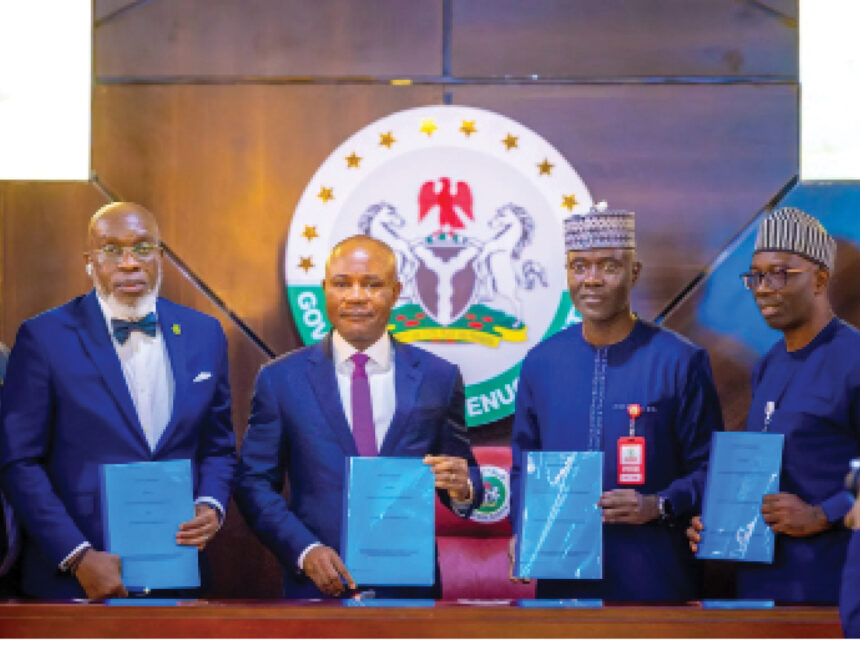
The Nigerian Communications Commission (NCC) has handed over the Digital Industrial Park and the Digital Bridge Institute (DBI) to the state government under a 15-year operational lease agreement.
The facilities, officially transferred at the Government House, Enugu, were among six digital industrial parks established across Nigeria to promote innovation, entrepreneurship and human-capital development.
The NCC Chief Executive Officer, Aminu Maida, said that the facilities were designed to deepen digital skills, support startups, attract investment and create jobs, while positioning Nigeria to compete in Business Process Outsourcing, Knowledge Process Outsourcing and other technology-enabled services.
He said their significance extended beyond the physical infrastructure.
According to Maida, the facilities were built as platforms for developing the people, ideas and enterprises expected to drive Nigeria’s digital economy.
“The success of these facilities will not be measured by the quality of the buildings or equipment, but by the skills acquired, ideas developed, businesses created and jobs generated,” he said.
That emphasis places the success of the agreement largely on what happens after the handover. The value of the facilities will depend on their ability to attract entrepreneurs, train young people, support businesses and connect Enugu-based talent to markets beyond the state.
Maida expressed confidence that the Enugu State Government had demonstrated the commitment required to maximise the assets through investments in education, innovation, infrastructure and digital capacity.
He said the partnership could support Enugu’s ambition to become a destination for digital services, artificial intelligence, startup incubation, outsourcing, research and technology-enabled enterprises.
The collaboration, he added, aligns with the Federal Government’s digital economy agenda and President Bola Tinubu’s Renewed Hope Agenda, which seeks to build a $1 trillion economy through productivity, innovation and private-sector growth.
Governor Peter Mbah described the handover as a historic milestone for Enugu, saying the state intended to use the assets to accelerate its emergence as a leading digital economy hub.
The governor disclosed that the Digital Industrial Park would be transformed into Enugu Talent City, a knowledge-driven outsourcing hub focused on Business Process Outsourcing and Knowledge Process Outsourcing.
The idea is to enable young people in Enugu to provide services to global companies without having to leave the state.
Mbah also announced plans to upgrade the Digital Bridge Institute into an AI Institute and AI certification centre serving the African continent.
“We see these assets as facilities that will deepen innovation in our state, unlock opportunities, create employment and position Enugu as a leading digital economy in this country,” he said.
The governor pointed to the projected economic significance of artificial intelligence, noting that it was expected to contribute about $20 trillion to the global economy by 2030. For Enugu, the implication is that digital infrastructure must be matched with skills capable of participating in that expanding economy.
The state government sees the two facilities as instruments for addressing that gap by combining infrastructure, talent development, innovation and enterprise creation.
Special Adviser to the Governor on SMEs and Digital Economy, Arinze Chilo-Offia, described the handover as a major boost to Enugu’s ambition of becoming a destination for digital innovation, technology-driven investment and high-value employment.
A Non-Executive Commissioner of the NCC, Ikechukwu Ugwuegede, expressed confidence in the state’s capacity to maximise the facilities. He noted that both were university-sized facilities strategically located along the Enugu-Ugwogo Expressway and the GRA Expressway.
The development consequently represents more than a transfer of ownership and operational responsibility. It is an experiment in whether public digital infrastructure can be converted into commercially relevant skills, businesses and employment.
For the NCC, the objective is to ensure that infrastructure supports the wider digital economy. For Enugu, the challenge is to turn the two facilities into functioning centres of talent, innovation and global service delivery.
The 15-year operational lease now gives the state a substantial period to demonstrate whether the assets can move from being government-built infrastructure to becoming productive engines of a technology-led economy.