By Anita Dennis
President Bola Tinubu has challenged Nigerian banks to convert the capital raised through recapitalisation into affordable credit, productive investment and jobs, warning that larger balance sheets will have little value if they do not strengthen the real economy.
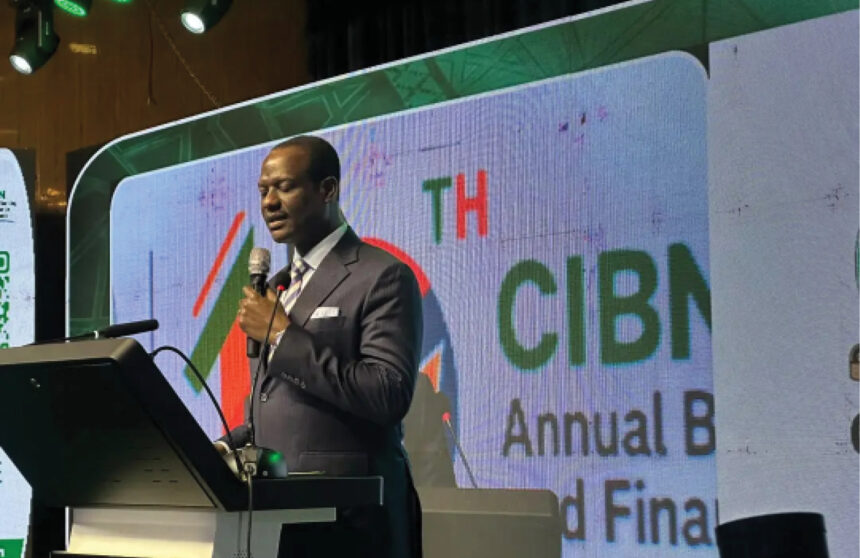
The President, represented by the Honourable Minister of Finance and Coordinating Minister of the Economy, Mr. Taiwo Oyedele, spoke at the recent 19th Annual Banking and Finance Conference of the Chartered Institute of Bankers of Nigeria (CIBN) in Abuja.
The President said the government’s economic reforms had helped restore macroeconomic stability and improve investor confidence, but argued that the next stage must be about translating those gains into investment, production, employment and better living standards.
“The current phase of our reform journey is accelerating the conversion of stability into investment, investment into production, production into jobs, and growth into improved living standards,” he said.
That transition places a different responsibility on the financial sector. President Tinubu urged banks to move “from intermediation to transformation”, saying their performance should no longer be judged mainly by balance-sheet expansion, profitability and shareholder returns.
The more important question, he argued, is what the banking system is doing for the productive economy.
“A resilient banking system cannot assist indefinitely where businesses cannot obtain affordable credit. Manufacturing that is struggling cannot expand, and millions of productive MSMEs remain outside the formal financial system,” he said.
The challenge is particularly relevant following the banking sector recapitalisation, which has strengthened the capital base of Nigerian banks. According to the Chartered Institute of Bankers of Nigeria, 33 banks met the revised minimum capital requirements and raised N4.65tn in new capital.
For the President, however, recapitalisation is only meaningful if that additional capital finds its way into businesses and productive assets.
“It must translate into capital formation in the real economy, financing Nigerian businesses as they expand across Africa and pursue our ambition of a $1 trillion economy,” he said.
“A bigger bank that does not finance a more productive economy is a suboptimal outcome.”
The President also questioned the traditional reliance on collateral as the principal basis for lending, particularly for small businesses and entrepreneurs whose potential may exceed the value of their existing assets.
He called for a financial system capable of financing viable cash flows and opportunities rather than concentrating credit among borrowers with established collateral.
“We must build a system that finances potential and opportunities rather than quick gains for the privileged,”President Tinubu said.
To support this shift, the government is expanding guarantees, risk-sharing arrangements, blended finance and credit enhancements, with the National Credit Guarantee Company expected to play a central role in attracting private capital towards productive investment.
President Tinubu also identified the structure of government borrowing as an important part of the equation. Attractive returns on government securities can make lending to businesses less compelling for banks, particularly where private-sector borrowers carry higher perceived risks.
The President said improving fiscal conditions should progressively create more room for private-sector credit. In his formulation, stronger fiscal discipline would reduce pressure on government borrowing, lower inflation would support lower interest rates, and cheaper capital would encourage investment and production.
Higher production would then create jobs, increase incomes and expand tax revenues, reinforcing fiscal sustainability.
“That is how gains from reform begin to compound at scale, and the financial sector must be ready for that transition,” he said.
The President cited recent economic indicators as evidence that the foundation for this transition is improving. Nigeria’s real GDP grew by 4.43 percent year-on-year in the second quarter of 2026, while headline inflation eased to 15.43 percent and external reserves crossed $54bn.
But he cautioned against interpreting macroeconomic stability as prosperity.
CIBN President and Chairman of Council, Dele Alabi, similarly acknowledged recent improvements, pointing to the stronger capitalisation of banks, Moody’s decision to change Nigeria’s outlook from stable to positive, the country’s impending reclassification to Frontier market status by FTSE Russell and the acceleration in GDP growth.
Yet Alabi stressed that these developments must ultimately be reflected in the daily economic experience of Nigerians.
“Macroeconomic progress must therefore be felt at the micro level, in households, small businesses and the daily lives of ordinary Nigerians,” he said.
That is ultimately the test facing the banking sector. Recapitalisation has provided greater capacity and a stronger buffer against shocks. The next question is whether that capacity can be deployed towards manufacturing, agriculture, infrastructure, MSMEs and other productive sectors at financing costs businesses can realistically absorb.