REFORM TALKS with Enam Obiosio
Nigeria’s food security challenge is often discussed in terms of farmland, fertiliser, finance, irrigation and insecurity. These are important constraints, but I believe there is another piece of the agricultural productivity puzzle that deserves far greater attention: the ability to get the right knowledge to farmers at the right time.
That is why the federal government’s call for an overhaul of the agricultural extension system should not be treated as another administrative adjustment within the Ministry of Agriculture and Food Security. I think it should be understood as an investment in productive infrastructure.
Minister of Agriculture and Food Security, Senator Abubakar Kyari, made the case at the Africa Agribusiness Extension Summit 2026 in Abuja, arguing that Nigeria cannot continue to depend on expanding farmland to meet the food requirements of a growing population. Productivity has to rise.
I agree with that direction. Nigeria cannot indefinitely solve its food challenge by putting more land under cultivation. There are limits to available arable land, water, infrastructure and the environmental sustainability of expanding agricultural production. The more durable route is to help farmers produce more, with better methods, better information and better access to technology.
This is where agricultural extension becomes critical.
There was a time when extension officers maintained close relationships with farming communities and were trusted sources of practical agricultural knowledge. Kyari recalled that during the period when Agricultural Development Projects operated on a large scale with World Bank support, one extension agent served between 1,000 and 1,500 farm families.
Today, he said, an extension officer may be expected to serve between 5,000 and 10,000 farmers.
“No field officer, however committed, can meaningfully serve that number through physical visits alone,” the minister said.
That statement captures the structural problem. It is unrealistic to expect a conventional, field-based extension system to cope with the scale of Nigeria’s farming population when the ratio between extension personnel and farmers has deteriorated so sharply.
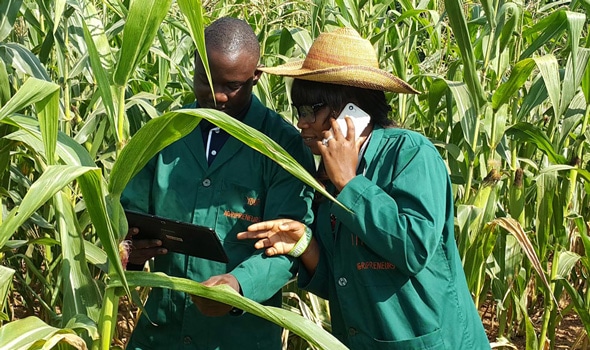
I think the government must therefore resist the temptation to see digital technology as a substitute for extension officers. Technology should extend their reach, not eliminate the human expertise that farmers still need for complex decisions.
The emerging digital initiatives are therefore important. More than 100,000 farmers in six states are reportedly receiving weekly text messages on expected rainfall and measures for protecting crops through collaboration involving the Federal Department of Agricultural Extension, the Nigerian Meteorological Agency and private-sector partners.
The planned digital agricultural extension platform, which is expected to provide advisory services through text and voice in Hausa, Igbo, Yoruba and Pidgin, is another useful development. So is the deployment of tablets to more than 1,000 digital extension agents with support from the National Agricultural Development Fund (NADF).
But I would argue that the real value of these initiatives will depend on whether they become part of a coherent national system rather than remaining isolated projects.
This is where farmer data becomes important. Kyari’s proposal to connect farmer registries with extension systems deserves serious attention because agricultural advice is most useful when it reflects the circumstances of the individual farmer.
“A registry tells us who the farmer is, where the farm lies and what grows on it. Extension tells the farmer what to do next,” he said.
That distinction is important. A farmer registry is useful for identifying beneficiaries, but its greater economic value emerges when the information enables tailored advice. A farmer growing maize in one ecological zone should not necessarily receive the same advisory information as a rice farmer operating somewhere else. Weather, soil conditions, crop cycles, pests, market conditions and available inputs all matter.
I believe Nigeria should therefore move towards a data-driven extension architecture in which farmer identification, location, crop information, weather intelligence, research findings and advisory services are connected.
This is particularly relevant in Nigeria because digital agriculture cannot be designed around smartphones alone. A system that excludes farmers because they lack sophisticated devices will reproduce the very access problem it is supposed to solve. Basic phones, voice services, local languages and human escalation mechanisms therefore remain important.
At the same time, I think the government must address the institutional fragmentation that has weakened agricultural support programmes. Extension Africa’s Chief Operating Officer and Co-Founder, Isa Abdulsamad, identified the proliferation of siloed solutions as one of the major challenges confronting agricultural advisory systems across Africa.
Nigeria has experienced versions of this problem across several sectors. Different programmes can have different databases, beneficiaries, platforms and implementation structures, even when they are addressing closely related problems.
Kyari’s approval of a steering committee to harmonise the Ministry’s extension programmes is therefore potentially significant. But coordination should produce more than another committee. It should establish clear responsibilities, common standards, interoperable data systems and measurable outcomes.
The human capital question also requires attention.The government has 774 agricultural desk officers serving across local government areas, but the effectiveness of such structures depends on their capacity, resources and connection to farmers. Extension must also become more attractive to young professionals, as Kyari suggested.
I believe agricultural extension can become an important employment pathway for graduates in agriculture, data science, meteorology, engineering, business and related disciplines. The modern extension officer should increasingly be part agronomist, part technology user, part data interpreter and part business adviser.
I think agricultural extension sits directly at that intersection.
Research cited by Kyari indicates that access to extension services is associated with reduced food insecurity and improved household assets among Nigerian farming households. Studies of mobile agricultural advisory services in sub-Saharan Africa and India have also found that digital advice can improve yields and encourage adoption of recommended inputs.
These findings reinforce an important principle. Extension should not be funded as a short-term intervention that disappears when a particular project ends. It should be maintained as permanent agricultural infrastructure, just like roads, irrigation systems, storage facilities and market infrastructure.
I urge the federal government to therefore build a national extension architecture around four connected pillars: qualified people, reliable technology, usable farmer data and strong partnerships.
Government should also establish clear indicators for measuring whether the system is working. The number of farmers registered or messages sent is not enough. The more meaningful measures are changes in yields, adoption of improved practices, reductions in crop losses, access to markets, farm incomes and the sustainability of farming enterprises.
We cannot afford an agricultural system in which farmers are expected to increase production while operating without timely and relevant information.
Nigeria’s food security challenge will require more than distributing inputs or expanding cultivated land. Farmers need knowledge that reaches them before the pest arrives, before the weather changes, before planting decisions are made and before market opportunities disappear.
I believe rebuilding agricultural extension is therefore not a peripheral agricultural reform. It is part of the infrastructure required to make Nigerian agriculture more productive, more resilient and more commercially viable.
The government has identified the problem. The next task is to build an extension system capable of matching the scale of the country’s agricultural challenge.