
By Jennete Ugo Anya
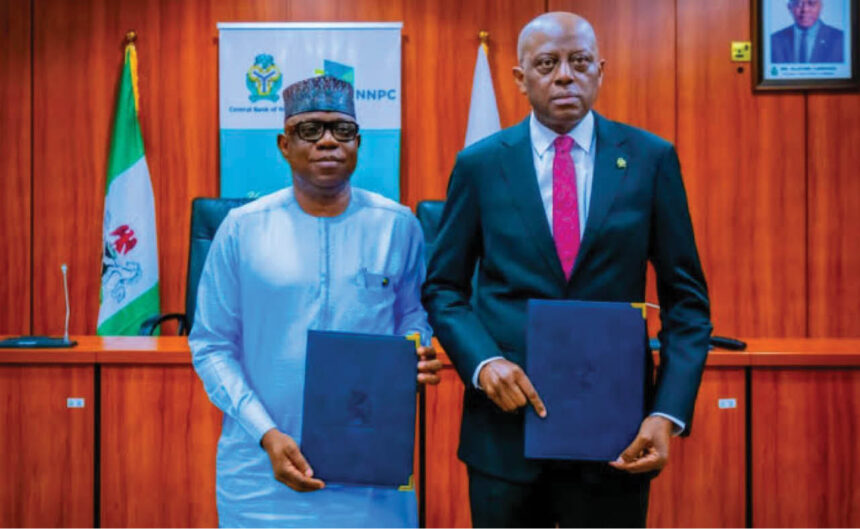
The Nigerian National Petroleum Company (NNPC) Limited and the Central Bank of Nigeria (CBN) have signed a Memorandum of Understanding (MoU) to strengthen financial coordination, improve foreign exchange inflows and support efforts to raise Nigeria’s crude oil production to 3 million barrels per day (mbpd).
The agreement, signed at the CBN headquarters in Abuja on Wednesday, provides a framework for collaboration between the energy and financial sectors, with NNPC seeking to increase production from the current 1.8 mbpd.
Speaking at the ceremony, NNPC Group Chief Executive Officer, Bashir Bayo Ojulari, described the agreement as a defining moment in the relationship between both institutions, noting that it would establish a structured approach to addressing challenges at the intersection of energy and finance.
“This MoU provides that structure by which the two institutions will collaborate at the meeting point between energy and finance,” Ojulari said.
He explained that the partnership would strengthen the repatriation of export proceeds, address foreign exchange constraints affecting trade and improve financing arrangements for energy projects. It would also enable NNPC to mobilise capital against its balance sheet and assets, with guidance from the CBN.
For NNPC, the arrangement represents an attempt to address financial bottlenecks that have affected investment and operational efficiency in the oil industry.
The company’s Group Chief Financial Officer, Adedapo Segun, said the agreement would replace irregular financial arrangements with a coordinated framework for managing transactions between the two institutions.
He identified improved financing and coordination as important requirements for attracting the investment needed to raise production to 3mbpd.
Segun stated that NNPC would align domestic payments, contractor settlements and foreign exchange conversions with CBN regulations to support naira stability and reduce dollarisation.
Both institutions have also agreed to establish working groups, implementation timelines and accountability mechanisms. NNPC Treasurer, John Etukudo, will coordinate implementation on behalf of the company.
CBN Governor, Olayemi Cardoso, described the agreement as a formalisation of an existing relationship, particularly in account management, fund transfers and liquidity support.
“Our continued collaboration in efficient account management, funds transfer and liquidity support directly contributes to macroeconomic stability by ensuring the availability of revenue to achieve fiscal mandates and predictable inflows into the foreign exchange markets,” Cardoso said.
While the agreement establishes an institutional framework for improving financial coordination, its broader economic value will depend on measurable outcomes.
The proposed increase from 1.8 million to 3 million barrels per day will require sustained investment, operational efficiency and the resolution of production constraints.
Ultimately, the partnership will be judged not by the signing of the agreement but by its ability to improve oil output, strengthen foreign exchange earnings and deliver more predictable revenue to the Nigerian economy.