
By Ahmed Ahmed
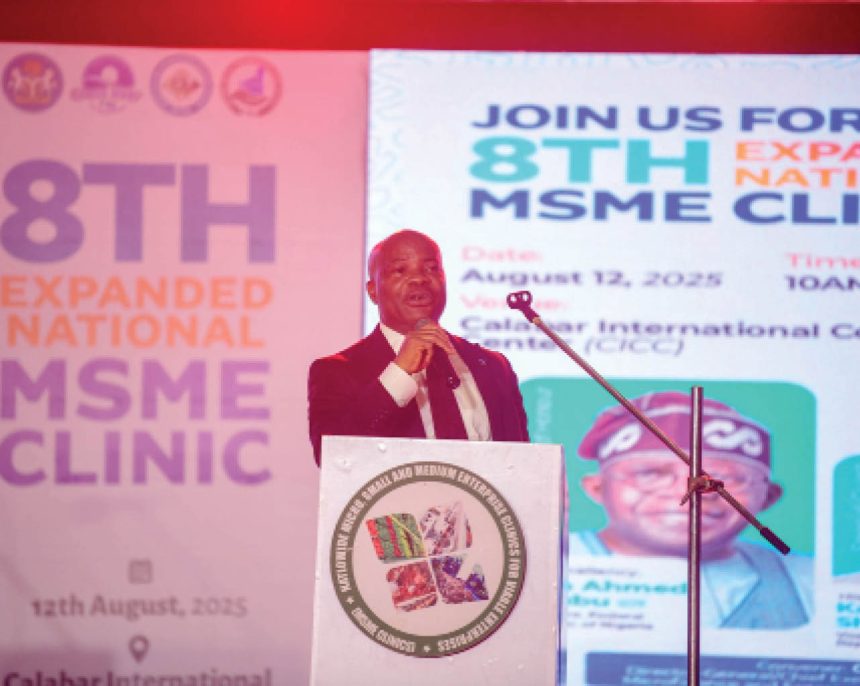
As Nigeria accelerates its push toward economic diversification in a post-oil era, the Nigerian Export-Import (NEXIM) Bank emerged as a crucial force at the 8th Expanded National MSME Clinic, held on August 12 at the Calabar International Convention Centre in Cross River State.
Leading a high-profile delegation, NEXIM showcased its innovative financing solutions and strategic initiatives, positioning itself as the go-to institution for empowering micro, small, and medium enterprises (MSMEs) to tap into global export markets.
This participation not only highlighted NEXIM’s evolving mandate but also aligned seamlessly with broader federal efforts to bolster the sector that forms the bedrock of Nigeria’s economy.
At the Calabar clinic, NEXIM’s delegation was spearheaded by Mr. Soni A. Oseghale, Head of the Calabar Regional Office, standing in for Managing Director/CEO Mr. Abba Bello.
This marked another chapter in the bank’s consistent involvement in the nationwide MSME clinic series, following successful engagements in states like Ekiti and Ondo earlier in 2025. The event provided a ‘valuable platform’ for NEXIM to articulate its core mandate, engaging directly with entrepreneurs on export value chain support, as detailed in the bank’s official communications.
Central to NEXIM’s presentation was the Produce, Add Value, and Export (PAVE) initiative, a flagship program designed to transform raw commodities into high-value exports, targeting an ambitious $10 billion in non-oil export growth by 2030. Launched as part of Nigeria’s diversification strategy, PAVE offers tailored financing for value addition in agro-processing, manufacturing, and other sectors, helping MSMEs overcome barriers like inadequate infrastructure and market access.
Complementing this is the Manufacturing, Agro-processing, Services, and Solid Minerals (MASS) agenda, which prioritizes these key areas for intervention, providing concessional loans, export credit insurance, and capacity-building workshops to enhance competitiveness.
These initiatives have already shown impact: Nigeria’s non-oil exports surged by 7% in Q2 2025, per Nigerian Bureau of Statistics data, with contributions from supported sectors like cocoa and solid minerals. A 2023 World Bank study further supports this approach, noting that MSMEs with export access grow 15% faster annually than those confined to domestic markets.
The clinic itself, the 8th in a series aimed at addressing MSME pain points through on-site consultations and partnerships, drew an impressive array of stakeholders. Vice President Kashim Shettima, representing President Bola Tinubu, headlined the event, announcing N250,000 unconditional grants to select MSME owners—a move commended as a strategic policy shift to inject liquidity without repayment pressures.
Backed by a 2023 World Bank report indicating that targeted grants can boost MSME survival rates by 15% in developing economies, this initiative reflects the President Tinubu administration’s commitment to grassroots empowerment. Vice President Shettima’s arrival in Calabar underscored the event’s significance, with attendees including Mr. Mohammad Idris, Honourable Minister of Information and National Orientation; Mr. Bassey Out, the Governor of Cross River State; his deputy, legislators, state executive council members, and heads of federal agencies.
For NEXIM, the gathering was more than ceremonial; it was an opportunity to forge real-time connections. Delegates interacted with entrepreneurs, offering insights on how PAVE and MASS could integrate with federal grants to scale operations. One entrepreneur, speaking anonymously, shared, “NEXIM’s team broke down export financing in simple terms—it is not just loans; it is about building sustainable value chains.” This hands-on approach contrasts with historical underfunding critiques and aligns with NEXIM’s recent collaborations, such as those with Afreximbank in 2024 to secure $10 billion in trade finance for regional integration.
The event’s timing is poignant amid Nigeria’s 2025 economic recovery goals. Post-COVID-19, MSMEs have faced compounded challenges, yet a 2021 World Bank study reaffirms their role in generating 48% of GDP and 84% of jobs, making interventions like this clinic essential.
NEXIM’s leadership in export support challenges the oil-dependent narrative, especially as non-oil exports hit $3.225 billion in the first half of 2025—a 19.59% year-on-year increase, driven by PAVE-backed commodities. Building on prior clinics, such as the one in Akure where similar grants were distributed, Calabar’s edition signals a nationwide momentum.
Looking forward, NEXIM plans to deepen its MSME engagement through follow-up clinics, capacity-building on PPP structuring, and investor matchmaking. As Mr. Oseghale noted in post-event reflections, “Our presence here reinforces NEXIM’s role as a catalyst for export-led growth.” With partnerships across government tiers and international bodies, the bank is poised to help MSMEs not just survive but thrive on the global stage.