By Anita Dennis
Food security is no longer determined solely by how much a country produces. It also depends on how accurately governments can track production, anticipate shortages and respond before crises emerge. For years, Nigeria has struggled with weak agricultural data, making it difficult to plan food reserves, manage imports and support farmers effectively. The federal government’s launch of the country’s first satellite and artificial intelligence-powered national crop monitoring system marks an important shift from reactive decision-making to data-driven agricultural planning.
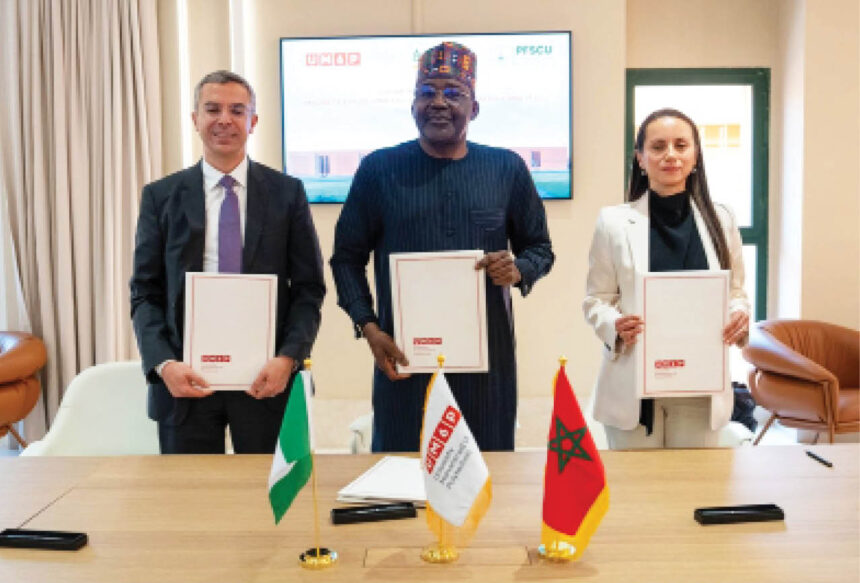
The initiative, unveiled through a Memorandum of Understanding (MoU) signed in Ben Guerir, Morocco, introduces the National Agro-Productivity System (NAPS), a platform designed to provide real-time intelligence on crop production, land use and emerging food security risks across Nigeria.
The agreement was signed by the Presidential Food Systems Coordinating Unit (PFSCU), OCP Africa and geospatial technology company Ground Truth Analytics, with deployment expected to begin across 15 priority states before nationwide expansion.
Signing on behalf of the federal government, Deputy Chief of Staff to the President (Office of the Vice President), Senator Ibrahim Hassan Hadejia, said the initiative represents more than the adoption of advanced technology. It is also about building Nigeria’s capacity to develop and manage its own agricultural intelligence systems.
“The problems we face should not define the limits of our ambition. They should inspire us to develop the technologies, institutions, and capabilities required to overcome them.”
His remarks reflect a broader policy direction under the President Tinubu administration, which has prioritised food security since declaring a national emergency on the sector in 2023.
Nigeria’s food challenges have been compounded by insecurity, flooding, climate change and rising production costs. At the peak of the crisis in early 2025, food inflation exceeded 40 percent, exposing the limitations of planning systems that relied largely on projections rather than verified field data.
The new platform seeks to address that weakness by using satellite imagery and artificial intelligence to monitor crop cultivation throughout the farming season.
According to Sen. Hadejia, the system will strengthen seasonal planning, agricultural investment and policy coordination by providing governments with reliable and timely information.
“Our ambition goes beyond the deployment of technology. We seek to build a Nigerian capability that is adapted to our conditions, understood and managed by our institutions, supported by Nigerian expertise, and sustained through knowledge transfer.”
For policymakers, one of the greatest advantages of the platform is its ability to verify what farmers are actually cultivating instead of relying solely on planting declarations.
Executive Secretary of the PFSCU, Marion Moon, described weak in-season monitoring as one of the biggest gaps in Nigeria’s agricultural planning.
“Monitoring during the season has been our biggest weakness. We reach the end of a season and find we did not hit the targets we saw at the beginning.”
She explained that real-time monitoring could prevent costly policy errors involving food reserves, imports and exports. “If a farmer said they were going to plant maize, did they actually plant maize, or did they switch back to rice? If we believed everyone was leaving rice and opened our reserves accordingly, only to discover they planted rice after all, we end up with a surplus.”
The government says the system has already shown encouraging results during pilot implementation. According to Moon, the programme has covered 13 states, reached about 250,000 farmers, surveyed more than 50,000 producers across over 2,000 communities and generated more than one million agricultural data points covering five major commodities.
Technology partners also highlighted the platform’s practical capabilities.
Chief Executive Officer (CEO) of Ground Truth Analytics, Driss Kitane, said artificial intelligence can automatically identify individual farm plots from satellite images, determine the crops being cultivated and monitor their growth stages without physical field inspections.
“Every parcel you see here has been delineated by artificial intelligence. Nobody manually drew them. We can do this at massive, country and even continental scales.”
He disclosed that similar technology already predicts Morocco’s national wheat harvest up to three months before harvest with between 90 and 95 percent accuracy, while financial institutions and farming cooperatives use it to support agricultural lending and verify farm activities.
Addressing concerns about data sovereignty, Kitane assured that all information generated through the project would remain under Nigeria’s control.
“Everything we develop is sovereign to Nigeria. It will be hosted on Nigerian servers.”
Also speaking, CEO of OCP Africa, Alafifi Laadel, said the partnership is designed to strengthen Nigerian institutions through knowledge transfer and local capacity development rather than simply introducing new technology.
The success of the initiative will ultimately depend on effective implementation, sustained institutional collaboration and the ability of policymakers to translate better agricultural intelligence into faster and more informed decisions. If successfully deployed, the National Agro-Productivity System could reduce uncertainty in food planning, strengthen farmer support programmes and improve Nigeria’s capacity to respond to emerging food security challenges. In a sector where timely information can determine harvest outcomes and market stability, investing in reliable agricultural data may prove as important as investing in seeds, fertiliser and irrigation.