


For decades, Nigeria has relied on foreign manufacturers to produce a document that represents its sovereignty and national identity. Now, the country is seeking to break that dependence with a passport factory designed to produce 6 million booklets annually. But will bringing production home solve the problems Nigerians have endured in obtaining passports, or will it become another ambitious investment whose impact falls short of expectations? Jennete Ugo Anya examines what is at stake.
At the heart of this initiative is a shift from managing passport supply to controlling its production. For years, Nigeria’s ability to issue passports has depended partly on the availability of booklets manufactured abroad. The proposed factory is designed to change that equation by bringing the entire production process closer to home. But while this could address a longstanding supply-chain vulnerability, it also raises questions about investment costs, operational sustainability and whether greater production capacity will resolve the administrative difficulties confronting passport applicants.
The Federal Government (FG) has commenced construction of the facility at the Nigeria Immigration Service (NIS) headquarters in Abuja, with completion scheduled for May 2027. The Minister of Interior, Mr. Olubunmi Tunji-Ojo, disclosed this during the groundbreaking ceremony last Friday, describing the project as a major step towards achieving full localisation of the Nigerian passport value chain.
Occupying 1.1 hectares, the artificial intelligence-driven facility is designed to produce 6 million passport booklets annually, with the capacity to expand to 10 million. According to the minister, Nigeria currently requires approximately 2 million booklets annually. This means the proposed facility could produce three times the country’s estimated domestic requirement, creating opportunities for regional supply.
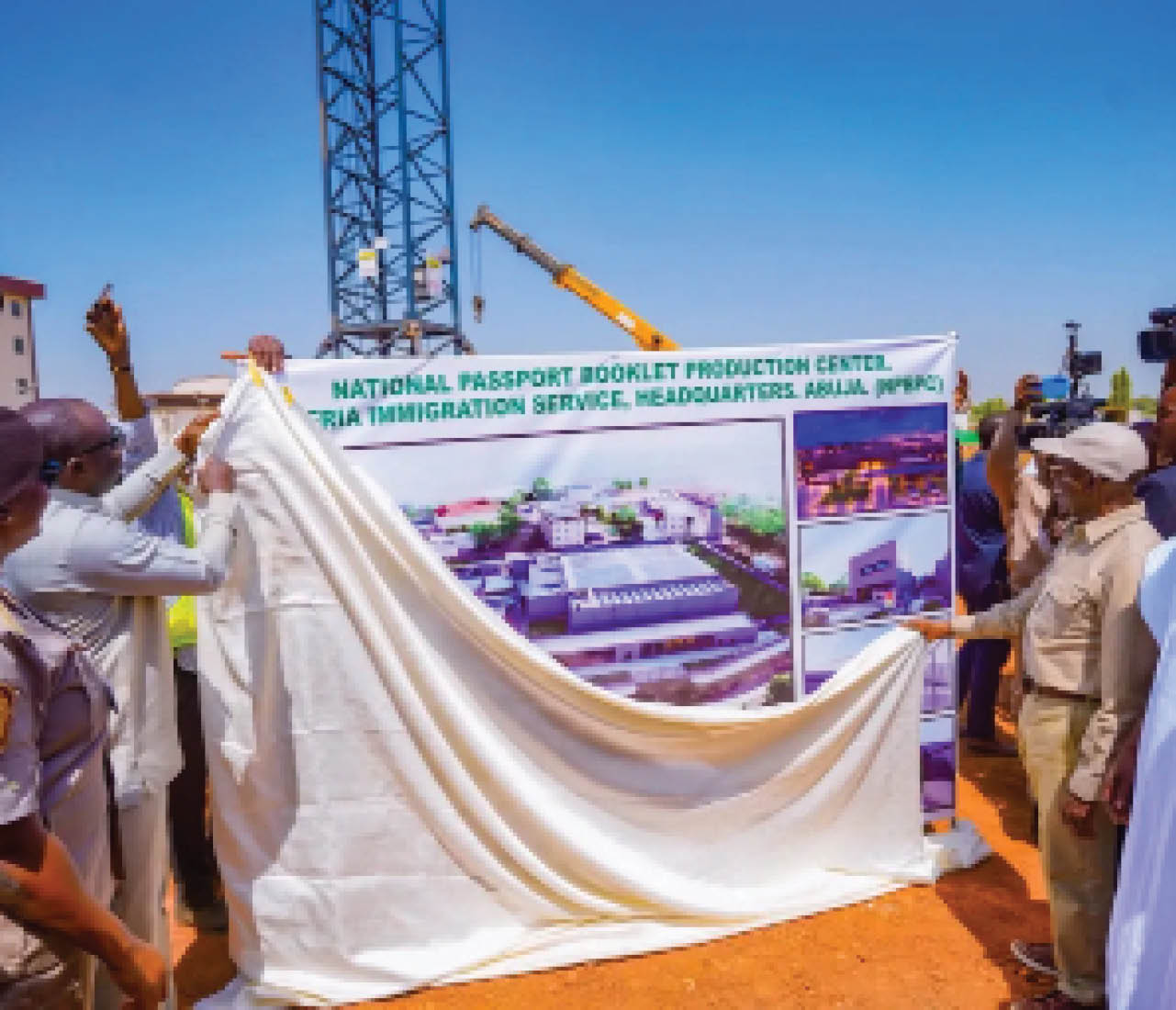
“This facility will complete the full localisation of the Nigerian passport value chain. Under this administration, Nigeria will no longer import the sovereign document that carries our identity.” Mr. Tunji-Ojo said.
The ambition is significant. However, the distinction between producing passport booklets locally and delivering an efficient passport service remains important. Manufacturing capacity alone cannot eliminate delays caused by administrative bottlenecks, verification procedures, poor coordination or inadequate distribution.
From managing shortages to domestic production
Nigeria’s passport administration challenges predate the current administration. In August 2022, under former late President Muhammadu Buhari, the then Minister of Interior, Mr. Rauf Aregbesola, announced that the FG had cleared outstanding passport application backlogs and addressed shortages of booklets across the country.
According to Mr. Aregbesola, Nigeria provided 1.3 million passports in 2021. By the second quarter of 2022, the NIS had issued 645,000 passports from 750,000 applications received.
To improve availability, the government distributed additional booklets to passport offices, including 11,000 each to Ikoyi and Alausa and 8,000 to FESTAC, all in Lagos. Another 10,000 were deployed to the Port Harcourt passport centre.
The intervention focused on improving the distribution of available booklets, expanding access and reducing administrative delays. Mr. Aregbesola also announced processing timelines of six weeks for fresh applications and three weeks for renewals after biometric data capture. Applicants were encouraged to use the NIS online portal rather than rely on intermediaries.
However, the 2022 intervention addressed immediate supply and distribution challenges rather than the structural question of where and how passport booklets were manufactured. Clearing backlogs and distributing available supplies could improve service delivery, but these measures did not eliminate Nigeria’s dependence on foreign manufacturing arrangements.
The current project represents a different policy response. Rather than concentrating primarily on managing available supplies, the President Tinubu administration is seeking to establish domestic production capacity. Its objective is to bring booklet manufacturing into the country, complementing the automation, biometric application and personalisation initiatives introduced since 2023.
Technology, sovereignty and economic implications
The manufacturing centre builds on a series of technological investments introduced under the current administration. Mr. Tunji-Ojo said the Immigration Service began automating passport application and approval processes in 2023. In 2024, it introduced contactless biometric passport applications, followed by the establishment of a passport personalisation centre in 2025.
The proposed factory is intended to complete this transition by bringing booklet production into the domestic system.
The minister also highlighted its off-grid operational design and potential to supply neighbouring countries that currently obtain their passports from Europe and the Americas.
He described Nigeria as set to become the first country in West Africa with an e-passport manufacturing plant and the second on the African continent with full e-passport production capacity.
If successfully implemented, this could position Nigeria as a regional supplier of specialised security documents. Local production could also reduce exposure to foreign exchange fluctuations, shorten supply chains and create opportunities for technical expertise, specialised employment and technology transfer.
Nevertheless, the expected economic benefits require further clarification. The minister did not disclose the project’s total cost, projected operating expenses or the anticipated savings from domestic manufacturing. He also did not explain whether reduced production costs would translate into lower passport fees for applicants.
These questions matter because the economic value of public infrastructure should be assessed not only by its capacity but also by its efficiency, affordability and contribution to citizens’ welfare.
Nigeria’s experience with public infrastructure projects demonstrates that construction announcements must be followed by measurable improvements. The proposed factory must therefore be assessed against clear performance indicators, including completion timelines, production costs, quality standards, equipment reliability and the consistent availability of booklets across passport offices.
Its projected capacity of 6 million annually also raises questions about how the government intends to manage production beyond domestic demand. Regional exports could provide an additional market, but this would require appropriate commercial arrangements, international certification and confidence in the security features of Nigerian travel documents.
Equally important is the relationship between manufacturing capacity and the wider passport application process. Faster production will have limited impact if applicants continue to encounter administrative delays, poor communication, unofficial charges or difficulties accessing services outside major cities.
The government has presented the National Passport Manufacturing Centre as a landmark in Nigeria’s pursuit of technological independence and institutional modernisation. It offers an opportunity to address a longstanding structural dependency while creating a potential new area of regional economic participation.
However, the real measure of success will not simply be how many booklets the factory can manufacture. It will be whether Nigerians can obtain secure passports more quickly, at reasonable costs and without unnecessary administrative difficulties.