
By Enam Obiosio
Over the past two years, the Ministry of Finance Incorporated (MOFI) has undergone a radical transformation—from a passive asset holder to one of the most dynamic institutions in Nigeria’s economic reform agenda. At the heart of this evolution is MOFI’s strategic repositioning as the active manager of the federal government’s investment interests—a shift that has already begun yielding measurable results in fiscal value, sectoral performance, and national economic impact.
The 2023 financial year marked a definitive high point in this journey, but it was far from a one-off performance. Instead, it symbolized the continuation of a growth arc built on rigorous asset identification, professionalized enterprise governance, and targeted capital mobilization. Today, MOFI is not just delivering on its mandate—it is helping to rewrite the narrative of public sector efficiency and state-owned asset profitability in Nigeria.
Unprecedented Growth in Portfolio Valuation and Earnings
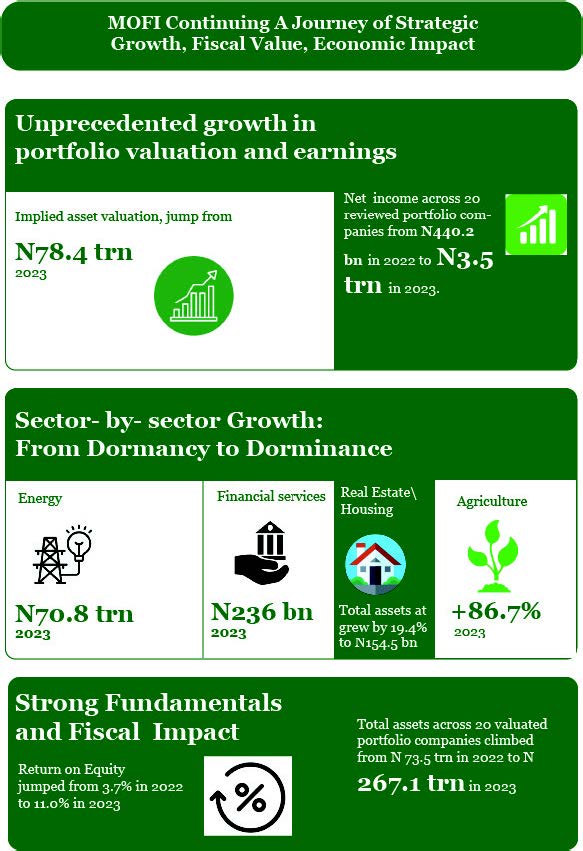
The total implied valuation of MOFI corporate assets (portfolio companies where the FGN, represented by MOFI, has an equity stake) portfolio soared from N27.1 trillion in 2022 to N78.4 trillion in 2023—a 189% year-on-year growth. Correspondingly, the value of MOFI’s equity stake surged from N13.5 trillion to N38.6 trillion, reflecting improved corporate governance, optimized asset performance, and stronger market valuations (For 20 portfolio companies. Source: MOFI Annual Assets report; www.mofi.com.ng).
The performance improvements extended beyond balance sheets. Net income across 20 portfolio companies reviewed increased by over 700%, from N440.2 billion in 2022 to N3.5 trillion in 2023.
More significantly, government revenue benefited directly, total dividends and remittances received by the federal government jumped from N52.1 billion in 2022 to N347.5 billion in 2023—a more than six-fold increase in fiscal inflow from FGN-backed investments.
Sector-by-Sector Contribution
The Energy sector stood as an outperformer. Valued at N70.8 trillion in 2023, the sector saw its implied value triple from the previous year, driven largely by the strengthened performance of the Nigerian National Petroleum Company Limited (NNPCL). MOFI’s equity stake in energy assets grew to N35.4 trillion, with NNPCL alone contributing N3.3 trillion in net income—93.2% of the entire portfolio’s profits.
Financial Services experienced a transformative recovery. From a sector-wide loss of N2.1 trillion in 2022, companies like the Nigeria Sovereign Investment Authority (NSIA), Bank of Industry (BOI), and NDIC drove the sector’s N236 billion in net income in 2023. Total equity rose by 38.9% to N3.3 trillion, and MOFI’s holdings in the sector were valued at N2.1 trillion.
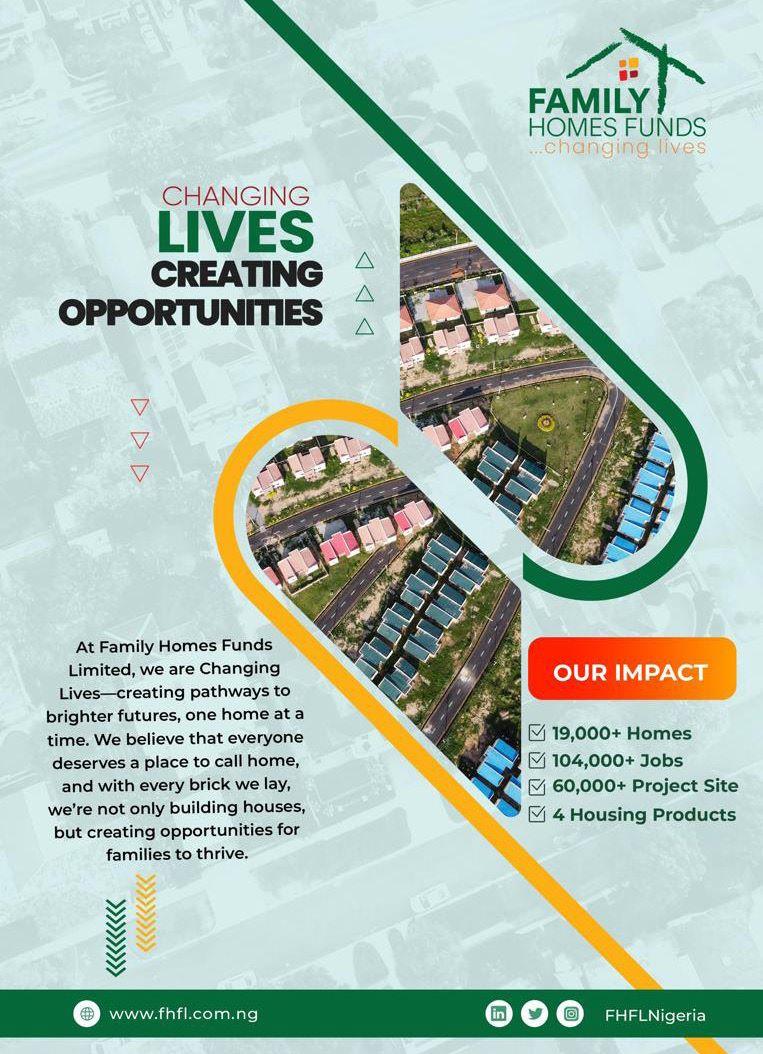
In Real Estate/Housing, represented by Family Homes Funds, sector assets grew by 19.4% to N154.5 billion while equity increased to N96.2 billion. Net income also more than doubled, reflecting steady demand in urban housing and mortgage-backed development.
The agriculture sector, encompassing Royal Eswatini Sugar Corporation and PFI-NPK, recorded a 40.5% rise in total assets and 86.7% growth in equity. Although net income dipped slightly, the fundamentals of asset growth and capital accumulation remained strong.
Hospitality, represented by Transcorp Hotels, recorded an increase in valuation from N80 billion to N414.3 billion, while net income more than doubled, from N2.9 billion to N6.3 billion—riding on increased domestic travel and renewed investor interest.
While ICT and Transportation sectors underperformed—with negative earnings from NigComSat and the Nigerian Railway Corporation—MOFI’s reporting underscores a clear understanding of these challenges and a forward-looking plan for restructuring and turnaround investments.
The health sector, represented by Bio Vaccines Nigeria Limited, showed improvements from a loss of N50 million to a profit of N108 million, and posting a 49% rise in total assets.
Strong Fundamentals and Fiscal Impact
Underpinning the operational performance strength of the portfolio companies is a robust return on equity (RoE), which jumped from 3.7% in 2022 to 11.0% in 2023—a sign of improved profitability and better capital efficiency across the MOFI holdings. The Energy and Financial Services sectors recorded RoEs of 11.5% and 7.1% respectively, while Health and Hospitality posted good positive returns.
Overall, total assets across the 20 evaluated portfolio companies climbed from N73.5 trillion in 2022 to N267.1 trillion in 2023, representing a 264% increase in the national investment base managed by MOFI.
Pillar of National Economic Strategy
MOFI’s consistent rise reflects more than financial metrics—it signals a deep structural shift in how Nigeria’s public wealth is managed and grown. With a firm focus on asset governance, a data-backed valuation system, and a strategic investment agenda, MOFI is proving that state-owned assets can be both profitable and impactful.
From energy to finance, and housing to health, MOFI’s mandate and goals are not only to provide the required support to enable sustained increase in the value of the government’s holdings but also ensuring that these assets contribute meaningfully to job creation, revenue generation, and sustainable development.
MOFI Strengthens Governance, Unlocks Value Across State Enterprises
Nigeria’s quest to unlock the full potential of its public assets took a decisive leap forward with the unveiling of the MOFI Corporate Governance Scorecard—an ambitious reform initiative aimed at transforming state-owned enterprises (SOEs) into high-performing, transparent, and investor-ready institutions.
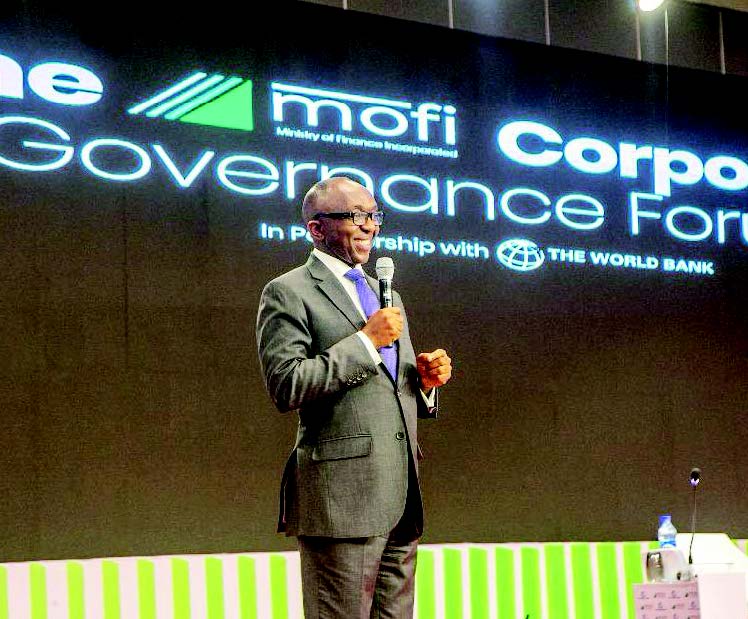
Launched at the 2025 MOFI Corporate Governance Forum in Abuja, the scorecard represents a landmark shift in how the federal government intends to manage, measure, and optimize the performance of its enterprises. The Honourable Minister of Finance and Coordinating Minister of the Economy, Mr. Wale Edun, described the scorecard as more than a policy document—it is, in his words, “a test.” One that will hold SOEs accountable to global standards of transparency, ethics, and commercial discipline.
According to the Honourable Minister, governance is the cornerstone of President Bola Ahmed Tinubu’s $1 trillion economy vision. As the government moves away from debt-driven budgeting towards equity-led development, it has become imperative that state-owned companies earn the trust of both local and international investors through credible governance systems. Mr. Edun noted that strong governance does not merely ensure compliance; it unlocks capital, attracts partnerships, and fuels sustainable economic growth.
Developed by MOFI with backing from the World Bank, the scorecard will assess governance performance in federal enterprises using independent, third-party evaluations. It will be used to identify strengths and gaps in how these institutions are run, and help develop remediation plans to drive improvement. In recognition of progress, top-performing enterprises will be honored through the annual MOFI Excellence Awards.
MOFI’s CEO, Dr. Armstrong Takang, outlined the implementation strategy, which includes public reporting and a focus on transparency, not just within boardrooms but across the entire operating culture of SOEs.
Dr. Shamsudeen Usman, MOFI Chairman, emphasized that the scorecard’s credibility begins with MOFI itself. “We are not asking others to do what we have not already done,” he affirmed, referencing MOFI’s own internal governance reforms.
This latest development reflects MOFI’s ongoing evolution from a passive custodian of federal investments into a dynamic investment manager committed to long-term value creation. Since its restructuring in 2023, MOFI has driven asset visibility, professionalized enterprise management, and mobilized capital into priority sectors of the economy. The introduction of the governance scorecard complements this strategy by embedding a performance-based culture across its portfolio.
The scorecard sets clear governance standards and expectations. It challenges institutions to move beyond bureaucratic norms and adopt systems that encourage innovation, accountability, and profitability. Enterprises such as the Nigerian National Petroleum Company Limited (NNPCL), which already operate under more commercial frameworks, are being held up as models of what is possible when governance reforms are implemented with commitment.
Renewed Hope Megacities Metro Rail Programme
As Lagos accelerates its transformation into a global megacity, one federal institution is quietly but powerfully providing its support, noting the state’s positioning as a leading contributor to national output and productivity: the Ministry of Finance Incorporated (MOFI). With its recent commitment to support the Green Line, under the Renewed Hope Megacities Metro Rail Programme (which extends into other states across the country including Ogun, Kaduna and Kano), —one of the most ambitious segments of the Lagos Rail Mass Transit (LRMT) network—MOFI is reinforcing its role not just as the custodian of public assets, but as a strategic partner in Nigeria’s infrastructure-led development model.
The Green Line, a 70-kilometre railway corridor designed to run from Marina to the Lekki Free Trade Zone, will connect some of the most economically significant areas of Lagos, including Victoria Island, Lekki, and Ajah.
At the heart of this massive undertaking is a signed Memorandum of Understanding (MoU) between the Lagos State Government and MOFI, signaling the start of exploratory work and federal-level investment collaboration on this game-changing project.
This partnership underscores a new era of coordination between the federal and state governments—one that places shared growth, investment readiness, and economic transformation above partisan divides. MOFI’s involvement reflects its broader mandate of unlocking value in public investments and ensuring that federal institutions play a catalytic role in infrastructure expansion and regional development.
The Lagos Rail Mass Transit system, managed by the Lagos Metropolitan Area Transport Authority (LAMATA), has been decades in the making. From the original Metroline vision conceived in the 1980s to today’s multi-line, multi-state expansion strategy, the vision has always hinged on forward-looking investment and consistent political will. Now, with MOFI in the picture, that vision has gained a new layer of credibility, finance structuring, and long-term sustainability.
Lagos Governor Babajide Sanwo-Olu, in his presentations to global investors at the Africa Investment Forum, repeatedly emphasized the Purple and Green Lines as priority investment corridors. These routes not only offer high commuter and cargo volumes but also reflect the strategic intent to reduce road congestion, cut greenhouse gas emissions, and strengthen regional economic ties between Lagos and Ogun States.
The Green Line project, supported by MOFI, aligns with President Bola Ahmed Tinubu’s broader economic vision for Nigeria—one that encourages public-private partnerships, long-term infrastructure financing, and coordinated action across all tiers of government.
Unlocks Africa’s Largest Housing Finance Fund to Power Affordable Homeownership in Nigeria
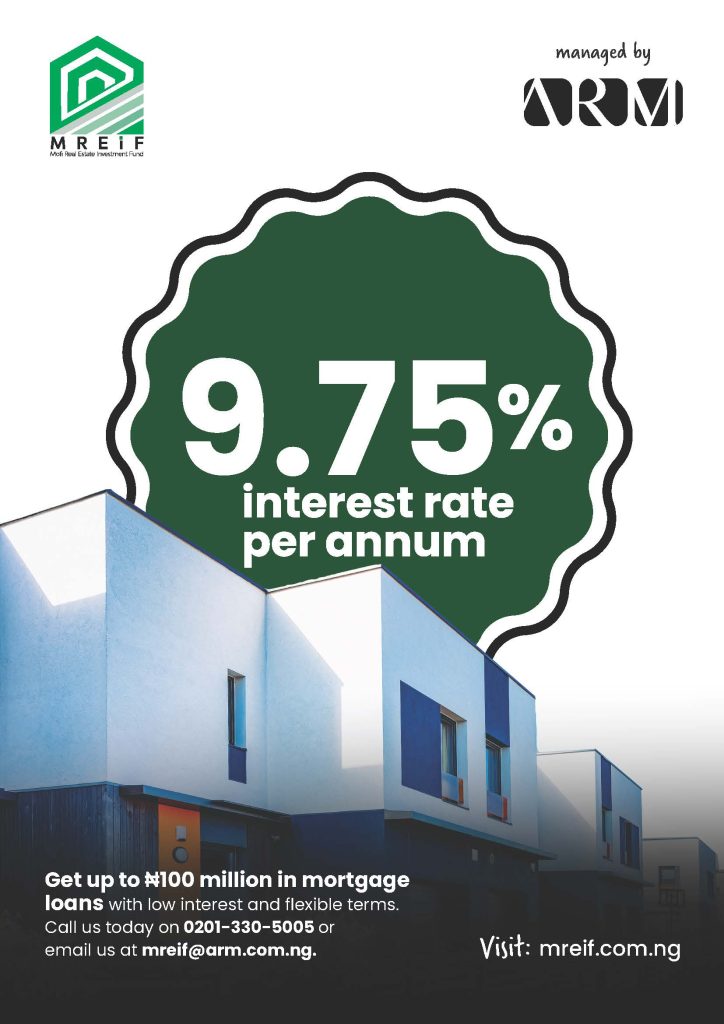
In a move that underscores its transformation into Nigeria’s most dynamic public investment manager, the Ministry of Finance Incorporated (MOFI) has launched the N1 trillion MOFI Real Estate Investment Fund (MREIF)—Africa’s largest housing finance initiative aimed at delivering accessible, affordable homeownership to millions of Nigerians.
Unveiled under the leadership of the Federal Ministry of Finance, the MREIF represents a bold step in President Bola Ahmed Tinubu’s Renewed Hope Agenda. Designed as a Public-Private Partnership (PPP), the fund is structured to provide long-term mortgages at interest rates not exceeding 12%, significantly lowering the barrier to entry for homeownership in Nigeria.
For decades, Nigeria’s housing deficit—now estimated at over 28 million units—has remained a persistent drag on inclusive economic growth. With the launch of MREIF, MOFI is deploying a transformative model that not only brings scale to housing finance but also introduces sustainability and accountability into a sector long characterized by underinvestment and fragmented delivery.
Already, N250 billion has been raised from a diverse pool of public and private sector investors. Contributors include the federal government, insurance firms, pension funds, commercial banks, asset managers, and institutional financiers. This broad investor participation reflects growing market confidence in MOFI’s governance framework and strategic approach to national asset mobilization.
The first two issuances—Series 1 (N150 billion) and Series 2 (N100 billion)—were fully subscribed, a powerful signal of investor appetite for impact-driven infrastructure and real estate investments. Disbursement of the funds has already begun, with more than 20,000 mortgage requests already received. For many working-class Nigerians, this marks the first real opportunity to access home financing with terms that are both affordable and sustainable.
This fund is more than just a financial mechanism—it is an instrument of national renewal. By reducing housing costs, stimulating construction, and creating jobs, the MREIF is expected to deliver ripple effects across the economy.