By Ahmed Ahmed
Nigeria’s economy received a rare piece of good news this week as new data showed inflation moderating for the second consecutive month, offering relief to households and businesses grappling with high costs.
Recent figures released by the National Bureau of Statistics (NBS) revealed that the country’s annual inflation rate slowed to 20.12 percent in August 2025, down from 21.88 percent in July. The latest figure represents a 1.76 percentage point drop month-on-month and a striking 12.03 percentage point decline year-on-year, compared to 32.15 percent in August 2024.
While inflationary pressures remain, the trend points to cooling consumer prices after years of relentless increases. The NBS clarified that the data does not suggest prices are falling outright, but rather that they are rising at a slower pace than before. On a monthly basis, inflation eased sharply to 0.74 percent in August, from 1.99 percent in July, underscoring what analysts see as a “turning point” in price stability.
Presidency Eyes Single-Digit Inflation
Reacting to the figures, the Special Adviser to the President on Economic Matters, Dr. Tope Fasua, expressed optimism that inflation is on course to return to single-digit levels-a development he said would translate into better living conditions for Nigerians.
“Inflation does not increase forever, not in any country. Ghana, our neighbour, once had inflation above 40 percent, but today theirs is trending toward single digits. Nigeria’s inflation will get there as well; it’s only a matter of time,” Dr. Fasua said during an appearance on Channels Television’s The Morning Brief.
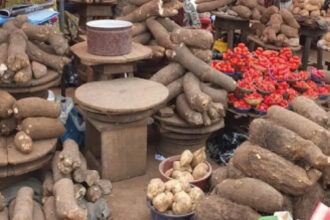
According to him, the slowdown is already being felt in the food market, where staple prices are beginning to stabilise. “For the first time in 26 years, we did not experience the usual tomato shortages and soaring prices. Some farmers even say the government’s push to stabilise prices is affecting their profit margins—but for consumers, it’s welcome relief,” he added.
Dr. Fasua attributed the cooling inflation partly to the recent stability of the naira, which has firmed to the N1,400/$1 range for the first time in eight months, as well as stronger crude oil prices on the international market. Both factors, he said, are easing cost pressures in import-heavy sectors of the economy.
The Bigger Picture
Beyond the politics, the NBS figures suggest that government reforms-such as exchange rate unification, tighter monetary controls, and targeted support for agriculture-are beginning to show results. The bureau uses a 2009 base year (November = 100) to track price changes, and August’s outcome indicates that inflationary momentum is slowing in both food and core segments of the economy.
Still, experts warn that sustained progress will depend on structural reforms. “The fact that inflation is easing is welcome,” one Lagos-based analyst told this paper, “but the real test is whether Nigeria can maintain this trajectory through the end of 2025, especially given global uncertainties in energy and food markets.”
For now, Nigerians can take some comfort in the trend line: prices are rising more slowly, the naira is stabilising, and food supplies are holding firm. Whether these improvements can be sustained-and translate into a lasting return to single-digit inflation-will depend on how consistently reforms are implemented and how well global shocks are managed.
As Dr. Fasua summed it up: “Nigeria’s inflation will certainly go to single digits. It is not a question of if, but when.”