
By Anita Dennis
The Securities and Exchange Commission (SEC) has inaugurated a Capital Market Working Group on Market Liquidity with a clear mandate: to use technology-driven solutions to bring 20 million new investors into Nigeria’s capital market. The move is aimed at improving market depth, participation, and overall resilience.
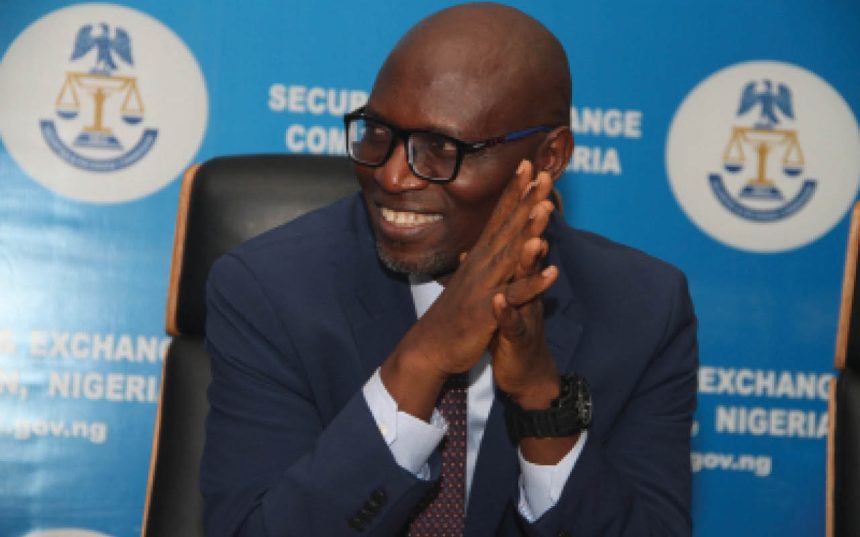
SEC Director-General, Dr. Emomotimi Agama, officially launched the working group last Friday, highlighting that despite strong growth in market capitalization, active participation is concentrated among a small segment of investors. He noted that a shallow investor base limits the market’s efficiency in allocating capital, with trading activity focused on a few institutional players and a narrow set of retail investors.
Dr. Agama said the commission plans to leverage digital platforms and fintech partnerships to convert passive savers into active investors. “I want you to explore how technology can onboard the next 20 million investors, turning passive savers into active market participants,” he said. The initiatives include the dematerialisation of share certificates and collaborations with financial technology firms to simplify access to capital market products.
The SEC chief also pointed to the newly enacted Investments and Securities Act 2025, which brings digital assets under regulatory oversight, as an opportunity to channel speculative capital into regulated investment instruments. “We must determine how to channel the speculative energy currently going into unproductive gambling into liquid, productive investments within regulated exchanges,” Dr. Agama said, emphasizing the blurring lines between traditional and digital finance.
While Nigeria’s market capitalization has grown from about N55 trillion in April 2024 to over N123.93 trillion, he warned that headline figures mask structural weaknesses. Trading remains concentrated in a few high-demand stocks, leaving much of the market thinly traded. Expanding participation, he said, will enhance price discovery, reduce volatility, and strengthen investor confidence.
Dr. Agama described the capital market as a critical engine for national development, capable of financing infrastructure, industry, and job creation when functioning efficiently. He urged members of the liquidity task force, drawn from exchanges, custodians, fund managers, and other market operators, to develop practical recommendations that will deepen the market and make investment opportunities accessible to ordinary Nigerians.
Building a broad and inclusive investor base, Dr. Agama said, is essential for transforming the capital market into a robust platform for mobilizing long-term capital for economic growth.
Recent market activity suggests momentum for these efforts. The Nigerian equities market closed January 2026 on a strong note, rising 6.27 percent with over 15 billion shares traded. The All-Share Index increased from 155,612.9 points to 165,370.4 points, breaking above the 160,000 mark for the first time. By February 17, 2026, the index had crossed 190,000 points, demonstrating sustained growth and investor interest.
The establishment of the liquidity working group represents a strategic push to address structural market challenges and expand participation. By combining technology, regulatory oversight, and targeted investor engagement, the SEC aims to make Nigeria’s capital market more inclusive, dynamic, and capable of supporting long-term economic development.