
By Ahmed Ahmed
Africa’s abundant natural resources have long sustained global industries, yet the continent continues to earn only a fraction of the value created from them. From cotton and cashew to cocoa and minerals, much of Africa’s wealth still leaves its shores in raw form, only to return as expensive finished products. This long-standing economic model has limited industrial growth, constrained job creation and weakened export earnings. Nigeria’s latest engagement with the Republic of Benin signals a renewed determination to change that narrative by placing value addition at the centre of Africa’s development strategy.
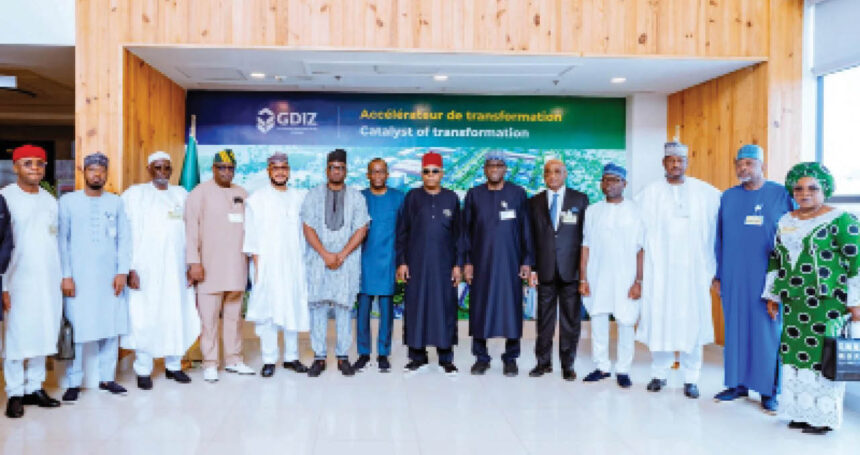
Speaking during a tour of the Glo-Djigbé Industrial Zone (GDIZ) in Cotonou, Vice President Kashim Shettima said the time had come for African countries to take greater control of their resources by building industries that process raw materials into finished products.
His message reflects a growing consensus across the continent that sustainable economic growth cannot be achieved through the continued export of unprocessed commodities.
“We are here essentially at the behest of President Tinubu, in the spirit of his Renewed Hope Agenda, to see and peer-review global best practices,” Vice President Shettima said.
The industrial zone offered more than a showcase of modern manufacturing. It demonstrated how agriculture can be integrated with industry to create complete value chains that generate employment, increase exports and attract investment.
During the visit, the Nigerian delegation inspected facilities where locally grown cotton is transformed into yarn, fabric and finished garments. It also toured factories processing cashew, soya bean and other agricultural commodities for domestic and international markets.
For Nigeria, the visit represents an opportunity to learn from a neighbouring country that has successfully linked agricultural production with industrial processing.
The Vice President described the GDIZ as an African model worthy of replication.
“It is an African success story where there is a whole chain of value addition in cotton, cashew and soya bean value chains. Be rest assured that we have learnt a lot of lessons through this visit, and we are going to replicate a lot of that in Nigeria.”
Vice President Shettima drew attention to one of Africa’s biggest economic paradoxes.
Despite producing significant volumes of cotton, the continent accounts for only about one percent of the global cotton industry, which is valued at $370 billion.
That imbalance illustrates the cost of exporting raw materials while other economies undertake processing, manufacturing and branding.
According to him, rebuilding Nigeria’s textile value chain could generate millions of jobs, expand non-oil exports and stimulate economic activity across the country.
The federal government’s response is beginning to take shape.
He disclosed that Nigeria is establishing eight agro-industrial zones across eight states, a move designed to encourage local processing, strengthen value chains and attract private sector investment.
The initiative aligns with the broader objectives of President Bola Tinubu’s Renewed Hope Agenda, which places industrialisation and economic diversification at the heart of Nigeria’s long-term growth strategy.
“We are setting up eight agro-industrial zones in eight states in our country,” the Vice President stated.
The significance of this approach extends beyond manufacturing.
Processing agricultural commodities locally allows countries to capture more value from their natural resources, create skilled jobs, increase foreign exchange earnings and reduce dependence on imports.
It also strengthens rural economies by creating stable markets for farmers and encouraging investment across the agricultural value chain.
Nigeria’s delegation, which included the governors of Kwara, Imo, Katsina, Plateau, Zamfara and Jigawa States, underscored the importance of collaboration between the federal government and subnational governments in driving industrial development.
That partnership will be essential if agro-industrial zones are to deliver their intended impact across different regions of the country.
Africa’s industrial transformation will not happen through policy declarations alone. It will depend on sustained investment, supportive infrastructure, efficient logistics and a business environment that encourages manufacturers to process locally rather than export raw commodities.
Benin’s experience offers practical lessons, but Nigeria’s success will ultimately be measured by how effectively those lessons are adapted to its larger economy.