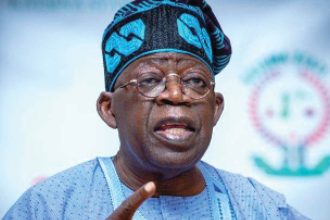
Nigeria’s economic reforms, under President Bola Ahmed Tinubu, are increasingly being measured not only by macroeconomic indicators, but by the changing depth, value and confidence of its capital market. According to Enam Obiosio, the President’s assessment of Nigeria’s economic trajectory is increasingly anchored in a development that is visible beyond government policy documents and official economic statistics: the dramatic recovery of the Nigerian capital market.
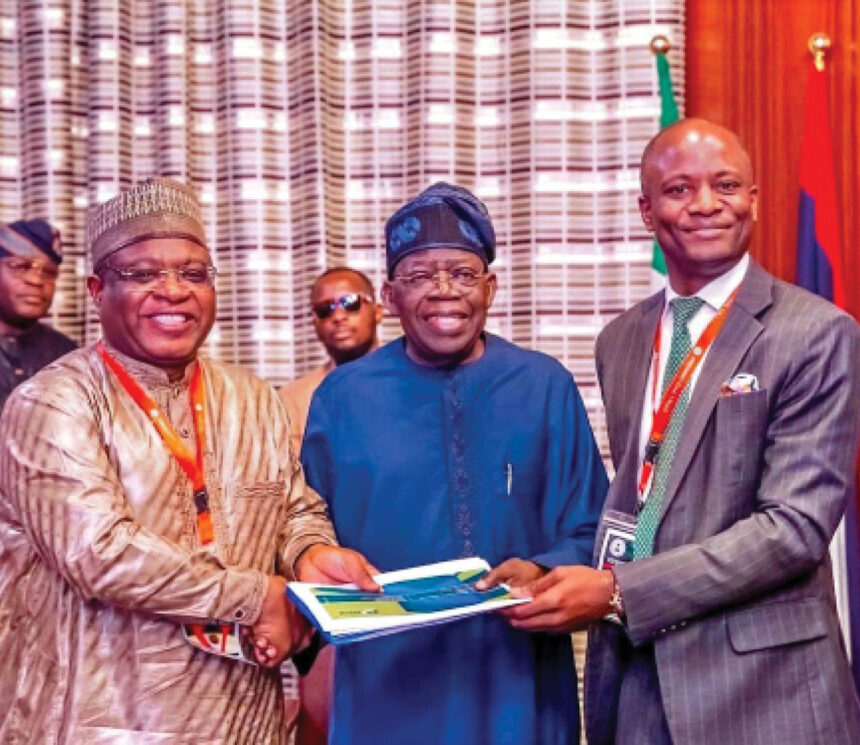
At the State House in Abuja, where President Tinubu recently received the Board and Management of the Nigerian Exchange Group (NGX), led by Chairman Dr Umaru Kwairanga and Group Managing Director/Chief Executive Officer of NGX, Mr.Temi Popoola, the President presented the market’s performance as evidence that the difficult reforms undertaken by his administration are beginning to reshape the economy.
The figures presented to him were striking. The total value of stocks listed in Nigeria, which stood at just under N30 trillion when he assumed office in 2023, has risen to N160 trillion. NGX expects the figure to reach N230 trillion by the end of 2026, based on listings already coming into the market.
The All-Share Index (ASI) has similarly moved from about 52,000 in 2023 to 244,000. The scale of the movement has been sufficiently unusual for market participants to describe reaching the 100,000 level as unfamiliar territory.
For Tinubu, however, the significance of the market recovery extends beyond asset prices. It represents a test of whether economic reforms can ultimately translate into broader confidence, investment and prosperity.
“I can see the excitement in the room. All I can do is to celebrate you all today. It is a thing of joy to have this feedback. When we took over, it was very challenging. I had to talk to myself and define my background to accept the assets and liabilities of my predecessor,” the President said.
His recollection of the starting point was deliberately stark. President Tinubu, in a release by Mr. Bayo Onanuga, Special Adviser to the President (Information & Strategy), acknowledged the difficult fiscal and monetary conditions inherited by the administration and singled out the Governor of Central Bank of Nigeria (CBN), Mr. Yemi Cardoso, as a key partner in confronting them.
“I asked for the job, and I have to do it. And my capable partner in one of the thinking and reasoning days was Yemi Cardoso, whom I put at CBN.
“I found a partner in the CBN Governor, Yemi Cardoso. We were in the negative with monetary policy and the reserve. We had N30 trillion printed, and there were liabilities. I thank you very much, Yemi Cardoso,” he said.
The President’s argument is that the reforms should be judged as an interconnected programme rather than as isolated policy decisions. Fiscal changes, monetary reforms, revenue reforms, banking-sector recapitalisation and capital-market development are presented as components of a broader effort to rebuild economic confidence.
“The rest of the team, we owe a duty to the country and our self-belief that this is doable. Nigeria can build a nation of prosperity by itself. If the stock market is doing well, then we are doing well,” Tinubu said.
He linked economic performance to the everyday circumstances of younger Nigerians, arguing that a functioning economy must ultimately create an environment in which education, employment and household aspirations are not overwhelmed by financial insecurity.
“We can teach this in classrooms to our undergraduates. If they can be in the classroom without the harrowing feeling of how to pay and what to pay, then we can build a nation of success and prosperity,” he said.
The Minister of Finance and Coordinating Minister of the Economy, Mr. Taiwo Oyedele, therefore, characterised the market’s performance as part of the broader reform outcome.
“The stock market has experienced significant growth over the past few years, especially in the last three years as a result of the reforms in the economy. So much so that the capital market in Nigeria is the best performing in the world. The capital market is one of the fastest ways to create wealth for millions of Nigerians,” Oyedele said.
Yet the minister also identified a structural challenge. Nigeria’s younger population is participating in financial activities, but much of that participation is occurring outside the formal capital market.
“Along with the Securities and Exchange Commission (SEC) and the regulator, we have seen these improvements, and we know that they are working on different innovations, particularly how to attract young people into the market.
“For example, many of our young people invest their money in virtual assets and gambling, whereas you can make more money from the capital market,” he added.
Oyedele said that the listing process could be simplified to make participation easier for more Nigerians, while challenging NGX and the Securities and Exchange Commission to pursue a one-trillion-dollar market.
That ambition corresponds with the administration’s broader target of building a one-trillion-dollar Nigerian economy. President Tinubu argued that the target is achievable because of the country’s population, human capacity and entrepreneurial energy. He also said that the Nigerian National Petroleum Company Limited (NNPC) would be reformed and listed on the capital market.
Kwairanga was equally emphatic about the possibility of reaching the target. “We believe the US$1trillion economy is achievable. We have the capacity. We have the resources. We have the material and human resources to reach the one trillion dollar even before 2030 with your support,” he said.
His explanation of the market’s transformation placed considerable weight on policy leadership.
“Your Excellency, we were at the London Stock Exchange last week, and I was part of a panel. The facilitator asked me what Nigeria is doing that you have turned the NGX around within the shortest possible time. I told them it is because of the leadership of President Bola Ahmed Tinubu. I told them that we have a President that is not only a politician but a businessman,” he stated.
The NGX presentation nevertheless pointed to significant wealth creation. Popoola said the market’s growth was associated with an estimated 500,000 to 900,000 new millionaires, although he stressed that the exchange did not have exact figures.
For the revenue authorities, the reforms are also inseparable from the restructuring of Nigeria’s fiscal architecture.
Chairman and Chief Executive Officer of the Nigeria Revenue Service (NRS), Dr Zacch Adedeji, described the administration’s reform programme as a break with decades of limited change.
“What we know privately is now globally known: the greatest gift to this republic is Mr. President. Every good thing starts and ends with good leadership. Now we’ve seen figures and the facts,” Adedeji said.
Adedeji also identified subsidy removal as a foundational element of the reform programme.
“The removal of subsidy is the foundation that corrected the distortion that affected the country in the last forty years. The courage to remove it in less than one hour after taking the oath of office is the bedrock, background and fundamental of the changes we are seeing,” the NRS Chairman noted.
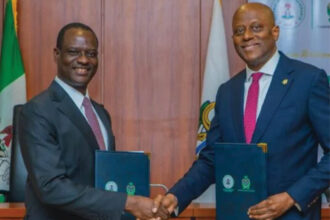
The banking sector provides another measure of the administration’s effort to deepen financial capacity. Mr. Cardoso said that the recapitalisation programme initially faced scepticism but was successfully implemented, with close to 75 percent of the capital coming from domestic resources.
“A lot of people didn’t think it was possible, and now it was done very successfully and, like we found out, close to 75 per cent was domestic resources. In the past it was the other way round,” he said.
Tinubu’s own formulation captures the political and economic stakes: “If we can push the private sector to invest in the economy wisely, then we will grow.” He cited his support for Aliko Dangote’s refinery investment as an example of the private sector’s role in building productive capacity.